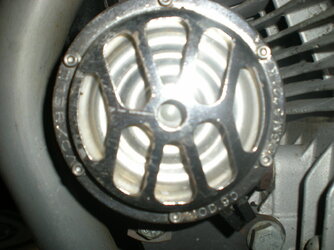
Voxbell Horns

Tapnell

New member
Location
Isle of Wight UK
Ok, trying without success to get both horns to work…they do individually! The low tone has double terminals ….any idea why that is? Going to try wiring them in series rather than parallel. But was interested to know why one has four terminals and one just the two.🤷🏼‍♂️
 
Connections should look like this:

IMG_6053.JPG
Wiring Diagram for CDI equipped Triple. I imagine the horn wiring would not be significantly change on subsequent models.

Horn Wiring.jpg
 
Ok, trying without success to get both horns to work…they do individually! The low tone has double terminals ….any idea why that is? Going to try wiring them in series rather than parallel. But was interested to know why one has four terminals and one just the two.🤷🏼‍♂️
Yes, I had that problem with my G***i T3. In the end I fitted a car horn off a VW Golf.. If no one else has come up with a solution by tomorrow, I'll go and have a look at my RGA Sprint and see how the horns are wired.
 
Ok, trying without success to get both horns to work…they do individually! The low tone has double terminals ….any idea why that is? Going to try wiring them in series rather than parallel. But was interested to know why one has four terminals and one just the two.🤷🏼‍♂️
Because the 2nd horn can be supplied with voltage from the 1st, simply by continuing the wiring.

You are not getting enough current to both horns, mainly due to the puny contacts within the switch block, but also due to aged and deteriorated wiring and plug connectors. Power them through a relay and both horns should work as they are meant to.

piet
 
Because the 2nd horn can be supplied with voltage from the 1st, simply by continuing the wiring.

You are not getting enough current to both horns, mainly due to the puny contacts within the switch block, but also due to aged and deteriorated wiring and plug connectors. Power them through a relay and both horns should work as they are meant to.

piet
Yeh was thinking about a relay….I presume it is switched ground/earth at the bar?
 
Yes, the horns are live and their current is simply switched to ground. There is also a ground wire to the LH switch block that is often not connected, black/white that usually ends in the connector block under the tank/inside the headlight bowl. Doesn't help much to continue this to ground, wire is of too thin gauge and is just as deteriorated as the rest.

Ground connection to the handlebars is often compromised, with only an inadequate connection through the steering bearings. Best is a nice, fat ground cable from the frame to a fork yoke/handlebar clamp.

If horn wiring has issues, the headlight will most definitely benefit from fitting a relay as well.

Relays not only provide more current for better lighting and horns that actually beep, but also reduce loads on the aging wiring, reducing risks of overheating and a possible loom fire.

piet
 
I nominate Piet for the Happy Honker award for his responded on the Voxbells.

The Happy Honker Award was something a sports radio commentator had fans do...honk their car horns after leaving a football game ...in appreciation of player who who made a difference in the game but didnt get media recognition.
 
Don't connect horns in series. They'll only get half the voltage that they get when connected in parallel, and neither will draw enough current to make any kind of squeak at all.

The reason one horn has 4 spade terminals and the other has 2 is simple. Have a closer look at the 4-terminal horn and you'll see that the 4 terminals are actually two pairs that are bridged together for use as a jumper terminal. You can see which ones are joined. You plug the +12V power feed to one of the bridged pairs, and the earth connection (via a switch or relay) to earth connects to the other bridged pair. That horn is now wired up to work. The two left-over terminals are simply there to run a pair of wires across to the two spade terminals on the other horn to connect that one as well. Note that it's a parallel connection.

1690600597470.png

Sometimes old horns will need to re-tuned. You do that by turning the tuning screw on the back in or out. Do one at a time so as not to piss the neighbours off too much. Put some ear plugs in. Hook a horn up to a healthy 12V battery, then turn the screw in or out as required to achieve maximum noise. There may be a lock-nut on the tuning screw. I can't remember. If you can't get one or both of them to emit anything more than a pathetic bleat, then it's time to take them apart and clean all the rust and dirt out of them.

If your horns have been apart before, there will be 6 x M5 bolts holding the front and back cases together. If they've never been apart since they left the factory, they'll be held together with rivets that you'll need to drill out and replace with bolts when you reassemble them. I can't tell from your photo whether those fixings are rivet heads or socket (Allen) head bolts with button heads. They look a bit like the latter, so your horns may have been apart before.

They're dead simple inside. You can't really fuck it up. Basically it's just a solenoid connected to the diaphragm and a set of contact points. Just clean everything you can find. De-rust anything that looks rusty and give it a coat of paint. (clean the contact points but don't paint them).
Stick it all back together with a smear of silicone around the edge to seal the space between the diaphragm and rear case. Don't bother trying to seal the front of the case. It's got bloody great holes in it for the noise to get out. Hook each horn up to a power supply and twiddle the adjusting screw. You should get a good lout honk from them. One horn should be a high pitch and the other low pitch.
 
It's been a good while since I followed Cam's horn rebuild info CAUSE I got the best info ever from some Blacktown Tragic. Have a look at the front grill of the horn and you will see 2 holes there to drain rainwater out of the horn. Rotate one of these holes down so water escapes. I also stopped excessive bike-washing and haven't needed to strip a horn for ages. The only actual pic of horns in this thread is cropped so the holes as just not seen.
 
Here is a pic of my horn with the tiny hard-to-see drain holes. You can just see the upper hole just to the right of the Alan Head bolt holding the upper part of the horn together. There is another drain hole directly below this one at the bottom of the horn. Never noticed them for the first 30 years of owning the bike. DSCN0525.JPG
 
Back
Top