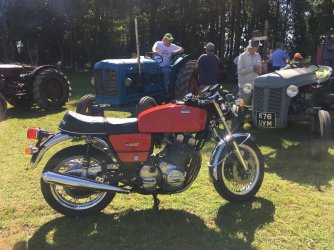
Was Laverda’s triple design ahead of its time?

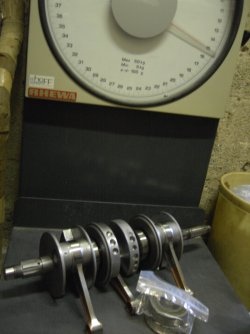
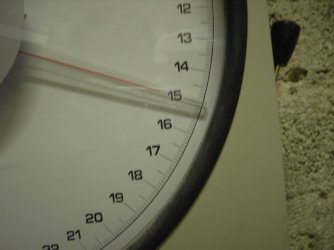
I've just weighed the crank assembly from the 'Eades' TTF1, which I recently recovered, and it weighs 16kg +/_ a few grams so I think that's only around 2kg saving on standard. However, it's still enough to get the engine to spin up noticeably quicker then a standard CORSA/SFC1000 lump.
 
I did cover my arse and say it was a 'guess' :cool:

Totally agree about lighter cranks - the factory should have sold SFs with SFC cranks - they could have easily started with triple webs 3 and 5.

130 in 1st Piet!! You're basically running the eq of my 2nd and I'm running very tall gearing (19-36)! Definitely not road bike stuff those racetrack 1st gears - noticed on the vid of IoM someone posted (Hailwood et al) the two stroke guys were slipping the clutches like crazy out of tight hairpins.
Works beautifully in Spa out of what used to be the Bus Stop chicane. While all others with heavy cranks and road 'boxes need at least 2 gear changes heading to la Source, I just keep it nailed and fly past when they attempt to jerk into the next gear. I think it tops out at 135 if I'm really determined, with a short burst in 2nd before heavy braking into la Source. Most of the rest of the track is about raw power... and big balls. ;)

That long first is actually the only downside to what is otherwise a fantastic set of gears, each change brings about only a minimal drop in revs and allows totally smooth riding. For road work, I guess a drastic reduction in final ratio would be ideal, if I'd be willing to sacrifice a load of top-end.

Stock triple crank comes in at a bit under 18kg, including outer bearings and slingers full of sludge.

PICT1377.JPGPICT1378.JPG

piet
 
Every bit of weight reduction is very noticeable. The triples with more webs have more to work with but even with a standard SFC crank in an SF the motor is very tractable. Many tuners found out that they had too light cranks, it has even been suggested that the oval piston Honda was way too light, apparently it sounded like a barking dog when blipping the throttle. The standard first gear is fine for road use, the only pain being the bigger step second to third. No way I would want the SFC first gear on the road, or even racing, I got really good starts with the standard box, and only needed second for a couple of corners among all the tracks I raced on.
 
We often talk about the various ways in which mechanical components could be made lighter. Often, a few kilos can also be shaved off the rider’s weight🫣… it’s simpler and cheaper😇
But sometimes you can shed too much weight, which makes man handling a Laverda triple around the workshop etc a hazardous occupation. I'm hoping to put on some weight over Christmas! ;)
 
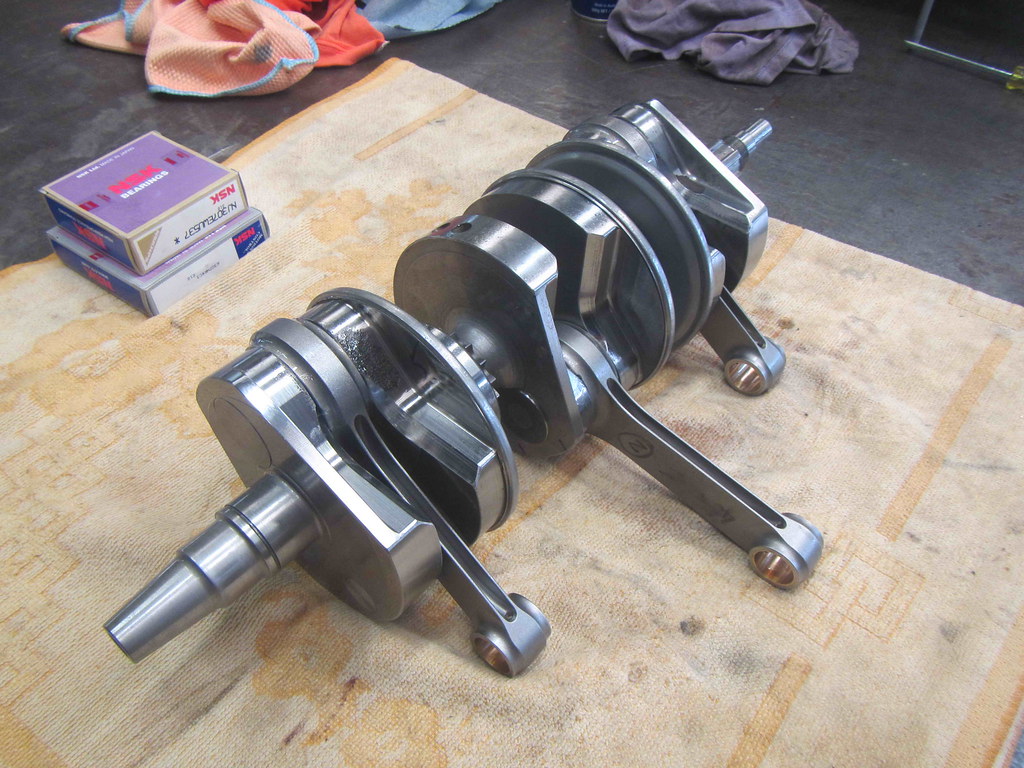
I think Red's crank work tosses about 6kg into the swarf bin - that's a guess, not sure of the actual figure.
depends on which crank version we start with it generally works out between 4.2 - 4.8kg


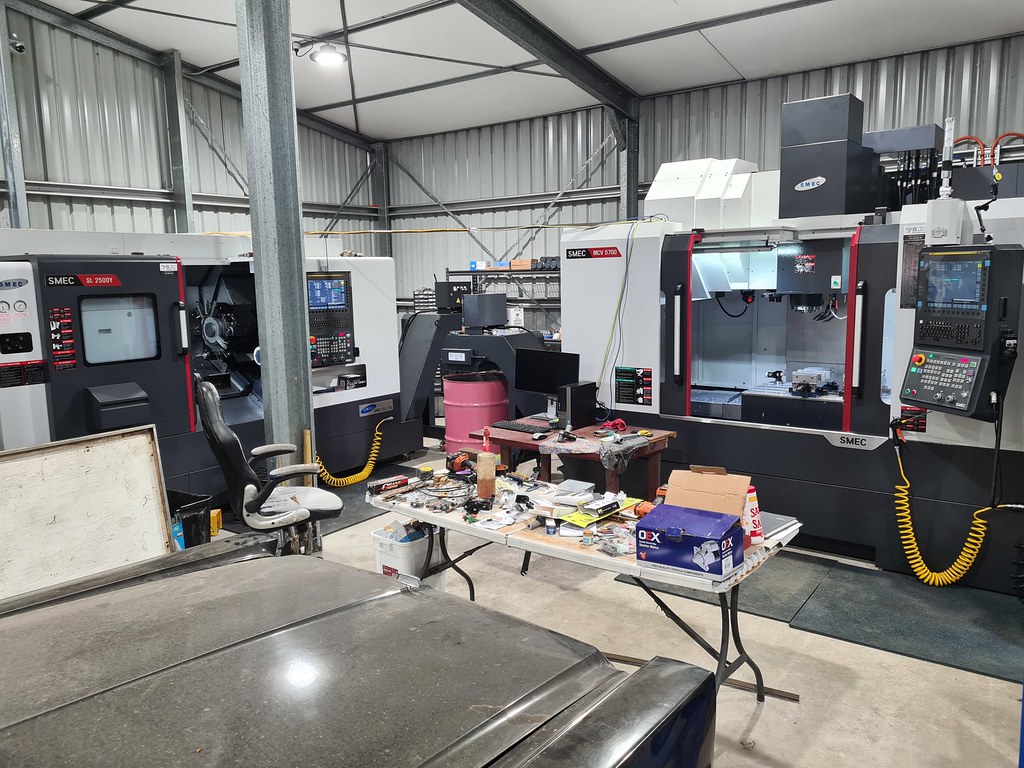
we slap the machined webs out on my mates SMEC VMC
I used to machine them myself on my Milling Machine where it would take me nearly all day for one web, Waz can do two full cranks in one day, being 12 webs

20240802_161911


Untitled
 
Last edited:
So was the Laverda twin design ahead of it`s time ?

Seeing it drew it`s inspiration ( through necessity ) from the Honda C70 Dream of 1956 , which became the sporty CB72 of 1961 ...... which were definitely ahead of their time compared to the opposition back then with their 9000 rpm overhead cam motors , electric start and indicators .......

The Laverda twin arrived just five years after the Honda CB72 , and most importantly brought virtually all those features to a large capacity twin for the first time ..........

How many 650 /750 `s in 1966 /7 had overhead cams , electric start etc ? ........ None that I can think of offhand , but the Laverda did ......

The Laverda was three years ahead of tne CB750 in that respect ......... So lets hear it for the old-fashioned ground breaking Breganze twin ..........
 
Last edited:
......... So lets hear it for the old-fashioned ground breaking Breganze twin ..........
Hear hear!! From my personal experience I think one of the most impressive things about a Breganze twin is that being basically a mid-60s design and manufacture, you can take the whole package and turn it into something with genuine performance even by today's standards (ie like-for-like capacity wise and number of cylinders)), retain the reliability, and upgrade the rolling chassis without overstressing anything. Red's done something similar with triples, albeit the Scorches having completely redesigned frames. The one downside i haven't been able to 'modify' out of a hotted up twin is vibes. Without a counterbalancer I'm stuck with what I've got. Fortunately it's more than acceptable at anything under 5k, which is 145kph.
 
I was surprised at how vibration free my counterbalanced Atlas is and how freely it revs for an upgraded parallel twin. And then they went a pitch to far with the Zanes.So to me it wasn't design other that water cooling, it's probably down to wear and tear in the machineing process and quality control. Plus cash flow.
 
And of course the Laverda 500 twin led the way with 8 valve heads and 6 speed gearboxes. :love:
While the Yamaha TX500 only had a 5-speed box in 1973, it won the 4-valve race pretty distinctly. Suffered form the same ailments that would strike the 500 and its derivants later.

Laverda clearly did not lack innovation, they rarely had the cash for further development.

piet
 
Except Triumph introduced the Ricardo four valve motorcycle back in 1921 ....... 70 mph plus and three world speed records ..........

The four valve " Riccy " was the enthusiasts Triumph long before the " Bonnie " had even been dreamt of .......


Then there was Rudge - Whitworth four-valve motorcycle of 1925 ..........

" Don`t trudge it ...... Rudge it ! ..... " ............ ( So the adverts of the time said ....... Snappy or what ? ) ...............
 
Last edited:
For what it's worth, I think the 180° Triple was of its time but, for me, it has been of all of the time since then, too.
It's still enough for me, fifty years on. I've never felt the need to "upgrade" and, with the wonderful assistance of Red, Piet and the other engineers keeping Laverdas in fine fettle, I can foresee the likelihood of mine still going in another fifty years.
I wonder how many "modern motorcycles" will last that long.
3D printing will help provide parts for our bikes but it won't recreate the LCD touchscreens and ECUs of the "moderns".
Call me old-fashioned, if you like, but I'll stick with what I've got.
2021 07 18 Farm Tractor.JPG
 
Except Triumph introduced the Ricardo four valve motorcycle back in 1921 ....... 70 mph plus and three world speed records ..........

Then there was Rudge -Whitworth four-valve motorcycle r of 1925 ..........

" Don`t trudge it ...... Rudge it ! ..... " ............
Ernst Henry developed a 4-valve OHC twin for Peugeot in 1911-12. Hardly a "production" engine though.

You forgot the Excelsior Manxman "Mechanical Marvel"!

Rudges' radial 4-valvers are beautifully eccentric. Even Harley and Indian produced 4-valve singles and twins for competition in the '20s and '30s.

I was once tasked with the repair/overhaul of a Ricardo Triumph head, one of the most challenging jobs ever. Had to make valves for it and have one of the rocker brackets laser welded. Looking at the wierd porting, it's truely a wonder they went that quick!

Perhaps the original statement should be re-phrased to "post-war mass production"...

piet
 
It`s electrics and associated components which will limit the service life of the current breed of motorcycles ....... I wouldn`t bet on getting replacements when something stops working or overheats the moment it realises the warranty has expired .........

And manufacturers themselves don`t help ........... Try getting hold of a new thermostat housing for a 1998 Triumph T595 Daytona .................


And what is it with wiring ? ......... They seem to use the lightest gauge possible , and then some .........

Ok , it will carry the amps , but I make a point of replacing this dental floss with 28 / 0.30 at every opportunity ..........

Case in point ...... I`m now repairing a blue / white on this particular motorcycle which someone had spliced into to fit a bloody useless alarm / immobiliser ...... ( probably insisted upon by an equally useless insurance company ) .......

This blue / white is part of the feed from the starter switch and connects the safety cut out relay to the starter relay ...... so it`s quite important , but the inner copper core is about the width of a gnat`s cock ......... I look at it and think surely the whole question of whether the bike will start or not can`t be down to this pathetic little piece of wire ? .......... But it is ...........

Surely it can`t be down to price ... although if you`re buying miles and miles of the stuff maybe it is ...... and maybe if you have to bundle lots of it together in a loom . or going into a connector then the slightly smaller outside diameter may make a difference , but now I`m just thinking up excuses for them .......

Why why bloody why ? .......... :mad: ..........................
 
Last edited:
It`s electrics and associated components which will limit the service life of the current breed of motorcycles ....... I wouldn`t bet on getting replacements when something stops working or overheats the moment it realises the warranty has expired .........

And manufacturers themselves don`t help ........... Try getting hold of a new thermostat housing for a 1998 Triumph T595 Daytona .................


And what is it with wiring ? ......... They seem to use the lightest gauge possible , and then some .........

Ok , it will carry the amps , but I make a point of replacing this dental floss with 28 / 0.30 at every opportunity ..........

Case in point ...... I`m now repairing a blue / white on this particular motorcycle which someone had spliced into to fit a bloody useless alarm ( probably insisted upon by an equally useless insurance company ) .......

This blue / white is part of the feed from the starter switch and connects the safety cut out relay to the starter relay ...... so it`s quite important , but the inner copper core is about the width of a gnat`s cock ......... I look at it and think surely the whole question of whether the bike will start or not can`t be down to this pathetic little piece of wire ? .......... But it is ...........

Surely it can`t be down to price ... although if you`re buying miles and miles of the stuff maybe it is ...... and maybe if you have to bundle lots of it together in a loom . or going into a connector then the slightly smaller outside diameter may make a difference , but now I`m just thinking up excuses for them .......

Why why bloody why ? .......... :mad: ..........................

Weight.

Just think of what a 1/2 mile of cable weighs. Thinner guage weighs less... You may have noticed the PVC sheathing has also become a lot thinner, again saving weight.

When showing 175kg against 176kg in the broschure becomes a selling point, you can be sure the engineers and designers will be looking for the very last grams.

piet
 
Back
Top