What size cam chain guide wheel and tensioner spring?

olly

Senior member
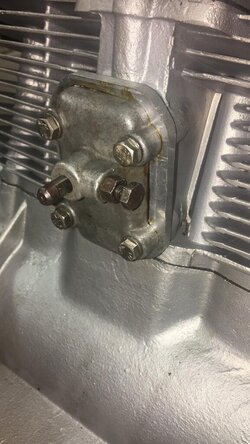
We've fitted a new IWIS cam chain on my SF1 and no mount of torqueing the head down is going to make it slack enough to fit the tensioner.
We made a new 'wheel [chain vibration damping]' circled and the tensioner wheel - the former we made 2mm smaller in diameter then spec.
Does anyone have advice on how small it needs to be to be able to bolt it all back together please?

Also

The spring on the tensioner seems VERY strong when fully compressed (Hooke's law and all that) it's no wonder the original wheels were mashed.
Is a lighter spring a good idea?

Thanks
Screenshot 2021-11-26 102042.png
 
I don´t think the original spring will cause undue damage to the wheel, the chain needs plenty of tension on the slack side. It sounds like you have got the chain on. It was mentioned using two gaskets on the tensioner. I solved your problem by carving out a bit of the rubber from the damper block, same effect. As long as there is a some slack in the chain before fitting the tensioner it should be ok, but I would want the tensioner spring to be providing the tension, not forcing the tensioner body into place by screwing the bolts in. If the chain is really tight just by itself I would fit a DID, they are same spec but sit with a bit more slack for some reason.
 
I don´t think the original spring will cause undue damage to the wheel, the chain needs plenty of tension on the slack side. It sounds like you have got the chain on. It was mentioned using two gaskets on the tensioner. I solved your problem by carving out a bit of the rubber from the damper block, same effect. As long as there is a some slack in the chain before fitting the tensioner it should be ok, but I would want the tensioner spring to be providing the tension, not forcing the tensioner body into place by screwing the bolts in. If the chain is really tight just by itself I would fit a DID, they are same spec but sit with a bit more slack for some reason.
Hmm...isn't that rubber there for reason? Two gaskets might work but I think we're talking more than that is needed.

Since we have the ability to make the wheel(s) smaller it feels like that could be the right approach - it's fiddly though - we only want to do it once.

Maybe it's simple - bolt up the tensioner till it's tight, measure the gap to the case and that's how much needs to come off the wheel. The gasket depth will give a bit of play to relieve the force being applied by the bolts later.

I'm not ready to think about buying a new chain at the moment having only just bought one from the most recommended source.
 
How tight is the chain once the head is on and fully torqued down? You can feel if there's any slack or if it's really tight by pushing on the chain through the tensioner opening. As long as it's not super tight checking the gap when fitting the tensioner and then fitting two gaskets or making a spacer and using two gaskets if nec should work OK. Once the motor has run for a few thousand km you can probably go back to the std single gasket. never had a problem with Reginas or other brands I've used over the years.
 
VERY! The screws holding the tensioner on don't even catch a thread
Does the engine turn over freely by hand?
Where did you get your new tensioner wheel?

Otherwise, try putting the old wheel back on and if all's ok, use that one for a few thousand miles to let the chain stretch.

Something's wrong though if you can't even catch the screw threads.

Paul
 
Don't know if it's so tight as to stop the engine turning - I'm not with the bike - I expect it will still turn over but I imagine the tightness of the chain will be felt, it span fine with the old chain on.
Made the tensioner wheel and 'idler' wheel - old one is chewed and cracked.
Yes - going to check the obvious first - count the chain links.
 
Thousands of these engines are in use globally, fitted with the original-sized damper and tensioner wheels without issues. If they don't fit in a particular engine, there is most probably something wrong with the cylinder base/head gaskets or the timing chain/sprockets, perhaps even the cylinder or head themselves. An incorrect spring can prevent the tensioner to be fully retracted. To fit the tensioner assembly, the lock screw should reach to the "front" edge of the flat on the tensioner shaft.

I haven't had any fitting issues for ages, there were quite a few dodgy chains available 20-30 years ago, DID is my choice these days. Chain can easily be joined with only a little pressure on 2 of the centre studs to compress the assembly a bit.

The spring tensions the chain, the rubber block smoothes out irregularities with the engine running once the lock screw is tightened.

piet
 
VERY! The screws holding the tensioner on don't even catch a thread
Was asking how tight it feels when you feel through the hole without the tensioner in place and actually push on the chain. If it was possible to join the ends then i can't imagine it is so tight as to cause damage (excessive force on bearings and chain).
 
VERY! The screws holding the tensioner on don't even catch a thread
The 4 screws, one in each corner? If it’s those ones, you have a problem.

You may have to grind down some of the dampener rubber. Mine was a tight fit, you need to be able to fit the unit, spring fully compressed, with enough freeplay, that the flange almost sits flat, without screws. Screw it up, then release the lock bolt to allow the spring to do its job, and lock it up again.

Force it in via the screws and you run the risk of creating a D out of the tensioner roller. The ensuing racket, as the roller spins occasionally and bounces around, back and forth, will have you pull the motor down looking for another problem...... I know first hand. :rolleyes:
 
Surely a missing link on the chain would render it impossible to close. it's tight when all's well
Center cam wheel is 65.5 mm. I unfortunately don't have a new one to hand.

There shouldn't be any problem with the tensioner. Is the rubber on the right way round, is it properly seated?

Paul
 
Ok so the new chain is a tiny bit shorter when pulled tight but not enough to make a huge difference. The stacked washers give enough room for the tensioner to deploy a little.
IMG-20211127-WA0000.jpgIMG-20211129-WA0000.jpg
 
The chain I couldn't get to join up was virtually identical overall length to the one that joined easily.
If you in fact have some slack at all in the chain, the easiest solution is probably making up a slightly smaller diameter tensioner wheel and swapping it out when the chain wears in enough.
 
Is the new chain dry or greased? New chain grease is quite firm and sticky stuff. If greased, try washing it in diesel or petrol. Give it a good soaking and plenty of agitation, then hang a weight from it to squish any remaining grease out from around the pins. It should then stretch a little further.
 
Is the new chain dry or greased? New chain grease is quite firm and sticky stuff. If greased, try washing it in diesel or petrol. Give it a good soaking and plenty of agitation, then hang a weight from it to squish any remaining grease out from around the pins. It should then stretch a little further.
it wasn't especially inflexible...lightly oiled.
This spacer will allow the tensioner to do it's job.
Will monitor how it goes...I was going to say - "and hopefully be able to remove it" but that means either the chain and/or new Delron wheels will have stretched/worn quite a bit - which isn't really a great outcome.
 
Back
Top