Cam blocks

Schurminater

Hero member
Location
Surrey Hills
Next Question if I may re Triples,

I have already read and learnt a lot from this forum regarding the Cam block issues and the fitting of them,but are there different types and are they interchangeable between cams...?

From what i can tell there are two part numbers for the outer blocks but various heights of offset, and it looks from the parts drawing that they can fit in dual positions ie inlet left or Exhaust right........is that correct?..........so if that is the case they are not machined matched to the head and could well be refitted in a different position if you didn't take care when dismantling.

And finally do or did any of them have shell/bearing inserts or are they all just plain Alloy?

Appreciate some education on the subject please,

thanks in advance. (thumbup)

Schurmie


Stock factory cam bearings were always all-alloy, with no seperate bearings/bushes.  They were also always in one height only.  The bearings/cams are interchangeable, but not all bearings are directly compatible with all heads.  Early bearings were of a very aesthetically pleasing design, but were far too fragile and were often squashed to oblivion by ham-fisted mechanics bodgers.  The most desirable of the factory bearings are the later, more solid design, but may require a bit of re-working to suit early type heads.  The locating system changed from simple dowels-over-studs to a milled channel in the head in which the bearings positively located.  Again, many bearings and heads have been damaged by before-mentioned bodgers, calling for a lot of creativity on the part of engine builders... ::)  Due to the 120? lobe phasing, the last of the line are a bit different again, but offer the best location method.

There are 4 different bearings in a set, the outers interchange diagonally.  The oil feed bores changed a bit over the years, but I have yet to determine any advantages/disadvantages from one type over the other.  The final version of 120? cams were locatated axially by a bronze thrust half-moon incorporated in the central bearings, but these bearings still have the groove necessary for the earlier cam locating steel half-moon, so can be used with earlier cams.

So, with a bit of imagination and machining skills, all bearings can be adapted to all heads.  OE bearings are all but unobtainable, so the best bet is to source a set of aftermarket bearings from Red in Oz or Gijs v. Dijk in Europe if replacements are needed.  OCT in Germany has original factory outers in stock, but none of the 2-piece inners.  Bearings with increased off-set are an easy way to get around recessed valve seats in the short run, avoiding a costly head overhaul, but throw up a few problems once the head does enjoy a proper going-over.

piet
 
excellent, simple, concise and dead accurate information from Piet, so many thanks for that, giving your time and long earned and learned information is a very generous thing to do, my thanks to you.
I wish he lived near me!
CLEM
 
CLEMTOG said:
excellent, simple, concise and dead accurate information from Piet, so many thanks for that, giving your time and long earned and learned information is a very generous thing to do, my thanks to you.
Plus one
 
Thank you Piet, that is perfect. (goodjob)

Thank you for taking the time to give me and many others an excellent overview into cam blocks,their history,development and even availability!

As a new laverda owner there is much to learn about the marque and these wonderful machines.
Having availability to such knowledge and the generosity and willingness of those with experience to share it with others,makes life and learning so much easier for us all, and we can only benefit from it.....so thank you.

One thing that does surprise me is that they are all alloy with no additional bearing shells as i would have thought and have come across in other machines,it also raises questions about my own set up and what has previously been done to it.

Steve


Yes, though my thoughts as a non engineer are that whichever engineer designed those extremely narrow and fragile ledges or channels on which the later blocks rest, wants shooting.😊
 
Schurminater said:
Thank you Piet, that is perfect. (goodjob)

Thank you for taking the time to give me and many others an excellent overview into cam blocks,their history,development and even availability!

As a new laverda owner there is much to learn about the marque and these wonderful machines.
Having availability to such knowledge and the generosity and willingness of those with experience to share it with others,makes life and learning so much easier for us all, and we can only benefit from it.....so thank you.

One thing that does surprise me is that they are all alloy with no additional bearing shells as i would have thought and have come across in other machines,it also raises questions about my own set up and what has previously been done to it.

Steve


Most comtemporary OHC/DOHC bike engines have the cams running directly in the head casting, secured with a bearing cap clamped over the top.  At least the Lav designers added complete replaceable bearings for the case of cams siezing... for whatever reason (yes, I've seen that).  Other engines would require a complete head for repair, often making such a repair completely unviable.  Perhaps an explanation why so (comparitively) few of those machines have survived, despite so many having been produced.

What's your set up look like?  I've just recently come across a set of bushed bearing blocks, the cam journals showed far more wear than would normally be the case with all-alloy bearings.

Nick, an accomplished mechanic has his mind on the job... no problem at all if the system is understood and one takes time and care. :D

piet


Yup, fair point about the cam block design avoiding the need for a new head..you only need to do that when it cracks, eh?!  And 40 years on , accomplished mechanics who know what they are doing with Laverda heads are as rare as hen's  teeth.I  bought a gear cam driven new VFR to avoid cam chains, and an XT 250 over a Honda XL ..because it had a gear driven balancer not chains, and no Honda style plain bearing cam running in the head.Call me old fashioned, but neither of them went wrong 😂 I remember my old man who was a graduate engineer telling me, a know nothing teenage upstart, that plain bearings were an acceptable design, but I just don't like the concept of one thing film of oil standing g in the way of catastrophic expensive failure...so I like the Laverda cranks!
 
Piet,

Yes i see your point and looking at it that way by having complete replaceable caps is a good thing and a good insight of the Laverda design
team and a plus point for us.

Now its interesting that you have just come across bushed bearing blocks as that is exactly what i have found in my set up but only on two of them.The right hand inlet and right hand exhaust blocks are fitted with what looks like bronze inner sleeves complete with oil feed hole.

Looking at them this would not have been an easy job to do,they are quite thin walled and seem to match their position on the camshaft,if i transpose them diagonally inlet to exhaust cam the fit feels too tight but in the position i removed them from the fit feels nice, so have they been machine matched to their position?

So the question is why are they there? .........and have they been honed to the correct tolerances as per the all ally blocks?

I have only tried to refit the inlet cam so far but there does seem to be slight resistance felt in that block when tightening though the cam will turn.

If i put an all ally block in its place the cam seems to stay free.

Do you happen to know the cam/block tolerance measurements? it would be a good idea if i compared them to mine,the bush may well be undersized causing any tightness.

I would also add that all the other blocks look to be in great shape.

Thank you Piet,i would appreciate any thoughts.


Honda's CB750/4 had separate cam bearings.
Yes, I managed to seize a camshaft in them (pattern oil filter collapsed and starved the cam of oil, fffff).
 
Steve,

Factory spec for cam bearings; Cam, 22 -0.025/-0.050mm  Bearing, 22.1 0/+0.033mm.

That's a minimum clearance of 0.125mm, maximum 0.183mm, quite a lot.

The head I'm working on had all four of the one-piece bearings bushed.  Thankfully, the owner has a spare set of cams to replace the buggered ones (not only worn journals, but also knackered lobes, due to... whatever ???).  The bearings are also going in the bin.

Reckon the bushes were fitted because somebody thought the clearance might be excessive or the bearing bore surface looked a bit rough (they very often do).  Result would just as often be binding cams and even further wear.

If your cams are binding, first port of call is to check the head for flatness.  Very common to have them bowed.  Don't rush off to have it skimmed, too many heads have been irrepairably "repaired" in this manner.  I have sucessfully bent heads back from as much as 0.4mm gap in the centre.  Just place them in the hydraulic press and gently nudge it over the bend about 0.3mm and leave overnight, may have to repeat a couple of times.  Afterwards, a slight dent can often be found in the barrel mating surface immediately between cylinders #1 and #2, and at the cam box sealing surface.  I wouldn't worry too much about a dent in the cam box surface, but the head/barrel surface can usually be restored with the slightest of skims.

Also check the underside of the bearing blocks, a sliver of metal is often lodged in the corner of the locating spigot, a result of the bearing being tightened down while not square to the head.  Often, a bit of head casting is broken off the edge of the milled locating channel, just as often, a sliver of bearing block is sliced off.  This then prevents the bearing block to bottom properly on the head surface, again bending/binding the cam.  Bent camshafts are also quite common, I true them to a maximum of +/-0.01mm (quite acceptable with over 0.1mm clearance!).  Also on the hydraulic press, requires a bit of practise though. :D

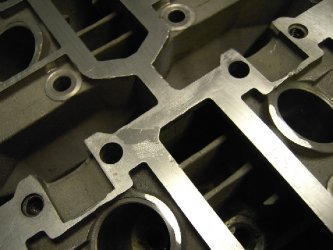
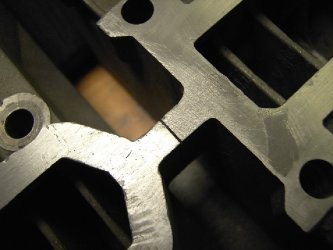
To prevent the heads from cracking at the cam box corners, a cut (about 2/3 through) can be made in the fillet between cylinders #2 and #3 at the cam box surface (passing under the chain run).  We have found this to cause cracking at the corners of the casting, the cut eases off a lot of pressure when everything heats up and expands.  Pics show laser welding repair of cracks, dressed welds and cut in the alloy bridge/fillet.

piet
 

Attachments

  • Neu_Neu_PICT0741.jpg
    Neu_Neu_PICT0741.jpg
    35.9 KB · Views: 69
  • Neu_Neu_PICT0747.jpg
    Neu_Neu_PICT0747.jpg
    100.7 KB · Views: 65
  • Neu_Neu_PICT0748.jpg
    Neu_Neu_PICT0748.jpg
    89 KB · Views: 78
Morning Piet and guys,

That is impressive work and way above what most of us are able to do in our workshops, there are times like this that we all could wish for a Piet in our toolbox. (thumbup) seems we still have much to learn.

As an engineer myself (though in Aircraft) we have an inherent can do attitude which drives us always to do a good job, but also to find solutions to problems.We must however be aware of our limitations and know when to stop and pass the problem onto someone else who has the all the knowledge, tools and experience to fix it..........or face the consequences. ;)

I could well be approaching that point, but for now there is still hope and much to learn,the simplicity and dare i say somewhat agricultural design of the laverda engine must allow us some leeway and which kept these masterful machines running in the early days before engineers became scientists.

But as we know unfortunately for us the design does not compensate for (as we say) having  'Spanner monkeys' in the equation. ::)

Piet....,thank you for the measurements you supplied,I measured both the camshaft and the bushed blocks last night and as expected the tolerances are way under what they should be and i suspect is the main reason why the cam starts to bind.

The bush inner dia is 21.95mm and the camshaft is 21.91mm

in caparison my standard all alloy block measures 22.04mm.

So my conclusion is that the bushes are too tight and not meeting the factory specs for clearance, my options I feel for me to continue myself are:

1) increase the clearance and bring the bushes into tolerance.

2) replace the 2 bushed blocks with new original blocks if available.

As i said if i transfer an original block diagonally it seems the cam will run free which may rule out head warp?

There is always Option 3 if 1 and 2 are not practical, will be to send my head to a specialist  :)

Thank you once again for your assistance,help and patience on yet another (goodjob)

Steve


Hi Steve

If you choose to replace the bearings, it's probably best to replace all bearings as a set. If you just buy the outer bearings, there's no guarantee that they're exactly the same height as your centre bearings, although I suppose you could put shims under them if they aren't the same. 

If you decide to buy a full set, I'd recommend Red's CNC machined cam bearings. They are sturdier than the original ones and with a full set you won't have any problems with misalignment (as long as your cylinder head isn't warped).

There's a picture of Red's bearing blocks on Laverdamania http://www.laverdamania.net/Redax_gb.htm

Cheers,
Cam
 
Hi Cam,

Many thanks for the advice and information it is much appreciated, (thumbup) I have seen postings on Red's machined bearings and they do look superb,I am just weighing up my options now but if i do decide to change the whole set i will certainly look into them and will contact him for details and prices.

My gut feeling at the moment is that if i do replace them all it would be sensible to know that the head is in good shape so I would most probably factor them in as part of a specialist overhaul.

I know that valve work has been done maybe a year or so ago, and you may then rightly presume that the head was checked over at that time which would be a sensible thing to do,...but that could also have been the time when the cam blocks were bushed, so who knows?

its a tad frustrating not being able to crack, on but these things happen and its not disastrous yet :D

I will follow my gut instinct and go with the flow  (thumbup)

will keep you posted.

Steve

 
I have some cam blocks but not a full set, if I have the ones that you need? they are yours for the price of posting from UK.
CLEM
"clemlav@tinyonline.co.uk"
0044 1959 532316
0044 7778 018464
 
So following on and to update you on the cam block situation,I purchased two new blocks from OCT in Germany (thank you Piet,Roger and Dirk) Very impressed with the service and a great help to me.

Following my gut instinct on this one and admittedly the cheaper option,I set about modifying the new blocks to fit my head and to replace the two that had clearly been bushed undersize and for reasons unknown.

The new blocks were 120 Jota items and as such i have learnt are generally identical to the 180 but have extra meat on the locating face where it sits on the head.


Careful working gave me two blocks which fitted my head perfectly and gave me free running cams on tightening down,
very happy so far with the outcome.


My question now is regarding the size of the oil supply hole which in the new blocks is smaller,is it necessary to open this up?

Cheers guys

Steve


Back
Top