Mirage TS Sticking clutch plates

I don't remember the clutch setup on my former 1971 SFC 750 drum brake 8000 series. Only Laverda 750 I have ever owned. On my triples, the clutch actuating rods are sectioend into a couple of pieces, with ball bearings in between the sections of rod. Are there ball bearings in between the 750 clutch rods?
 
Thanks Mark. I'll do some research. Vince mentioned using silver steel (unhardened) and it lasted about a minute, so I'd need to be sure I got the hardening right.
Heat to cherry red and quench in old oil. Make sure to put a centre drilling - just a conical depression - if you're going to put ballbearings in between - Do this BEFORE you harden it. Do a trial assembly to confirm lengths BEFORE hardening.
I've made valve shims from silver steel and hardened them this way for around 30 years. Never had one split or crumble.
 
Same set up as a triple, Paul.

Thanks Greg - excellent info. I did the cherry red and oil trick on my custom double row oil pump drive peg but wouldn't have felt comfortable trying it on a custom clutch rod. But will do so now - and would never have thought of using the conical depression, but excellent idea in ensuring the 1/4" ball centres perfectly.

Of course, I'm only assuming I'll need a longer pushrod after measuring the friction plates at 4mm ea (vs 3.6 for std supposedly)
 
But I bought these plates decades ago and don't think the kevlar thing was happening back then - IIRC I got them from Eades. But if the kevlars are also 4mm then I shouldn't have a problem.
 
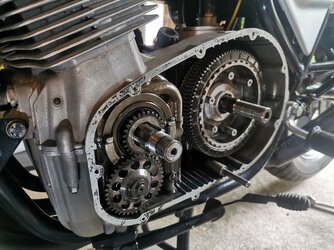
Update! With the assistance of my mechanical genius mate, the clutch plates have now been removed, separated, cleaned & put back. The clutch worked again. Yippee. However, we decided to replace the clutch fluid with fresh fluid as it hadn't been done in a long while, esp as it looked rather dark! Now wishing I'd left it alone, because I've got no clutch again now. 🙁. After pumping clean fluid through, removing the old dirty fluid, from top to bottom, even trying the reverse, no joy! No pressure! We can only assume maybe the seals have gone in the master or slave cylinders, due to age of the fluid. I feels like my Laverda is putting up stiff resistance to being sold 🙁😄
 
I once rode an SFC 1000 I'd just purchased near Gothenburg to South West London with a totally inoperable clutch . Well it was OK for the first 100 miles and then the crap in the hydraulic reservoir stirred up by fitting a RAM sat nav mount on the clutch lever perch before departure blocked the return port in the master cylinder , so no clutch , or rather no disengaging the clutch . I only worked this out once home otherwise it would have been an easy fix !
I found you could literally paddle the bike away from stoplights and clunk it into first gear at walking pace and it would chug away without stalling! Kept my hand near the kill switch for any emergency stops and got through Sweden, Denmark , Germany , Holland , South East England and 3 ferries like this , though a tail back on the Dutch motorway was a bit hair raising .
I've also just recommissioned a mate's Ducati Darmah which had badly stuck its clutch plates . It needed a bit more than walking pace or it stalled , but didn't need the brakes touching to free off , just accelerate hard with clutch lever in when safe to do and it soon released its death grip .
To the original poster , if you're in South Cheshire I'll gladly pop up from Shropshire and help with procedure described above . Otherwise I have an electric rattle gun I'll loan you if you want to meet half way ? If I recall correctly this worked fine on the last Jesus nut but my memory is shit and it was ages ago , others can comment if it needs a kosher compressor powered one ?
Dave
Much appreciated Dave, with assistance from a much more mechanically competent person than myself, we managed to remove the plates, separate & clean them, then reinstall. Initially all good, I had a clutch back!?👍🏻 Unfortunately we decided to change the clutch fluid, as it was looking rather black & old. Bleeding the system, resulted in a total loss of the clutch!! So now the plates are separated, all good, the lever is innafective. 🙁. One step forward, one step Backwards. Damn!
 

Attachments

  • IMG_20220805_103748.jpg
    IMG_20220805_103748.jpg
    174.4 KB · Views: 22
Much appreciated Dave, with assistance from a much more mechanically competent person than myself, we managed to remove the plates, separate & clean them, then reinstall. Initially all good, I had a clutch back!?👍🏻 Unfortunately we decided to change the clutch fluid, as it was looking rather black & old. Bleeding the system, resulted in a total loss of the clutch!! So now the plates are separated, all good, the lever is innafective. 🙁. One step forward, one step Backwards. Damn!
If you have a system to pull fluid through via the bleed screw, be it an enema syringe, it's easy.
Otherwise, bleeding those hydraulic clutch systems is a right pain. Keep at it.

Paul
 
If you have a system to pull fluid through via the bleed screw, be it an enema syringe, it's easy.
Otherwise, bleeding those hydraulic clutch systems is a right pain. Keep at it.

Paul
Hi Paul, well I had good resistance before, l decided to change the old fluid, now there is pretty much zero. It's So frustrating as the clutch plates are now free & the clutch was working as it should, albeit for 5 minutes, before the idea to put fresh clean fluid in. We don't think it could be blocked, because we have run plenty of the old and new fluid through the line, in both directions. Hence why we think a seal has gone / perished? 🤷. I've just posted in tech help for the Brembo part codes. If it's the slave cylinder, I hope this isn't another mare of a task 🙁👍🏻
 
Is there any "oil" under the front sprocket ? if the slave seal ( read big o ring) has gone big time the hydraulic oil will end up running down the casing inside but around the sporocket area - it has to go somewhere
 
the clutch slave cylinder, if leaking, is a very easy repair. Order the single O ring, and order a new rubber cover while you are at it. Best way to bleed is to remove the bleed screw, wrap the threads in some teflon tape so air doesn't sneak by the threads during bleeding, and best of all, use a power bleeder. I am at work and do not remember the O ring size, it is a common size available from any seal shop, just make sure what you buy is impervious to brake fluid. Could someone post the O ring size please?
 
Air bleed from hydraulic circuits on Laverda is for the well knowledge'd, lads here have the path to success, notable Laverda Lothar, we have similar experiences and techniques. Try leaning the whole bike to the right ( get help ) and slowly crack the master lever, do not pull the lever in all the way, you will feel a "sweet" spot where the air bubbles appear in the uncapped reservoir, with gentle persistent motioning of the master lever. Works for the master, there is another technique for the slave and hydraulic hose. HTH j
 
There is more than one O ring size, drop the engine oil if you haven't already then remove the gear lever or crossover shaft, selector cover undo all the M6 bolts including the one under the triangle cover then ease out the gearbox cover, spin it around and you will see the end of the piston in the slave cylinder you maybe able to pump the piston out, measure the diameter and order a new one (Viton O ring) I think the common size is 30x3.
 
I had a similar problem bleeding my Brembo rear brake. The master cylinder simply would not take any fluid in and I was sure there was no prob with the seals (I'd reco'd the unit). Eventually I had to manually flood the master cylinder and connect it. Finally it started to pump, very slowly getting air through the line and finally I had piston movement and a firm rear brake. A vacuum bleeder would probably have worked.

So it's not always due to a dodgy seal.
 
If you want to get in there, as Maurice points out, there are at least two piston and hence seal sizes.

Paul
My aforementioned SFC1000 had a sheared clutch bleed nipple . I found bleeding the system very easy just by leaning the bike the opposite way to the sidestand so master cylinder at highest point and zip tying the lever against the bars overnight . Worked every time . Assumes o rings etc all OK of course . Even just pumping the lever once resistance felt got it pretty good . IIRC Keith Nairn recommended this but could be wrong ?
 
I've never understood the zip tying of a lever against the handlebars as a method of bleeding a hydraulic system. It shouldn't achieve much in a hydraulic system that's in good condition. All it does is seal and pressurise the system. There's no path for air to escape.

I figure there a couple of ways it can work as a "bleed" system.

One way is if an air bubble is trapped behind a somewhat dodgy sealing rubber (as achieved my leaning the bike over) then air may leak past the imperfect seal under pressure, but the fluid not so much because of its higher viscosity. That would certainly improve things in a band-aid fix kind of way. But it would seem that a new set of seals might be a better long-term solution.

Another way it could remove gas from the system is for the gas to slowly dissolve in the fluid because of the constant high pressure. I would expect in that case for the sponginess to return some time after the pressure is released, like a fizzy drink when the lid is opened, but it might last long enough for a day's ride.
 
Back
Top