Dellortoman
Hero member
- Location
- Tasmania, Australia
I reckon your fork seals were already knackered then Chris.
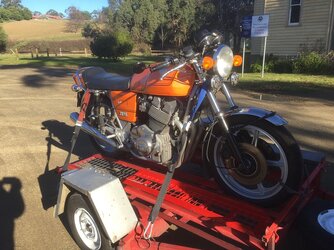
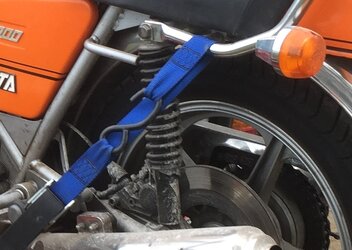
With our old Marzocchi or Ceriani forks, when a bike is parked with barely any load on the suspension, there's practically no pressure inside the forks, so even if the seal is worn out, you won't see much leakage. But when you crank down on a set of tie-downs to compress the forks for transport, you'll create pressure behind the seal. Sustaining that pressure for hours on end during a lengthy transport will naturally make the seal piss out more oil than it would during normal use. It doesn't mean the seal is "blown" though. It doesn't even mean it's in worse condition than it was at the start of the trip. All it means is that it's a leaky seal.
Shaft seals generally work in two modes: rotation, such as in a gearbox or engine; and reciprocation, as with hydraulic rams or motorcycle suspension.
Seals on a rotating shaft have an easier life than reciprocating shafts and usually last longer, but we're not concerned with them in this instance.
Reciprocating shafts can drag dust and grit into the seal as the shaft retracts. Some fork seals are designed to minimise this problem by having a double lip, two seals together, or an external dust cover that wipes the shaft clean. On forks like the old Marzocchis or Cerianis on our Laverdas, there's a space between the outer dust seal and the inner oil seal. Some owners will stuff a bit of oily rag in there to add another level of dust protection for the oil seal.
Another problem with reciprocating shafts is that the shaft has to be in perfect condition for its full length of travel through the seal. Motorcycle forks are rarely in perfect condition. There can be stone dings and other damage that can have raised edges that tear at the seal lip as they pass through.
The result of all this is that motorcycle fork seals are rarely in perfect condition. If you hold pressure on any bike fork seal, it'll probably leak. I believe that's the reason for the belief that using tie downs to compress the suspension results in blowing seals. As Haggis eloquently states, it's "bollocks". In my opinion, there's no way that compressing the suspension can cause any damage a fork seal.
The inescapable truth is that the suspension is designed to compress and the seal is designed to withstand the pressure. Whether the pressure is for a short or long duration makes little difference to the physical state of the seal.
The only way a seal can actually blow out of the fork leg would be as a result of incorrect installation. For example, if someone forgot to install the retaining circlip, or if it wasn't seated in its groove. That's something you'd definitely want to know about before riding the bike, so the seal popping out during transport would be a good thing.
A possible exception might be AndyW's experience with transporting Triumph T140, T150 and T160 bikes across the country. Those bikes have no circlip to retain the fork seal. All that holds the seals in the forks is friction. I suppose under constant pressure and vibration they could work loose and pop out. But in my opinion, that's poor design. A heavily loaded bike will have its forks compressed under the load. Riding it across the country would provide a similar or harsher environment than Andy's trailer transport as far as the fork seals are concerned. I'd be worried about the seals working loose during use.