What did you do to or for or with your Laverda today?

... optical illusion? Here is a pic from the other side! Ciao, GertView attachment 89046

Cool, did not know anyone else was running 180 x 17" slicks on their bikes
Not an easy modification, well done

Today we ran both bikes on track, Mule with her 180 rear and Veloce still on a 160 rear
Huge difference, Mule is wheel standing coming out of nearly every corner where as Veloce just spins up when Matt gets on the throttle
He asked me if we could install a ride height device on them like MotoGP have to keep the front wheel down
That is not going to happen

Hopefully will have both bikes on 180 tyres by the next round at Morgan Park in May, maybe not though
Lot of machining to do plus also the Clutch modification we have in the works

Racing is additive, am certain a drug habit would be cheaper though maybe not


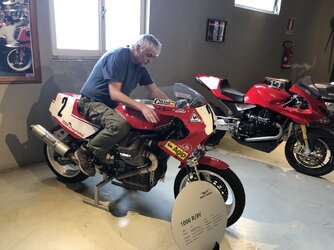
Saw in the pits today a replica Dr John Guzzi, cool bike but disappointed he has decided to run in a lower class than our triples
Bummer
 
I've been wanting to do this literally for decades...

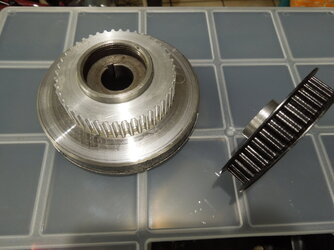
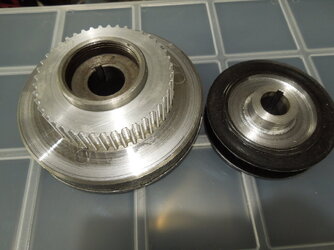
The performance and longevity of the stock 750 generator V-belt has never impressed me, finding black rubber residue inside the cover every time it is lifted doesn't exactly inspire confidence. It seems either the generator pulleys are all worn or the belts don't fit as they used to/are supposed to. Fitting a new belt only results in it becoming loose to the point that slippage sets in within only a couple of 1000km. This mod will finally cure all these symptoms, experience with a similar mod on my Matchless magneto drive makes me very optimistic.

The pulley ratio has been subtly altered, the generator will run about 10% faster. As the GTL won't be doing any 24-hour endurance races, I'm pretty confident the generator will be quite OK and the battery will always be fully charged when only tootling through villages. Presently waiting for a 515mm belt to arrive, the calculated and ordered 520mm is a tad too long. Easy mod for under €100 and a couple of relaxing hours at the lathe and workbench.


DSCN0845.JPGDSCN0846.JPG

Disclaimer; no irreplaceable original Laverda parts were harmed for this mod, that had been taken care of a hammer and monkey-wrench wielding imbecile before me. I salvaged what was left over. The bare clutch housing has been cleaned up inside and out and a new internal ramp thingy and cover plate fitted and rivetted in place.

piet
 
I've been wanting to do this literally for decades...

The performance and longevity of the stock 750 generator V-belt has never impressed me, finding black rubber residue inside the cover every time it is lifted doesn't exactly inspire confidence. It seems either the generator pulleys are all worn or the belts don't fit as they used to/are supposed to. Fitting a new belt only results in it becoming loose to the point that slippage sets in within only a couple of 1000km. This mod will finally cure all these symptoms, experience with a similar mod on my Matchless magneto drive makes me very optimistic.
piet
Nice mod Piet. Agreed v belts are not ideal, and it seems to be getting harder to get one that fits properly for SF. One thing comes to mind is that all the vehicles that I know of that use toothed belts have a tensioner to prevent any possibility of slack. Maybe the very short belt used here will negate the need. I know that Q had the toothed alternator belt on his bike shred just in the short time he had it on the road.
 
I run a toothed belt on the original setup. Has been going for donkey's years.
Paul
No, you do not. You're running a segmented vee-belt Paul. Huge difference, like oranges and apples. Both round, but completely different species. The segmented have certain advantages over the solid type, but not enough for my liking.

Of course the original belts work for donkeys' years, just not efficiently. If you'd check carefully, I'm pretty certain your belt will be rather on the loose side, as they all are. The belts are then prone to excessive wear and slippage. I'm also pretty certain the inside of your belt cover is covered in black grime...

My vee-belts would probably also go on for donkeys' years, just not in the manner that I would prefer. Guess it all boils down to personal expectations.

The toothed belts are very competitive price-wise, especially as vee-belts are getting rarer and harder to find.


@ Lee,

Hopefully my the 515mm belt will fit OK without a tensioner. Experience with the toothed belt for my Matchless magneto drive is that it requires no maintenance once set up with the correct tension. Periodical checks show no change in tension. Been running reliably for over 20000km now. I did carry a spare on the Milano-Taranto though... just in case. But then, I also carried a spare primary and drive chain, also not needed.

piet
Yes Piet, my belts are loose and worn.
But the battery charges.
Belts I use are 19 1/2 10 x 500. Toothed V belt.
Paul
 
Last edited:
Belts I use are 19 1/2 10 x 500. Toothed V belt.
No, you do not. You're running a segmented vee-belt Paul.
Is there some confusion as to what a toothed belt is?

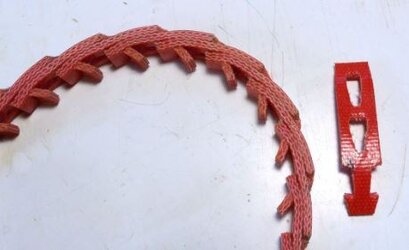
A segmented V-belt would be a strange choice for a generator drive belt. Segmented V-belts (otherwise known as linked belts) as shown below were traditionally found as drive belts on ancient bikes that didn't have gearboxes. They were originally made from leather segments that link together. I guess rubber V-belt technology was in its infancy back then.
They're still used in some light-duty applications where the adjustable length may be useful for some reason, but nowadays they're made of some kind of reinforced synthetic material.
For a given pully groove size, a segmented V-belt is not as strong or durable as a reinforced continuous rubber belt, so would generally be an inferior option for power transmission.

v-belt linked.JPG

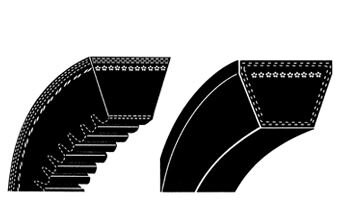
I suppose it's possible that Paul has a segmented generator belt, but I suspect what he's talking about is a continuous rubber belt with "teeth" moulded into the inner edge (shown at left below), but they're not actually teeth in the sense of the toothed timing belt that Piet has fitted. They are only toothed in as much as a wavy brake disk can be described as a having teeth. It might make more sense to think of it as a notched belt rather than toothed. The notches don't engage with anything. They're only there to make the belt more flexible. The toothed V-belt still relies on friction between the sides of the belt and the V-groove in the pulley for its drive, so it can slip just as a plain V-belt will if not tensioned properly. Note that the inside edge of a V-belt (whether toothed or not) does not contact the bottom of the groove in the pully. If it's worn so much that it does, then it's time to replace the belt.
v-belts.JPG

The flexibility of the toothed V-belt allows it to conform better to the curve of the pulley, especially with small diameter pulleys, giving better grip than a plain belt.
The toothed V-belt also has the benefit of running cooler than the plain type. Without getting into V-belt drive theory or hysteresis of rubber deformation, suffice to say that rubber absorbs energy as it bends. That absorbed energy heats up the belt. A belt that bends more easily as it rotates around the pulleys will absorb less energy and will therefore run cooler. Heating up the belt wastes energy and accelerates degradation of the rubber, so a cooler belt is more efficient and will last longer.

It's been my experience that V-belts available in automotive shops these days are predominantly the toothed type. It's getting harder to find the plain type. Not that it's a problem as they fit the same pulleys.

Piet's flat toothed belt drive is a different thing altogether and has a lot of advantages over a V belt. It's basically a timing belt. The teeth engage with those in the pulleys (sprockets may be a better word), giving a positive drive, much like a chain. Timing belts require less tension than V-belts because they don't depend on friction to provide grip between the belt and the sprockets. This leads to lower bearing loads and lower wear rate due to reduced stress within the belt. They're pretty much maintenance-free in that they don't need to be periodically tightened like V-belts to maintain optimum drive. The initial tension will last for the life of the belt. Timing belts are thinner and more flexible than V-belts, so are even less prone to thermal failure than any kind of V-belt (toothed or plain). The only minor disadvantages of timing belts are that the pulleys are a little more costly to produce, and they're more sensitive to misalignment than V-belts.

I replaced the plain V-belts (water pump/fan, alternator and aircon) on my car with the toothed type about a year ago, for the simple reason that they were the only type I could find. It wasn't a conscious decision. They ran OK for around100 km then started slipping like crazy, making the typical screeching noise. I re-tightened them, and they ran for about 1000 km before slipping again. I was starting to think I'd bought rubbish belts, but I tightened them again and they've been OK ever since. I guess they just took a while to stop stretching and bed in. I've not noticed such an obvious running-in period with plain v-belts before.

PS: I don't know much about the Laverda twins, but all of the above is just general belt drive info. It's not specific to the generator belt of the Laverda 750.
 
Is there some confusion as to what a toothed belt is?

A segmented V-belt would be a strange choice for a generator drive belt. Segmented V-belts (otherwise known as linked belts) as shown below were traditionally found as drive belts on ancient bikes that didn't have gearboxes. They were originally made from leather segments that link together. I guess rubber V-belt technology was in its infancy back then.
They're still used in some light-duty applications where the adjustable length may be useful for some reason, but nowadays they're made of some kind of reinforced synthetic material.
For a given pully groove size, a segmented V-belt is not as strong or durable as a reinforced continuous rubber belt, so would generally be an inferior option for power transmission.

View attachment 89096

I suppose it's possible that Paul has a segmented generator belt, but I suspect what he's talking about is a continuous rubber belt with "teeth" moulded into the inner edge (shown at left below), but they're not actually teeth in the sense of the toothed timing belt that Piet has fitted. They are only toothed in as much as a wavy brake disk can be described as a having teeth. It might make more sense to think of it as a notched belt rather than toothed. The notches don't engage with anything. They're only there to make the belt more flexible. The toothed V-belt still relies on friction between the sides of the belt and the V-groove in the pulley for its drive, so it can slip just as a plain V-belt will if not tensioned properly. Note that the inside edge of a V-belt (whether toothed or not) does not contact the bottom of the groove in the pully. If it's worn so much that it does, then it's time to replace the belt.
View attachment 89097

The flexibility of the toothed V-belt allows it to conform better to the curve of the pulley, especially with small diameter pulleys, giving better grip than a plain belt.
The toothed V-belt also has the benefit of running cooler than the plain type. Without getting into V-belt drive theory or hysteresis of rubber deformation, suffice to say that rubber absorbs energy as it bends. That absorbed energy heats up the belt. A belt that bends more easily as it rotates around the pulleys will absorb less energy and will therefore run cooler. Heating up the belt wastes energy and accelerates degradation of the rubber, so a cooler belt is more efficient and will last longer.

It's been my experience that V-belts available in automotive shops these days are predominantly the toothed type. It's getting harder to find the plain type. Not that it's a problem as they fit the same pulleys.

Piet's flat toothed belt drive is a different thing altogether and has a lot of advantages over a V belt. It's basically a timing belt. The teeth engage with those in the pulleys (sprockets may be a better word), giving a positive drive, much like a chain. Timing belts require less tension than V-belts because they don't depend on friction to provide grip between the belt and the sprockets. This leads to lower bearing loads and lower wear rate due to reduced stress within the belt. They're pretty much maintenance-free in that they don't need to be periodically tightened like V-belts to maintain optimum drive. The initial tension will last for the life of the belt. Timing belts are thinner and more flexible than V-belts, so are even less prone to thermal failure than any kind of V-belt (toothed or plain). The only minor disadvantages of timing belts are that the pulleys are a little more costly to produce, and they're more sensitive to misalignment than V-belts.

I replaced the plain V-belts (water pump/fan, alternator and aircon) on my car with the toothed type about a year ago, for the simple reason that they were the only type I could find. It wasn't a conscious decision. They ran OK for around100 km then started slipping like crazy, making the typical screeching noise. I re-tightened them, and they ran for about 1000 km before slipping again. I was starting to think I'd bought rubbish belts, but I tightened them again and they've been OK ever since. I guess they just took a while to stop stretching and bed in. I've not noticed such an obvious running-in period with plain v-belts before.

PS: I don't know much about the Laverda twins, but all of the above is just general belt drive info. It's not specific to the generator belt of the Laverda 750.
And how’s your nogen now Cam?
 
Nice job Cam, it's good to learn stuff. As I have never changed any belts other than to change speeds on a Pedestal Drill those notched belts are a new one on me. I could see how it's easy to confuse a proper super accurate timing style belt with toothed pulleys like on my Pantah with those notched types. Similar but very different.
 
You're correct Cam. I mixed up segmented and the "new-fangled" toothed vee-belt, mea culpa. The grand daddy of vee-belts hadn't occured to me when I wrote that.

The problem with the Laverda belt drive is that there is no provision for adjustment, the centres are fixed. Adjustment can be bodged, within limits, by shimming the generator away from the crankcase, which is hit-or-miss at best, mostly miss... This is limited by the size of the cover, only about 1-1.5mm total movement is possible before the cover clashes with the sheet shroud of the genny. Judging by the looseness of most belts, about 2-3mm would be necessary to attain the correct tension. Repeat, as in your case, more than 6-7mm would be required.

Drive pulley on the crank is steel, genny carries an alloy pulley. I reckon the alloy pulleys are all quite worn by now, they are made of a rather crap die-cast grade. I had been thinking of rigging up a 2-piece adjustable pulley as in air-cooled VW Beetles, but that would have been just as much hassle as my complete mod.

Anyway, I'm quite confident the mod will work as well as I imagined, don't think alignment will be a serious problem. Got plenty of experience with Harley/Buell final drives, most owners couldn't get alignment right and the belts still lasted OK.

Sounds like you're on the way to a good recovery, Cam. I wish you all the best!

piet
 
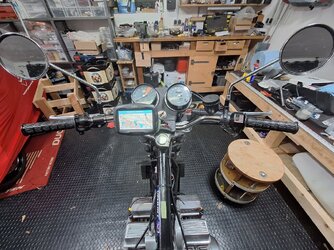
Got round to replacing my standard handlebars, now the brake master cylinder does not clash with the speedo.
 

Attachments

  • 20240331_175452.jpg
    20240331_175452.jpg
    241.1 KB · Views: 42
The problem with the Laverda belt drive is that there is no provision for adjustment, the centres are fixed.
Blimey, that's a pretty basic design flaw. Not being a 750 owner, I wasn't aware of that. All V-belt drives should have a way to adjust belt tension.

I had a couple of VWs last century, including an old split-windscreen Kombi that I sold for peanuts. The bloody things are worth a fortune now for some inexplicable reason. I quite liked the split pulley generator belt adjustment. It's a sensible solution if it's not practical to make the centre distance variable.
In case anyone that's never had an old VW is wondering what we're talking about, the V-belt pulley has separate side plates. The width of the V-groove is adjusted by stacking the desired number of shims between the side plates. Spare shims are kept under the nut on the outside of the moveable plate. The closer together the side plates, the higher the belt rides in the groove, making it tighter. It would be such a simple modification that I'm surprised nobody has produced an adjustable pulley as an aftermarket kit for the Laverda 750.
 
Back
Top