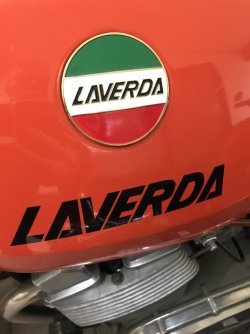
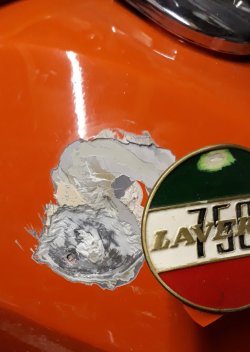
Laverda badge.

I'm very picky and like to understand every detail when I tackle a restoration; however, I'm pleased to see how my new thread generate a touch of good humor in this interesting forum. :)

I still haven't figured out whether the brass screws were nickel-plated or chrome-plated, but above all, why they were made of brass and not steel; there was definitely an underlying technical reason.
Nickel doesn't plate well on naked steel.
Chrome plating requires a coat of copper, then nickel, then chrome. Occasionaly described as "Triple Plated Chrome".
Brass obviates the need for the, thicker, copper plating.
 
I'm very picky and like to understand every detail when I tackle a restoration; however, I'm pleased to see how my new thread generate a touch of good humor in this interesting forum. :)

I still haven't figured out whether the brass screws were nickel-plated or chrome-plated, but above all, why they were made of brass and not steel; there was definitely an underlying technical reason.
Now is very clear, thanks for the explanation.
 
Oh now that's interesting. I always have my badge screws in the horizontal plane. You've got me thinking now 🤔
I'm torn. The engineer in me says stop when they are tightened correctly whichever way the heads are pointing.....the spectrum side of me says all vertical to let any water drip out (and to look right)
 
I'm very picky and like to understand every detail when I tackle a restoration; however, I'm pleased to see how my new thread generate a touch of good humor in this interesting forum. :)

I still haven't figured out whether the brass screws were nickel-plated or chrome-plated, but above all, why they were made of brass and not steel; there was definitely an underlying technical reason.
More decorative than structural.

These type of screws were already quite rare in engineering of the late 1960's-early 70's. Mass production already favoured crosshead/Phillips type screws, I imagine sourcing these type in steel AND nickel/chrome plated would have been rather difficult. Difficulties in plating steel are definitely another factor. Of course, the factory could have made or commissioned them, but I guess the bikes were already expensive enough without them going to extraordinary lengths in every tiny detail. BTW, the factory went to great lengths with the engine casing screws/bolts of the earliest 1200. These were smoothed, domed and chrome plated, a very classy touch! Fasteners supplied later as spares were simply standard chromed stuff, from which the chrome would seperate as soon as a spanner was applied.

Plated brass screws have always been available for all manner of decorative and low-stress construction odds and sods. Thankfully, stainless steel has become dirt cheap and is an excellent, durable replacement.

piet
 
Last edited:
"Nickel doesn't plate well on naked steel."

there are plenty of original and restored bikes from the 1920's that have exactly that and it looks great! verty classy not vulgar as is the case with too much chrome.
CLEM
 
"Nickel doesn't plate well on naked steel."

there are plenty of original and restored bikes from the 1920's that have exactly that and it looks great! verty classy not vulgar as is the case with too much chrome.
CLEM
Agreed, Clem.

Guess it's all in the preparation, the guys had lots of time back then...

There's also loads of cadmium plate that has held up better for nearly 100 years than zinc does in 2.

piet
 
"Nickel doesn't plate well on naked steel."

there are plenty of original and restored bikes from the 1920's that have exactly that and it looks great! verty classy not vulgar as is the case with too much chrome.
CLEM
To clarify: "Nickel doesn't plate well on naked steel."
If a long lasting, mirror finish is required.
 
I'm very picky and like to understand every detail when I tackle a restoration; however, I'm pleased to see how my new thread generate a touch of good humor in this interesting forum. :)

I still haven't figured out whether the brass screws were nickel-plated or chrome-plated, but above all, why they were made of brass and not steel; there was definitely an underlying technical reason.
Probably rust stains running down from the badges
 
In an attempt to find replacements, I took one of the screws to Barry my bolt guy. (Barry has found me heaps of obscure items over the years)

Barry held it in his hand, looked at it, raised his eyes to mine, without moving his head, and gave it back to me.

No further explanation needed.
 
I wouldn't be relying on just the supplied glue with those stick-on badges, way better to cut away some of it and add some Silicon. Heat from the Sun will have those stick-on badges dropping off real quick with some stronger help. Little story, we did exactly that with Alloy wall trim on a job with big windows, 3 days later it was lying on the floor. From then on, the double-sided tape was used in small strips with stronger glue between them. No more problems.
 
I wouldn't be relying on just the supplied glue with those stick-on badges, way better to cut away some of it and add some Silicon. Heat from the Sun will have those stick-on badges dropping off real quick with some stronger help. Little story, we did exactly that with Alloy wall trim on a job with big windows, 3 days later it was lying on the floor. From then on, the double-sided tape was used in small strips with stronger glue between them. No more problems.
Vince, the stick-on badges have been stuck on the tank for nearly 20 years. The body repair shop that painted the tank supplied the 'stick-on' component for the badges. It is the same component that auto manufacturers use, and so far it has survived 19 summers in the Coachella Valley, where summer temps regularly hover around 48C and, on occasion, hit 51C. It's not unheard of for midnight temps to be over 38C.
Tomorrow I'll walk out, look at the Lav and the f.....g badges will have fallen off, I'll blame you, ha ha,ha.:eek::cool:(y)
 
Back
Top