Steering head bearing notchy

Quentin,

You've re-imagined the SFQ into what could have been and I admire it and the effort you've put into it!

My point was that an USD fork would look pretty silly on an otherwise stock 3C... my humble opinion.

There's a couple of RGS built by v.Dijk with USD, (again) imo they just don't look right.

piet
 
Hi Piet, I have a plan.
I may have a set of 41mm off a K series BM. Half expecting I'll need to custom make the triple clamps.
The Marzos on my motodd is the weakest link. Hard breaking on track I can feel the flex. But for general road use they're ok. Have springs and valves so work as well as can be.
On the road it's rock steady.
Im with what Sock said.
USD on our old runners just don't look right to me either. On the other hand that M3 Red built looks good with the USD forks
 
Hi Piet, I have a plan.
I may have a set of 41mm off a K series BM. Half expecting I'll need to custom make the triple clamps.
The Marzos on my motodd is the weakest link. Hard breaking on track I can feel the flex. But for general road use they're ok. Have springs and valves so work as well as can be.
On the road it's rock steady.
Im with what Sock said.
USD on our old runners just don't look right to me either. On the other hand that M3 Red built looks good with the USD forks
Those forks are a cheap 'n cheerfull yet awesome upgrade! Pretty sure you can use the Beemer yokes Rob.

I fitted them to my track bike, I know of a couple of others that have them in their triples. In hindsight, I wish I had addressed headstock length back then (around 2005?), would have been even more of an improvement!

Can't remember details of the steering stem, but do remember the axle can be a challenge, depending on which version you choose. In my case, it was a simple swap of wheel bearings with larger ID to house the thick, hollow axle. At worst, a new custom-made steering stem may be required.

This is a 41.7mm fork from a K1100. Quite a few different versions were used by the Bayrischen Motorenwerke.

piet

Neu_Kopie von DSCF0034.jpg
Eisenschwein.JPG
 
My point was that an USD fork would look pretty silly on an otherwise stock 3C... my humble opinion.

There's a couple of RGS built by v.Dijk with USD, (again) imo they just don't look right.

piet
Have to agree on that front - ie otherwise stock. And triple forks are so much longer - reckon you'd def have to find adventure bike forks. I think I get away with it because it sits well with the rest of the build.
 
Those forks are a cheap 'n cheerfull yet awesome upgrade! Pretty sure you can use the Beemer yokes Rob.

I fitted them to my track bike, I know of a couple of others that have them in their triples. In hindsight, I wish I had addressed headstock length back then (around 2005?), would have been even more of an improvement!

This is a 41.7mm fork from a K1100. Quite a few different versions were used by the Bayrischen Motorenwerke.

piet
Longer headstock an excellent mod on a std triple frame to strengthen those long unsupported legs IMO. Does the Motodd take shorter forks than a stock triple, Rob?

There are loads of Japanese donors for 41mm clamps, but I think the K series might all be 41.7 as per yours. The other issue I had when trying different Jap front ends was virtually every potential donor bike used very flat (shallow offset) clamps, which just didn't work at all with stock geometry (28-29 degrees of rake). I'd end up with huge trail figures - which is why I went down the cut-and-shut new head tube and angle path, with the added bonus of the longer, stronger head tube.

I've got a pair of 46mm Paiolis I sourced from Tommy TW - I don't want to chop up another SF framer so making clamps with 45mm offset will probably be what I end up doing.
 
Longer headstock an excellent mod on a std triple frame to strengthen those long unsupported legs IMO. Does the Motodd take shorter forks than a stock triple, Rob?

There are loads of Japanese donors for 41mm clamps, but I think the K series might all be 41.7 as per yours. The other issue I had when trying different Jap front ends was virtually every potential donor bike used very flat (shallow offset) clamps, which just didn't work at all with stock geometry (28-29 degrees of rake). I'd end up with huge trail figures - which is why I went down the cut-and-shut new head tube and angle path, with the added bonus of the longer, stronger head tube.

I've got a pair of 46mm Paiolis I sourced from Tommy TW - I don't want to chop up another SF framer so making clamps with 45mm offset will probably be what I end up doing.
They're not all 41.7mm Quentin, most are 41.5...

Seems most Beemer forks were supplied by Marzocchi but I've found the Brembo trademark cast into some of them! Can't remember which are which.

Not too difficult machining a couple of 0.1mm out of the yokes on a lathe, might be a bit challenging on your little Emco though! ;)

piet
 
Not too difficult machining a couple of 0.1mm out of the yokes on a lathe, might be a bit challenging on your little Emco though! ;)

piet
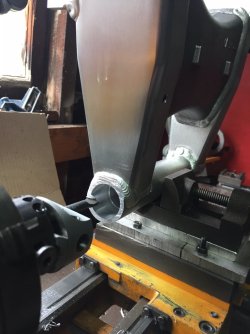
You'd be surprised at some of the crazy shize I've done on that little Emco! Think a Honda swingarm mounted in the cross slide and a boring head taking the bearing journal out to fit Laverda needle rollers. A picture is worth a thou....

Swinger machining.JPG
 
There are loads of Japanese donors for 41mm clamps, but I think the K series might all be 41.7 as per yours. The other issue I had when trying different Jap front ends was virtually every potential donor bike used very flat (shallow offset) clamps, which just didn't work at all with stock geometry (28-29 degrees of rake). I'd end up with huge trail figures - which is why I went down the cut-and-shut new head tube and angle path, with the added bonus of the longer, stronger head tube.

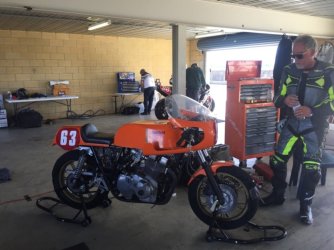
Hi Q. I used BMW K-series 41.7 mm forks and yokes on this bike. Memory a bit hazy now, so without going back through my notes I can't quote numbers. The BMW yokes do have less offset than the Laverda originals, but the front axle is a few mm forward of the fork centreline on the fork sliders, which offsets the flatter yokes to some extent. The difference in trail between the BMW front end and the original RGS was only a few mm. Not enough to notice. Handling was perfectly OK. It steered well and was stable at speed.

Suspension pre-load and ride height settings front and rear probably had more effect on trail than the minor difference in front end geometry. There was plenty of length in the forks to slide them up and down in the clamps. Also, I'd fitted a plate to the back end of the frame (visible in the photo) that allowed the upper shock mounting position to be varied so I could play around with the rear end spring rate and ride height, a bit like the moveable upper shock mount on old Velocettes. The shocks could be vertical, leaning forward or several positions in between.

63.jpg

Getting back to the OP's question. Sometimes the notchy steering on Laverdas can be caused by a non-circular bearing mounting cup on the frame. I reckon they must have turned the bearing cups to final dimensions then welded them to the steering head tube. The welds would sometimes pull the cup our of shape. I worked on a 3C that suffered that problem. It had always had notchy steering from new. It's top bearing mounting was quite oval. I forget the actual measurements but it was enough to push the bearing race out of shape. The long axis of the oval was fore-and-aft, so a couple of whacks with a lump hammer on the front of the bearing cup restored it to a much more circular shape. Steering was nice and smooth when the upper bearing was re-fitted.

I prefer to use a tapered roller bottom bearing with a ball top bearing. It makes adjustment easier (less sensitive) than with two tapered rollers.
 
Last edited:
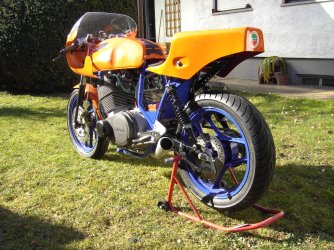
I took a slightly different approach to rear suspension adjustment, Cam.

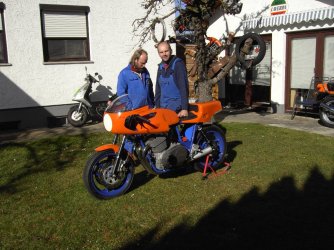
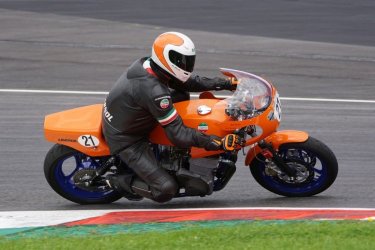
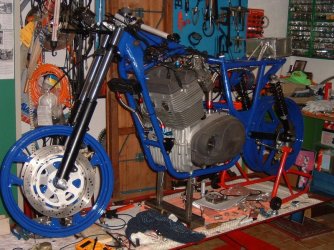
The whole bike was wildly experimental for Willi and me, we really didn't know where we were when building this beast. Living 500km from the workshop in which it was being built, I wanted some level of control over our mods in case we over-shoot certain limits. With Willi being almost 30kg heavier than me at the time of the build wasn't going to help make the bike equally suitable for both of us.

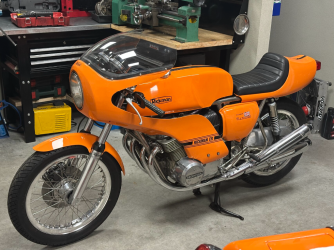
I too adapted the old Velocette method and simpified it a bit for our needs. Thin-walled U-channel with a threaded alloy block guided in the channel for quick and easy changes (please don't inspect the welds too closely... :rolleyes: ). Main goal was to lift the bike for more cornering clearance, the long Beemer forks certainly helped there. Frame is an old 180 type, engine mounts were modified to lift the crankcase 15mm at the underside mounts. Engine more-or-less needs to be tilted through the plane of the gearbox exit. Cam cover is only just removable with the engine bolted up! Engine is a re-phased RGS, quite a bit of drilling and threading necessary to adapt it to solid mounts.

The Beemer forks actually have a slightly trailing axle! Yoke offset isn't much different to the stock Laverda Marzocchi yokes, straight-line stabilty turned out excellent while handling is quite OK. I've only ever ridden the bike a couple of times at Spa Franchorchamps which is mainly fast bends, so can't really say how it behaves on a twisty Mickey Mouse circuit.

In reality, the suspension adjustment simply wasn't needed, the shocks have remained in the most forward position since Day One. Willi is a big guy and needs all the ground clearance he can get with the springs on full pre-load, he's ridden the bike on a number of different circuits and has always been happy with it. When I ride, I just reduce pre-load to suit my weight, works well.

piet
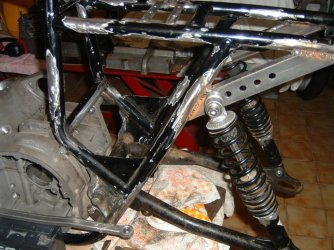
rear adjustment.jpgPiet and Willi.jpg2016RedBullRing-010b.jpg
 
I tried something similar but much simpler to see what effect I got from jacking up the rear. Most of my riding was on very tight and twisty roads. I made a steel block with 2 mounting holes as close as 2 alan heads could be placed. One through the std upper frame mount and the other through the upper shock mount, and I forget how I avounding any pivoting that might happen. It ended up raising the rear 25mm or a bit more. You couldn't go shorter without impeading those bolts. You can buy Icon shocks 15mm longer, but didnt want to do it before testing it. It did have an effect, quickening the steering, almost to making the bike twitchy. I didnt like it, so I have stayed with the std lenth of shocks, even now with that ability available in the top-level Nitrons now on the bike. Forks are 20mm through the trees. The bike steering quick enough for me and holds a line in the faster stuff just fine.
 
My mate Jürgen just sent me a bit of additional info regarding Beemer forks. He's done loads of research and has sucessfully fitted a set to his RGS, possibly the nicest-riding RGS I've ever had the pleasure to ride. ;)

Laverda yokes have 195mm stanchion centres, BM either 190 or 192mm. This will call for a bit of adjustment in regard to disc spacing, stock 3C/3CL/1200/RGS/SF2/3 spacing will need to be reduced as they only just clear the stock sliders. SFC1000 spacing may just work out, this is exactly 5mm narrower to clear the thicker M1R sliders! Speedo drive mount will also cause a couple of headaches with stock wheels, totally irrelevant for a track bike though.

Certain yokes were made by different manufacturers but carry the same part #s.

K75 and K100 have 41.3(!)mm stanchions, not the 41.5 I had remembered. These came either from Brembo or Fichtel & Sachs.

Bottom line; probably easier modifying a pair of 38mm Marzocchi yokes to accept the Beemer legs. After all, that's exactly what Marzocchi did for the M1R!

piet
 
I had a look to see if SKF made a set of green fork seals for BMW forks, but couldn't find any
 
What the fork's (pun intended) wrong with a simple bloody 41.0!!! I think I've heard 41.2, 41.3, 41.7!! I've got a nice pair of early VFR 41mm Showa forks, cartridges and bushed. I had them in the SF with the original narrowsih triple clamps and adapters for my 08 Goldlines, but I never managed to get the spring rate sorted (TBH, I didn't put in much effort!). With shimmed Beemer clamps and a decent spring rate they would probably make a nice conventional option for the SF.
 
I’m looking at Suzuki 1200 Bandit forks from my upcoming triple build.

43mm conventional forks in keeping with the original look, and from memory, 10mm longer than standard Marzocchi jobbies.
 
Think Rickman bros were the first to use thick stanchions back in 1966. These were 41,2 mm, or 1-5/8 inch. Here in my 1974 CR750.

Marnix
 

Attachments

  • IMG_5788.png
    IMG_5788.png
    1.4 MB · Views: 15
Think Rickman bros were the first to use thick stanchions back in 1966. These were 41,2 mm, or 1-5/8 inch. Here in my 1974 CR750.

Marnix
They certainly were pioneers in this field, went even larger later, 45, 48mm? I understand they worked closely with Betor/Spain for suspension development.

:unsure:Now there's a thought, maybe 41.7mm equates to some wierd imperial size.

piet
 
Piet,

These forks were Rickman’s own product as were the hubs, which they made accommodate the Lockheed disc brakes. The Lockheed brakes were a development in cooperation with Rickman bros.

In 1975 they started to mount Betor forks in combination with twin Lockheed disc brakes. These were always 38mm, in the CR750 and CR900/1000s that is.

Marnix
 
I'm starting to think the early Honda VFR forks at 41mm I have would be a good combo (sleeved to??? 41.2?!) with the Beemer triple clamps in a standard Laverda frame, retaining decent trail figures. I had the top off one of the forks the other day and they're nice cartridge units (non-adjustable). Length is pretty good. All they really needed was decent springs, but I abandoned them before i got that far. With the 08 Brembo adaptors they'd almost be a bolt on fit ... maybe some skimming to fit the Laverda hub and discs in.

Someone on FB Market platz offered me $80 for the pair of forks - what a forkin insult.
 
Back
Top