Rob3CL
New member
- Location
- Phillip Island
Hi All,
New to this, so hopefully I'm posting in the right place? If not, my apologies in advance. (Also still working out how to post images!!)
I started in March of 2025, the process of rebuilding my 1977 Laverda 1000.
Since then I’ve had the engine top end rebuilt and the frame straightened, wheels trued, new brake discs and brakes refurbished, and a zillion other little bits and pieces!!
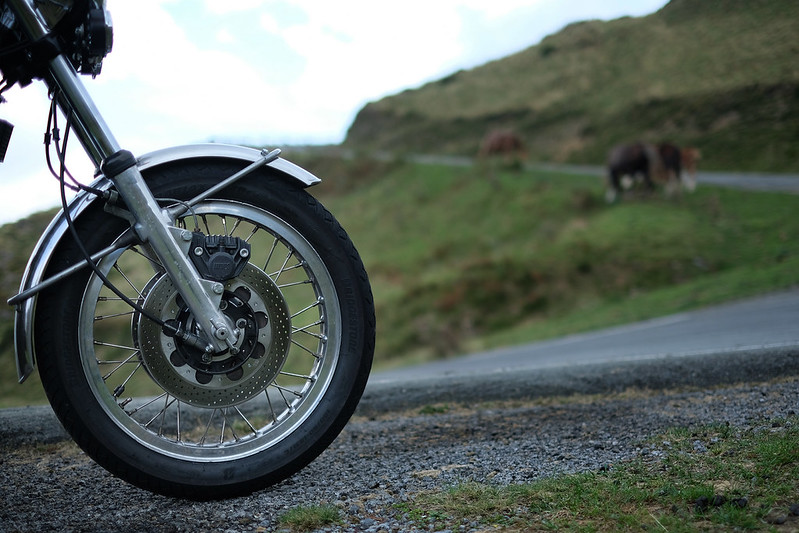
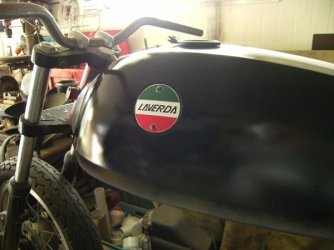
So, now it is getting time to consider the body work. First photo below is what the bike looks like now (May 2026).

Recently I started work on cleaning the inside of the fuel tank. It wasn’t particularly bad, just needed a bit of a clean out.
Initially I used white vinegar, left in for about 48 hours. Didn’t seem to do much.
Then I tried citric acid, worked a treat! (1 kg of citric acid dissolved in 20 litres of warm water, left for 48 hrs) The inside of the tank, that I could see, was nice and clean. Only problem was that this process revealed a small leak. Of course the leak was in a difficult position. (see photo 'Tank 8')

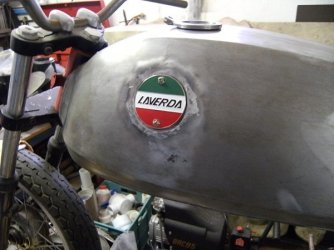
Yes, right beneath the top mounting screw for the lovely LAVERDA name badge!!
So, I’ve had to consider options and ‘bite the bullet’ and in the photo above you can see where I’ve partially drilled out the spot welds on this vertical mounting plate.
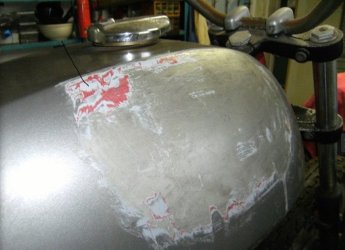
Once I’d prised this little bracket off, the tank looked like this…(photo 'Tank 7')

Yeah, not pretty but necessary, and clearly the top ‘little’ hole was a bit more substantial. Isn't it always!!
Now the task is to remake this area of the tank so the rusty bit can be removed. To do this I need to make a couple of metal shapes for a ‘press’ that replicates the badge area of the fuel tank.
Essentially there are 3 presses, with 2 pieces of metal to make each ‘press’. (I hope this makes sense, it did to me!)
Firstly, cut a circle (73mm dia) of 3mm thick aluminium…(refer photo Tank 6)

So this aluminium circle matches the Laverda badge, as shown in photo Tank 9.


Here you can see the 2 pieces of aluminium that make up, what I will call ‘press #1’
Next I need to make the other side of the press. This means I need a 78mm hole on a 3mm thick piece of aluminium. In this photo (Tank 5) I’ve already pressed the 2 pieces of aluminium together in my vice with a piece of 1.25mm piece of steel between.
Next step, gets me to this point. I have the circular indent into a piece of steel, where the LAVERDA badge sits rather nicely, just like on the original tank.

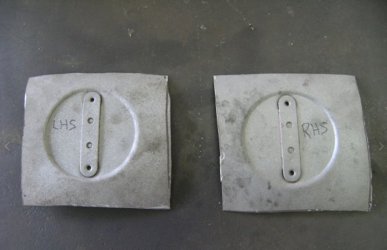
Now I need to make the vertical indent for the mounting bracket that I took from the tank. To do that I’ve made another pressing tool, shown on the right in the photo below. The darker coloured piece, on the far right, is made out of steel, as I wanted something a bit thicker than the surrounding 3mm aluminium. The steel bit is 5mm thick. This is ‘press #2’, both parts of it are shown below.

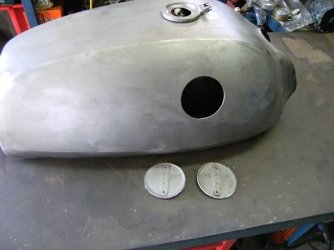
And below you can see all 3 pressing tools together with the nearly finished product in the bottom right of the photo.

All that remains is for this shaped piece of metal to be bent into the curvature that replicates the area of the tank where this repair needs to be welded into place. I’ll get onto that sometime soon, I need to source a MIG welder for this coming task!
New to this, so hopefully I'm posting in the right place? If not, my apologies in advance. (Also still working out how to post images!!)
I started in March of 2025, the process of rebuilding my 1977 Laverda 1000.
Since then I’ve had the engine top end rebuilt and the frame straightened, wheels trued, new brake discs and brakes refurbished, and a zillion other little bits and pieces!!
So, now it is getting time to consider the body work. First photo below is what the bike looks like now (May 2026).
Recently I started work on cleaning the inside of the fuel tank. It wasn’t particularly bad, just needed a bit of a clean out.
Initially I used white vinegar, left in for about 48 hours. Didn’t seem to do much.
Then I tried citric acid, worked a treat! (1 kg of citric acid dissolved in 20 litres of warm water, left for 48 hrs) The inside of the tank, that I could see, was nice and clean. Only problem was that this process revealed a small leak. Of course the leak was in a difficult position. (see photo 'Tank 8')
Yes, right beneath the top mounting screw for the lovely LAVERDA name badge!!
So, I’ve had to consider options and ‘bite the bullet’ and in the photo above you can see where I’ve partially drilled out the spot welds on this vertical mounting plate.
Once I’d prised this little bracket off, the tank looked like this…(photo 'Tank 7')
Yeah, not pretty but necessary, and clearly the top ‘little’ hole was a bit more substantial. Isn't it always!!
Now the task is to remake this area of the tank so the rusty bit can be removed. To do this I need to make a couple of metal shapes for a ‘press’ that replicates the badge area of the fuel tank.
Essentially there are 3 presses, with 2 pieces of metal to make each ‘press’. (I hope this makes sense, it did to me!)
Firstly, cut a circle (73mm dia) of 3mm thick aluminium…(refer photo Tank 6)
So this aluminium circle matches the Laverda badge, as shown in photo Tank 9.
Here you can see the 2 pieces of aluminium that make up, what I will call ‘press #1’
Next I need to make the other side of the press. This means I need a 78mm hole on a 3mm thick piece of aluminium. In this photo (Tank 5) I’ve already pressed the 2 pieces of aluminium together in my vice with a piece of 1.25mm piece of steel between.
Next step, gets me to this point. I have the circular indent into a piece of steel, where the LAVERDA badge sits rather nicely, just like on the original tank.
Now I need to make the vertical indent for the mounting bracket that I took from the tank. To do that I’ve made another pressing tool, shown on the right in the photo below. The darker coloured piece, on the far right, is made out of steel, as I wanted something a bit thicker than the surrounding 3mm aluminium. The steel bit is 5mm thick. This is ‘press #2’, both parts of it are shown below.
And below you can see all 3 pressing tools together with the nearly finished product in the bottom right of the photo.
All that remains is for this shaped piece of metal to be bent into the curvature that replicates the area of the tank where this repair needs to be welded into place. I’ll get onto that sometime soon, I need to source a MIG welder for this coming task!