3D Scanning

And billet more again I'd hazard a guess. Printing would cover parts that aren't subject to mechanical stresses, eg an ignition cover.

If you intend to manufacture a component using CNC machining, at this point it would be better to work with alloys from the 7000 series, such as 7075.

Exactly. 3D printing technology is still not advanced enough to manufacture components subjected to significant mechanical stress, such as a brake lever. On the other hand, it's perfect for covers and small caps, although I'm not sure how reliable it would be for a carburetor fuel cable entry cap.
 
If you intend to manufacture a component using CNC machining, at this point it would be better to work with alloys from the 7000 series, such as 7075.

Exactly. 3D printing technology is still not advanced enough to manufacture components subjected to significant mechanical stress, such as a brake lever. On the other hand, it's perfect for covers and small caps, although I'm not sure how reliable it would be for a carburetor fuel cable entry cap.
Just a question of what you're prepared to pay... aviation landing gear components, auto gear casings and brake calipers fall into the "stressed" catagory in my book.

Hot rod/engine swap guys are having complicated exhaust manifolds printed to their specs, easier and quicker than welding tiny segments together and risking throwing it all in the bin because one bend was wrong...

Even printable plastics are making giant leaps, increased tensile strength and temperature resistance allow truely functional components to be printed even with affordable DIY printers. I'm currently contemplating an upgrade from my current max of 280°C print temp to around 350°C in order to print stuff like CF-reinforced PPA nylon, withstands temps of up to 240°C before deformation begins. This stuff however is a far cry from the common PLA or PETG used for toys, etc which costs around €8-15/kg, PPA-CF comes in at €150+/kg.

piet
 
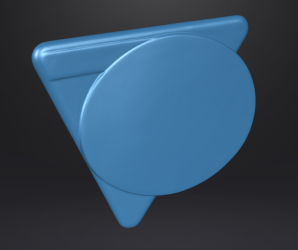
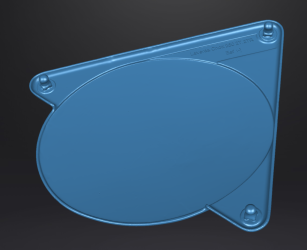
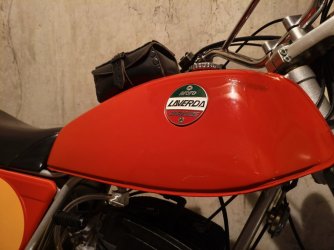
Scanned using an EinScan-Rigil (borrowed from a good friend).
Software: ExScan, Meshmixer, Netfabb.
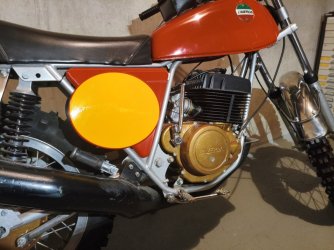
Printed: Nylon PA12 via a commercial printing service.
PLA on a Bambu printer.
Very happy to have a nice set of side panels again.
The old, original ones had become brittle and were full of cracks.

Eef

Schermafbeelding 2026-11-02 223045.pngSchermafbeelding 2026-11-02 223020.png
 
If you intend to manufacture a component using CNC machining, at this point it would be better to work with alloys from the 7000 series, such as 7075.

Exactly. 3D printing technology is still not advanced enough to manufacture components subjected to significant mechanical stress, such as a brake lever. On the other hand, it's perfect for covers and small caps, although I'm not sure how reliable it would be for a carburetor fuel cable entry cap.
You need to talk to Bugatti and tell them what they are doing is not gonna work. The brake calipers on the 3.3 million £ car have 3D printed brake calipers which see a huge amount of stress. They are eight piston calipers that are 3D printed from titanium.

We were told years ago that powdered metal parts were not strong enough to do anything. But my BMW R1200RT has 154,000 miles on powdered metal connecting rods.
 
Last edited:
Yes, exactly. It's important to distiguish between what is actually intended for large scale production and what is prototype development dressed up with fair amount of marketing.
At least, that's been the case up untill now. DMLS technologies, for sure, would have been untihinkable until just a few years ago.
 
choke lever should be possible in plastic, worth a try.
I'm working on getting one to put into CAD.

As a follow up to the Exhaust flange I fixed up the scan and had it quoted. They are about $35 ea. Not as shocking as I originally suspected. I used PCBWAY for the quote and they have a SHARE AND SELL option I inquired about.

Anyone have an idea how the cost compares to a machine version? I can make a STEP file available if someone is interested in perusing it further. The model represents the cast version and is rough as such. I have never had a metal 3D print made so I would like input about what post processing is required; would it be best to reduce diameters for final machining and will the flat face come out flat enough to not require any post processing?
1794003206268.png
 
Last edited:
@MotoV: If you've done things as well as I think you have, a light sanding of the contact surface should be enough. Services as JLCPCB have a CNC section also, so you can compare prices directly.
 
All this 3d printing, scanning and AI just blows my mind.
My working career as a model maker
started mid 70s and ending 2006.
For me, technology didn't start till mid 90s When CNC and related software arrived. Was fantastic.
3d printing an AI is at another level
Probably no longer qualified for the job thankfully.
 
Printed directly from a scan file;
View attachment 108952View attachment 108953
Rough print but dimensionally correct.

Also did the 500/MkII/120° ignition cover but forgot to photograph that before passing it on.

piet
Good morning Piet,

Looks good! I m looking for the right tools to do that.
What Kind of equipment you use for scaning? With your mobile or a 3D Scanner? Which App or Software?

Regards
Peter
 
...
3d printing an AI is at another level
Probably no longer qualified for the job thankfully.
Yep. In my case there's no probably about it.
Made a vain attempt to update my drafting skills back in 2018.
Passed the 6 month part-time course then gave up. Today the rate of change far outweighs my ability and/or motivation.
Now just want to change the oil, check fluids, tyres and ride... while one still can... :cool:
 
Peter,

The scan files came from a friend with the scanner, these were converted to .stp and then sliced and printed on a Prusa Mk4S. No idea what type of scanner was used, definitely not from a phone app.

Although the Mk4S is only about 2 years old, it's pretty dated by todays standards. It's a single colour machine without heated enclosure, for the price, one now can buy multi-colour enclosed printers that offer more versatility and better print results. Bamboo Lab has pretty much taken over the desktop 3D printer market, the competition is fierce.

As I am more focussed on making technical odds and sods with no need of multi-colour prints, the Mk4S will see me out for quite some time yet. It's a very sturdy machine that has been very reliable. I intially bought the Mk3 and then up-graded to the Mk4 and then Mk4S. End of the road though for this model type. The major restraining factor now is printing temperature, I cannot yet take advantage of the high-strength and temperature-resistant materials now available.

@Mark, after attaining my engineering degree in the early 1980s, the entire metal-working industry took a pretty fatal nose dive here in Germany, resulting in me never working a single day in my trained profession/s. CAD and CNC were just emerging at the time, but as I was being distracted by other joys in life, I never found real interest in the technologies at the time and having one-offs or small runs made by CNC was still horrendously expensive. 3D printing fascinated me from the beginning, I eventually bought my first Prusa machine in 2020 and then inevitably got stuck into CAD. While seeming quite daunting initially, I had learnt drafting on paper with pencil and t-square, it turned out to be far easier than I had feared. I've advanced from simple brackets and spacers to working components of my own design for my bikes and cars as well as throughout our household. Lots of inspiration to be found online, the own imagination is the sole boundary!

Being able to design stuff yourself and supplying your favourite local CNC guy with a digital file makes one-off components quite affordable. I recently designed footrest/exhaust hangers for a friends Barcelona replica and recieved a quote of around €50/piece to have them laser-cut from 6061 alloy, half that when commissioning 2 sets. For that price, I'm not even going to unpack, or even start searching for the jigsaw to start cutting...:rolleyes: Turning up with a rough sketch on the back of a fag pack is what makes CNC expensive, lots of costly time goes into designing and programming, material costs are usually quite minimal in comparison. Working from a template and basic dimensions, design of the hangers, as well as the revision after I decided I had over-done the weight saving, took about 30 minutes using Fusion 360. Printed out a sample costing about 25 cents, sent it to the friend 150km away and recieved the OK to go ahead 2 days later.

@Rob, with your modelling background, CAD and 3D printing would be an ideal supplement to your skill set, especially so that it has now become so affordable. A word of warning though, it is highly addictive!

Never too old to learn...;)

piet
 
@ MotoV
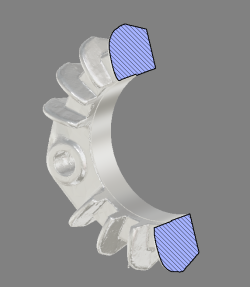
I would like input about what post processing is required; would it be best to reduce diameters for final machining and will the flat face come out flat enough to not require any post processing?
Nope no need , this is a nice example of a part where only printing is effective , machining of 3D parts is more in parts like fuel systems where you need smooth surfaces that are for sealings or so.

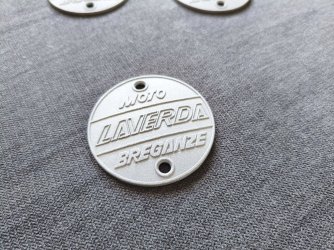
Here is an example of an aluminum print ( sorry no scan ) it was a real cheap printing service and i also made the mistake to not specify an orientation. Was just a fun experiment , conclusion it need some more attention in the printing process to make it good enough.
But it shows you what to expect from it.

At the underside of the letters there are some rough particles melted to the letter , this is an orientation problem in the print process.
But it is 100% logic they choose the orientation like this because standing up right creates a lot more platform space , so more prints in one batch.
Asking for a flat print would probably increase the costs.

IMG_20260617_172941.jpg
 
Last edited:
Back
Top