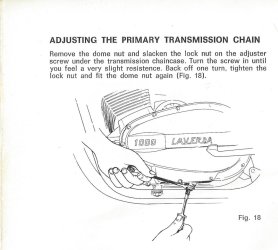
1000 Primary chain alignment.

If I understand you correctly you need to move the crank sprocket INBOARD - so yes, you can machine it (and can always shim it out again) - but it seems a little odd that it's too far out in the first place.
 
If I understand you correctly you need to move the crank sprocket INBOARD - so yes, you can machine it (and can always shim it out again) - but it seems a little odd that it's too far out in the first place.
More than a little odd.
I'd take that whole engine to bits if there's that sort of problem on something as simple as the primary drive.
Give it to a competent Laverda mechanic and in two years, minus £ 5000, you'll have a decent engine.
Then you'll need carbs, ignition, brakes and so on.

Paul
 
If I understand you correctly you need to move the crank sprocket INBOARD - so yes, you can machine it (and can always shim it out again) - but it seems a little odd that it's too far out in the first place.
I'd place a bet on an incorrectly assembled/fitted crankshaft.

The half-ring locating the RH ball bearing, which ultimately locates the entire crank, allows a good 0.5mm of axial movement of the crank upon assembly. In rare cases, a shim (usually in the 0.2-0.4mm range) can be found under the RH main bearing. This is necessary if the RH crank pin length is at the upper tolerance limit or big-end axial clearance is set too close. Without the shim, the bearing outer race will rub on the end of the crank pin. If the crank has been apart and big-end axial clearance has been set at maximum, or beyond, the LH journal will be pushed out a further 0.3-0.5mm. Not unusual to find excessive big-end axial clearance, for whatever reason.

Correctly assembled, the crank sprocket might require a 0.5mm shim to locate it outwards and get the chain run in line. This has been necessary for about 30% of the cranks/engines I've built.

If there were any lube issues with the stock thrust washers there may have been holes or scallops ex-factory... but there weren't. No need to re-invent the wheel.

piet
 
Shims have arrived and I have 1.5mm on the inside and 0.5mm on the out side, with 0.1mm float. To get the primary chain aligned I have taken 0.5mm off of the crankshaft sprocket. If I ever need to put it back on! i will just add a shim.

When putting the cover back on I noticed someone had drilled a hole in the case webbing to allow oil to the gearbox shaft needle roller. So oil flow to these needle bearings must have been a concern for some one else.

I have just screwed the primary chain in until I can just feel it is getting tight against the chain.
 
The shims have arrived and I have fitted 1.5mm on the inside and 0.5mm on the outside, leaving a 0.1mm gap. To get the chain aligned I have removed 0.5mm from the primary socket face. If I need to move it back out I will just add a shim.

Someone also had a concern about the oil supply as the cover had a hole drilled into the webbing supporting the bearing to allow to flow.
 
You are taking some risk putting the engine into service like that. As has been pointed out by people who really do know, the crankshaft is not correctly fitted if it is too far to the right, and it might not even be positively located. It is your choice but I would definitely find some way of monitoring movement of the crankshaft.
My twin came new with an oil hole to the needle roller in the side cover.
 
The shims have arrived and I have fitted 1.5mm on the inside and 0.5mm on the outside, leaving a 0.1mm gap. To get the chain aligned I have removed 0.5mm from the primary socket face. If I need to move it back out I will just add a shim.

Someone also had a concern about the oil supply as the cover had a hole drilled into the webbing supporting the bearing to allow to flow.
The concern about oiling the needle bearing was the builder's, since the hole was drilled in Breganze.
It would have been even better had the builder worried about the cooling and oiling of the clutch, since there's a few problems there.
Paul
 
Back
Top