1969 750 Timng Issues

MotoJouni said:
.Have you guys tried to buy contact brakers and condersers from Bosch shop with the Bosch numbers? I wasn't able to found the numbers at the moment, but I do have them somewhere.

Yes.
Bosch no longer supply points.
Haven't done so for years.

Condensors aren't an issue.


Paul
 
sfcpiet said:
The point is, Paul, checking/adjusting ignition contact points should be a 3-5 minute affair using a feeler guage, screwdriver and strobe light, not something that consumes an entire afternoon and requiring files...

Of course an engine can do many, many miles with a bodged and clapped-out ignition system.  The question is, how well can it do them, what sort of performance can be expected?  And how much maintenance does it require to keep it from expiring?

The only times I've had to adjust the timing of my DMC-equipped GTL were when I fitted the system and every time the primary chain has required renewal.  I don't regard that as a silly idea at all.

Quite OK with me if you choose to retain your clunker in the ignition stone age, perhaps you should re-fit your old carbs to suit.  Just saying... :D

piet

Once filed, filed for life.  :)

Maintenance apart from oil is once yearly, so every 7-8000 km. Last check of timing beggining of September 2017 revealed that it hadn't budged since last setup in August 2016.

Points changed twice in 100 000 km.

Performance isn't an issue.
Next weekend will be spent slipping and sliding on small country roads where smooth pick up from 1000 RPM is a lot more relevant that top end whack.


Paul
 
Paul Marx said:
Once filed, filed for life.  :)

Maintenance apart from oil is once yearly, so every 7-8000 km. Last check of timing beggining of September 2017 revealed that it hadn't budged since last setup in August 2016.

Points changed twice in 100 000 km.

Performance isn't an issue.
Next weekend will be spent slipping and sliding on small country roads where smooth pick up from 1000 RPM is a lot more relevant that top end whack.


Paul

Yes Paul, but that's just you! 
By loading the engine to only 50-60%, you can get away with a spark occurring almost anywhere.  Possibly, the reason you have needed to elongate the adjusting slots is beacause the points themselves are truely knackered.  ::)

With others, performance IS an issue.  More 750 Lavs have died of slipped/incorrect ignition at WOT than from any other cause.  Leaky induction systems come a close second... quite often, a combination of both. 

Car makers in the 1970s generally specified points and spark plug renewal every 15000km.  The cars I serviced in the late '70s-early '80s (a cross-section of what was on german roads at the time) always showed a noticable improvement after servicing.  Points do not only wear at the tungsten tips, the slipper heel and the supporting bush or axle wear as well. Generally, MC systems lead a harder life due to the higher revs involved.  I see absolutely no reason why motorcycle points ignition systems should be any better... be they from Bosch, Lucas, Denso, CEV, Marelli or whoever! 

Many say oil is cheaper than engines, I say new points are cheaper than pistons.  Considering their rarity and cost these days (next to the overall condition of the remaining ignition hardware), the easy way out is to do away with them completely.  A new electronic ignition system is still a fair bit cheaper than a pair of pistons and a re-bore.

I'm not delving any further into this topic, some people need to learn the hard way. :D

piet
 
Japanese bikes went to elec ign systems in the late 70s, almost universally, all makes, all models - I don't recall them becoming infamous for leaving people stranded on the side of the road. I adapted a Suzuki GS trigger and pickup and its ND ingiter box for my SF (fitted to the original Bosch adv-retard flange) in about 1979 and it ran faultlessly from that day on. It was very nice knowing it didn't change with time. Pull off the primary cover and have it back on in a jiffy without having to go through the rigmarole of points gaps and two separate timing plates was bliss. 

I'm going to tunable curve Ignitech now, but I'm not predicting doom.
 
Well, if you want to keep it simple and retain nearly all of your existing ignition system, there are at leat two points replacement modules available. They're actually for cars but can easily be adapted to a bike setup.
I've used both Pertronix and Accuspark modules on a variety of bikes. Two modules for a 180 degree twin, triple or four. One with a twin lead coil for a 360 degree twin. Space would be a problem with a 120 deg triple.
Both brands are simply magnetic switches using a rotor with magnets inside. I open the rotor and remove unneeded magnets to suit the application. The rotor fits where the points cam went and uses the same advance mechanism.
 
A couple of questions before I establish the error by resetting the discs to the centre of the slots and establishing the timing error.
the situation and start inspecting the gears etc.
Can I establish the crank / 22 tooth pinion marks without removing what I suppose is the 'Jesus' nut?  In order to remove this nut
I used to have a 4-5 mm piece of steel plate that jammed the primary drive sprockets.  I gave it away so need to make another, does anyone have the dimensions?
Is it essential to drain the sump before removing the primary drive cover? 
The crank rotates CCW when viewed from the ignition side.  Therefore the 44-tooth gear rotates CW so to move it one tooth clockwise will advance the timing.
 
Don?t use the plate between the sprockets idea, just go out and buy a rattle gun and deep socket. I have used the plate, in aluminium, radiussed to sit in the wells between the teeth and still snapped teeth off the extremely brittle clutch sprocket, not worth the risk.
Yes you can pull out your oil pump drive shaft without removing the crank end nut. The opening/slot in the oil pump faces straight back, and the keyway and drive pin on the oil pump drive shaft face the same way on my bikes ( I once heard of one where they were 180deg apart). With the keyway facing at 3 o?clock (straight back) you should be able to slide the drive shaft out of the oil pump. Be careful, don?t force it, you may need to rock the crank a bit to get it properly aligned. You can then rotate the crank one tooth in your desired direction, keeping a clear head for the reversed direction of drive etc. You have certainly opened up the worm can with a points posting, Simon.
 
there is/was a special tool for locking the crankshaft on the twins, (its different to the triples)  mine is long gone due to an extended loan/house move/bike disposal/loss of contact/memory failure etc ( I don't do tool loans any more with very very few exceptions). I would dearly love to buy an original factory tool for this purpose, but surely there are enough 750 users out there with similar needs, to warrant the manufacture of a batch of replica's, say 20/25 or so, I might even help with the investment to set that up.

Many are using the jammed sprockets method, either a flat bar or two 10mm rods under the teeth, whatever, this method does cause damage on a regular basis, so please don't! and rag under the teeth !!! you will never get the nut tight enough, those crank splines are precious and so are the clutch drums, and again they are different although similar looking to the triples.

CLEM
 
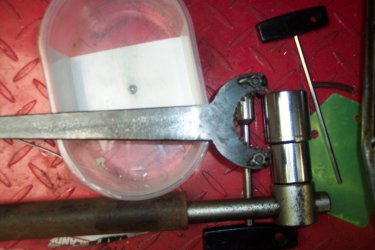
You mean this one Clem - I've welded a couple of nuts to the back of it so that it can't semi slip off the cog! - Regards - Phil
 

Attachments

  • 100_1746.JPG
    100_1746.JPG
    144.2 KB · Views: 72
The green bible states on p72 that if the engine is in the frame you can engage 5th gear and press on the rear brake pedal to hold the crank.  Has anyone succeeded using this method.
Otherwise, if moving the 44-tooth oil pump will allow me to correct the timing this is what I shall do.
 
The green bible states on p72 that if the engine is in the frame you can engage 5th gear and press on the rear brake pedal to hold the crank.  Has anyone succeeded using this method. 

have found a few loose nuts that don't need any engine locking - but I do prefer to use the Laverda locking tool or an air wrench - Regards - Phil
 
69 and 70 Triumph's came with Magnetic Diodes - You did not need a Battery to run the bike; however, a battery in the circuit was nice if you had an electric starter.

Nice racing setup - Saving the weight of a battery and starter.

As far as timing goes - Follow the instructions and after that fine tune by ear and that include carb adjustments and jetting.

Just because an engine starts and idles (1st Step) doesn't mean the mill will produce power at Hi-Rev's under load without disintegrating.

I've found Breganzies have an inherent rich stand off idle and you do not want to lean them out on the top end.

Set the timing accordingly to match the carb and exhaust you are using.

I love doing this shit and ride them like Hell listening and feeling what they can do.

I don't care if you own a 2 or 3cyl Breganzie you need a handful of Carb-Jets to enjoy her - Triumh's, Nortons, Ducata's, Guzzies... etc are all the same.

The trick is having the engine do both within reason without destroying a strong engine ;o)

You will find yourself going faster and faster until your nerve gives into your mount and then both are happy.

I often considered putting a Mag-Diode System on my SF to save 35 lbs and go faster but gotta love that one finger instant startup - Besides my SF "WAS" a PIG to run an jump on - 69 Bonnies do it easy.

  ---------------------------------------------------------------------------

PS:

One other thing - I don't think Triumph made 750 Bonnies before 1973 or I would have bought one over a 70 Laverda 750SF as I already had a 69 650 Bonnie.

In 70 both Breganzie and Norton promoted 750's - Triumph did not.

In 73 Triumph introduced their 750 Bonnie and Trident - Norton their 850 Interstate and Breganzie introduced their 1000CC 3 Cly  BREV Drum Brake while Kawasaki sold 4 Cylinder 900's for less then half the price.

By then it was too late for European bikes to compete, price wise, against the Japanese.

It took the Suzuki GSX 1100 to shoot down the Laverda 1000 some 8 years later in 79.

I owned an 84 1100 GSX-F - Sold it when I got married and the last bike I sold was my SF ;o(


Just to add my voice to the crowd ... Please don't lock the primary drive by blocking the chain/sprockets with a piece of plate or anything else. You're likely to break a tooth off a sprocket or overload part of the chain.

Putting it in 5th gear and locking the drive with the rear brake also puts high loads on the primary chain and the rest of the drive system all the way through to the rear sprocket and brake components. I doubt it would work very well anyway, so that's a bad idea to my mind too. The factory locking tool is like hens' teeth so you're unlikely to ever come across one for sale. The best option is to use a rattle gun (impact wrench). That's also the kindest option to your engine and drive system. You don't need to lock the drive at all.

If you already have a compressor, an air-powered rattler isn't particularly expensive. If you don't have a compressor, you can buy an electric rattle gun for similar money. A cheap impact wrench can be had for as little as ?50. A professional mechanic who uses it every day would want to spend a bit more on a high quality tool, but a cheap tool is fine for occasional home use.

A ?50 outlay is cheaper than replacing a busted primary drive, and you'll have a tool that you can use for other things like the wheel nuts on your car, stubborn rusty threads, etc.

Even if you manage to find a factory locking tool for sale, I doubt you'd get it for less than the coast of an impact wrench (considering its rarity). And it's only good for one job.
 
Just to add to the chorus: when I took delivery of my Mirage from the UK I found four broken teeth in the primary case :o :o ... just sayin'.
 
Your Mirage obviously had a bit of biff with another bike :o :o... just sayin' ;)
 
Back
Top