1971 SF a couple of questions please - Updated

Piranha Brother 2 said:
Shouldn't be necessary. Once back to bare metal I'd be surprised if you get any rust there. Mine never had paint there by the time I bought it in 1974 and still haven't rusted after 47 years of use and non use.

Well mine rusts.
Maybe you haven't converted to a water engine yet.

Paul
 
Takes a few years to understand a Breganzie SF 750 Twin - 1st off all if she doesn't kill you at first your off to a good start, providing you know how to start her.

They don't don't particularly handle well at low speeds and if you over size the tires your in worst shape. 120 rear & 100 front Max.

Anything between 60 to 120 mph is an other story ;o)
 
Dellortoman said:
WTF is a self-tightening nut? I've heard of self-locking, but not self-tightening. Are spanners now obsolete?

Bad phrase, more like a nyloc,they are designed for manifolds, friggin engineers honestly, :D.
 
Kickback said:
Is there a comprehensive torque value guide?

Ex-factory, you mean?  I stand to be corrected; but not to my knowledge.

The later RGS workshop manual has a few, but there was nothing of that ilk for the 750s.  I don't think there was even a workshop manual, as such, for the 750s, just a "Uso e manutenzione" (Operation and maintenance) booklet handed out to the owner, sometimes with a parts list, sometimes not.

Different era, I guess.  Maybe spanner twiddlers were expected to have the feel in their fingers; or maybe torque wrenches weren't so common.  I can certainly remember that they weren't cheap, even into the 1980s - no Chinese producers then  :-X.

And it was common at the time for mechanics to supply/buy their own tools.  Anyone else remember the visits of the Snap-On man and his van?
 
Ventodue said:
  Anyone else remember the visits of the Snap-On man and his van?

Our local Snap on man tried to kill himself, took over the business, which is a massive outlay, similar to buying a unit :o
He couldn't make it work, so thought to end it.However he failed at that too, not a good outcome.
I love snap on tools but there business model is doubtful
 
I think worrying about torque settings for an SF exhaust manifold clamp is an unnecessary burden. Modern bicycles with carbon fibre tubes and seatposts etc ... that's when it can be critical and low torque values are essential (like 5-8nm).
 
LJ-2 said:
Bad phrase, more like a nyloc,they are designed for manifolds, friggin engineers honestly, :D.

Nyloc nuts are not designed for manifolds. They're actually worse than ordinary steel nuts in that application because the heat will melt the plastic insert and make a mess.

The trouble with exhaust manifold nuts is not so much them coming undone, but the damn things galling on the threads with the repeated heat cycles, and they end up being a bastard to get off. It's advisable to choose a nut that wont stick itself to the stud. Copper nuts are very often used for that reason.
 
Dellortoman said:
It's advisable to choose a nut that wont stick itself to the stud. Copper nuts are very often used for that reason.

Or brass ones - what the factory put on my SF1, as mentioned above. I bought some more M8 brass nuts from Bunnings even. I've never had an exhaust nut come loose, ever.
 
Just a quick update....

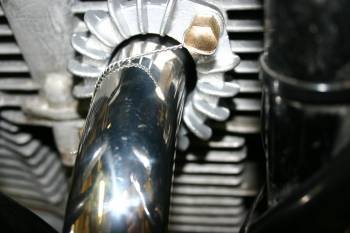
The M7 'self locking' manifold nuts I had fitted were not actually copper but steel with a copper coating to prevent corrosion, they are all-metal with no plastic insert for obvious reasons. The self locking action is provided by the thread having a deformable section (over-rounded or over-squared thread profile) that effectively jams on the stud and locks. They are easy to confuse with an identical looking standard flange nut that has a normal thread. Ideally they should be single use unless the maker says otherwise. I've just bought a pack from my local BMW dealer for ?0.67p each which makes it the cheapest purchase I've ever made from BMW!  :)  (part number 11 72 1 437 202).

Snapping old fastenings or pulling studs out of old heads is all too easy, I'm cautious and do like to do do stuff by the book if I can, in the absence of any Torque charts being available I've found several sources quoting M7 manifold nut settings at between 6-11 ft Lb (8 -15 Nm) which gives me a clue to not get carried away.

Out of interest I've spoken with a specialist workshop here in the UK about Titanium M7 nuts, having told them that M7 self-lockers are used on lots of BMW manifolds (M54, M52, S54 etc) as well as our bikes, they are going to knock up a batch of 100 x M7 Aero Grade 5 Ti, flanged, self locking nuts with an 8 - 10 week lead time. I'll post as and when they have them available in case anybody is interested, I don't think they will be outrageously expensive. 
 
this is what I do, a bit of extra cooling (maybe) and the threads are like new when you do want to see them, the lockwire fitted after about three heat cycles and a nip up each time ensures that you never lose (loose) the things, very inconvenient when 500 miles from home and in a different country. OK so yours is a twin, same difference.
CLEM
 

Attachments

  • shrunk exhaust nuts.jpg
    shrunk exhaust nuts.jpg
    13.5 KB · Views: 151
The small valve heads had M7 - all later (SF1/2/3) had M8 - similar deal with the inlet manifolds IIRC. the factory must have upped the size for a pretty good reason.
 
Dellortoman said:
Probably because 8mm nuts are easier to find. It's a pity they didn't use M8 studs on the triples.

7mm threads are used to fix hen's dentures in place.
Easy to up the size on the SF head - is there an extra half mm to spare on the triples?? M7 threads in SF sidecovers - BAD idea!!
 
Back
Top