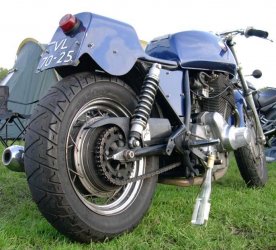
3C spoked wheel

Dellortoman said:
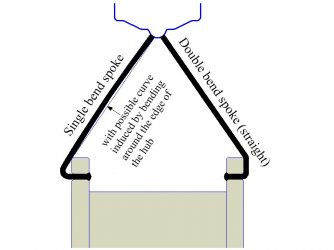
Incidentally, I had a look at my broither's re-spoked rear wheel on his 3C today (first time I'd seen it since I started this thread). It's a very neat job. The bloke who made the spokes put a double bend in the outer spokes. The first bend is the elbow bit where it goes through the (axial direction) hole in the brake drum. The second bend is to accommodate the curve the spoke has to make around the outer edge of the brake drum flange to achieve the correct angle to meet the centre of the rim. The original Laverda spokes didn't have this pre-bend in them, so they had to bend around the edge of the hub under their normal operating tension, which would have caused a point load on each outer spoke. It seems to me that the spokes will have an easier life if any bends they need are pre-formed rather than forced on them by wheel geometry.

?

For a spoke to be able to be strained to its limit it needs to be as straight as possible.  The only bend should be at the hub, in the case of "normal" bent spokes.  From this bend, the spoke should go straight to the point where it enters the rim, without the bore of the rim forcing the spoke to take another bend.  Any bend between these 2 points will prevent the spoke from carrying its weight, a pre-determined fail point.

Real life might let you get away with this sort of bodge through excessive spoke guage or extremely short spokes, but in no way is it correct engineering practise!  And not particularly clever either... ::)

piet
 
Is it any worse than the spoke being forced to bend around the flange on the brake hub?
That is a bend AND a hard contact point on the 3C rear wheel.
 
I'd say it is worse.

If the spoke is bent around the hub flange and makes contact along the way, it will continue on straight to the rim, the bend cannot straighten itself and the spoke will hold its' tension.

If the spoke has a kink/bend half-way up, it will attempt to straighten, losing tension.  Simple really...

Reality lets us get away with it, doesn't make it any better though.

piet
 
I disagree Piet.

There are two possible problems:

1. When a spoke is bent around an obstruction (the obstruction being the edge of the flange on the drum hub) then it will take up a curved shape, like a bow. Think about beam deflection - it's no different to a beam supported at the ends with a point load somewhere along its length. A bending moment is induced which is highest at the point of the load, and reduces towards the ends. So while the bend will be greatest where the load is applied, the entire length will actually be affected. Any curvature induced into the spoke will allow the rim to move in relation to the hub as cyclic radial loads on the wheel will pull the spoke straighter and let it spring back to its curved shape.

2. If the spoke is built with enough length in the "hook" end so that the main shaft of the spoke will clear the edge of the drum flange, then it will be able to flex in the short "cantilevered" portion between the hole in the hub and the bend in the spoke. I suspect this is how my brother's bike came from the factory because it had a history of spoke fatigue failures of at the bend.

Both of the above scenarios (or a combination of them) are poor engineering. The only sensible way to accommodate the geometry of the Laverda drum brake spoke flange is to pre-form a double bend in the spoke. Pre-forming the required shape with two bends allows the spoke to lie straight along the hub flange, and also have a straight run from the edge of the flange to the rim. A much more solid arrangement with lower residual stresses on the spoke (no bending moment) and no possibility of flexing at either bend.

The somewhat exaggerated sketch below better illustrates what I'm trying to say (obviously not to scale).

Cheers,
Cam
 

Attachments

  • 3C spoke.jpg
    3C spoke.jpg
    51 KB · Views: 27
So what about my question on evening up the stresses with a spoke toque wrench,finding the general toque value on most of the spokes and setting them all even without distorting the rim.There might be different amounts of friction between the rim and nipple so I thought a tiny splash of WD would help this.Good idea or crazy waste of time.I have lots of difference in tap of the spoke tones.
 
Cam,

Your sketch is very different from what I understood from your description.  It is in fact, just a pre-bent version of what is generally fitted, the spoke is in contact with, and bows around the hub flange and continues from there in a straight line to the rim nipple.

The scenario often found in spoked wheels isn't ideal, but, as I already stated, reality lets us get away with it.

piet
 
While there's no doubt a physics-based correlation b/w moto and bicycle spoked wheels, the flexibility inherent in bicycle rims make them very different in terms of spoke dynamics (but modern high-end bicycle wheels have super-rigid rims relative to older type conventional wheels - and they require far fewer spokes as a result).

A moto rim is a very rigid construct and spoke tension will only offer lateral adjustment of out-of-true to a far lesser degree than is poss with a bicycle wheel. Tension meters work on bicycle wheels because they have considerable built-in flex (that can be quantified relatively easily). A torque wrench on spoke nipples (even on bicycle wheels) will never produce a good result as there are too many other factors at play. Ideally, you start with a straight rim, apply even numbers of turns to nipples on each side and should have the basics of a laterally and radially true wheel. From there you simply add tension until you 'feel' you have applied sufficient tension to produce a strong wheel while not putting excessive stress on nipple threads and rim-to-nipple junctures.

QF
 
Back
Top