G'day Scrumpy.
Very interesting and erudite analysis there.

I'm not sure I agree with your conclusion though. I remember a bit of materials science from my engineering studies, but I'm not a metallurgist so I could be talking through my arse. In fact it's quite likely... ???
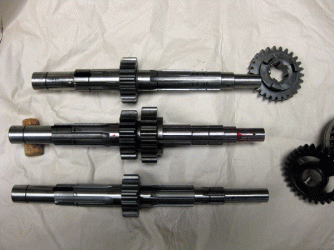
The inner edge of the oilway drilling is a sharp edge as you say, but that shouldn't be a stress raiser. When you look at it in section (which is exactly the view shown in the photo) that sharp edge is an external corner. It's generally only internal corners (or notches) that cause stress concentrations. The oil hole itself will be a stress concentrator, but not the edges of the hole.
Also, it looks lake a sudden failure to me, not a fatigue crack that's propogated slowly then let go. Fatigue cracks typically show as a smoothish fracture surface with concentric rings emanating from the starting point, a bit like the growth rings in a tree, or the ripples when you chuck a rock into a pond. The crack propogates a wee bit further with each stress cycle, creating the rings. When it gets to a point where the part can no longer carry the load, the remaining portion will break suddenly and show a rough "crystalline" surface. The fracture surface in Rob's shaft appears to be evenly rough looking, indicating a sudden failure.
Even though I don't think it's fatigue cracking, the failure mode can still be one that's developed slowly over time, such as work hardening that's caused the shaft to become more brittle over time. As it gets more brittle, it becomes less able to handle shock loads. It'll eventually get a shock that'll snap it like a carrot.
Not that any of this theory and conjecture makes any difference in the real world. The fact remains that the part wasn't strong enough and it fell apart. It needs to be made stronger somehow. It might be better to have several smaller diameter oilways instead of one big one if that's possible.
Cheers,
Cam



 (I'm certain you don't do that, Rob.... but worth a check how the chain tension changes through the full range of suspension travel. Your Wilbers(?) units will most probably offer more travel than the stock units, and if they are longer, the chain needs to be adjusted accordingly)