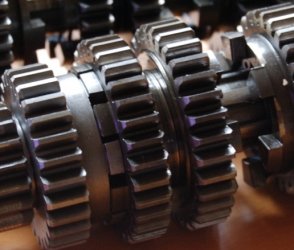
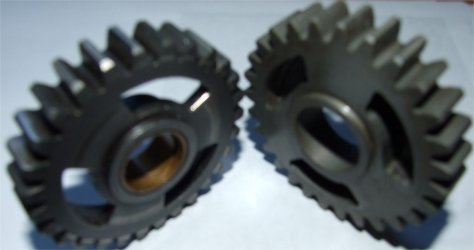
4th Gear Problems, Options

Thought I'd give an update on this project.

Currently have the metal blanks which Im turning for the Gear cutter to then machine the teeth onto, no problems there.
After examining the dog slots x 3 stamped into the side of the gear, these are a law unto themselves and possibly why they are stamped out as Piet kindly informed.

Keiths Photo below
index.php


The mating faces, ie slot to dog, driving and overrun, are angled, somewhere around 7 degrees. Thought I'd mention this as I've not seen it on Japanese gears, thats why those cheaper made driving dogs  wear and then slip as they are pushed apart. The inverse? taper on the laverda dogs pull the gears together (I've seen it, just not in this situation). As I want to make the gear solid, ie the holes will be blind, its not so easy to hand work the slots but should keep me busy over xmas. ha.!

Laverda Clearly recognised this and went a whole lot further and made the job quite difficult for me  :D  Just another inbuilt quality you probably hadn't noticed, when polishing your beast !

Rob
 
Rob, Most modern gear engagement dogs are undercut, especially on sportsbikes. There is an optimum figure for the angle in Phil Irving's Tuning for Speed, I can't remember what it was but I think it was less than the 7 degrees you mention, 4 degrees rings a bell but I might be wrong. Laverda may have done things their own way of course.
I haven't got any experience of the triple gearbox but on the 500s the gears are beautifully undercut which no doubt contributes to the slick change. I think Phil used to modify his gears with an undercut.
I presume you want to leave the holes blind in order to keep some strength in the cog?
I wonder if the originals were broached...
 
Bob
I'm clearly demonstrating my lack of knowledge in this area, I certainly haven't seen it on the Japanese boxes that I've destroyed had problems with in the past but then perhaps its was there and I didnt notice it.

Yes, the blind hole is a result of wanting to keep the gear solid or at worst a small relief in the opposite side.

The following I found in relation to a Kawasaki triple site:

Back cutting the dogs
Back cutting the dogs is a popular modification, not just on our triples but on all types of transmissions. Here's why:

On a stock, new condition setup, the flat faces of the dogs are carrying all of the load which propels your motorcycle. If you release the clutch and give it gas before the dogs have fully engaged, the powerful forces from your Kawasaki Triple are being supported by tiny areas on tips of the dogs, and under the right conditions the dogs can slip. This may round off the tips of the dogs, and put a huge side load on the shift forks and the shift drum. This can burn/gall the shift forks and slider gear grooves, bend shift forks, or even break the shift drum. There are all degrees of this, but once the dogs become rounded, it takes more engagement to support the load. Unfortunately, due to poor shimming many bikes have shallow engagement. Re shimming and careful shifting techniques will help, but back cutting is even better insurance.

Back cutting involves milling an angle on the dogs, so that once they engage, even if not fully, the torque will pull the gears together, assuring that the trans will not slip out of gear. This is a precision process requiring special tooling. Some of the case hardening is removed, but if done properly material removal is minimal on the ends of the dogs where it counts the most. First gear is the most difficult to back cut, and since 1st isn't notorious for problems as much as the other gears, many times only the other gears are cut.

http://kawtriple.com/mraxl/tips/undercut/undercut.htm
Kawasaki Gears
undercut.jpg
 
Rob , Here's a pic of the close ratio cluster I fitted to my Atlas motor. These are original Laverda gears from an F500. Unfortunately it's not as clear as the pic of the Kwak but you should be able to see that the dogs, unlike the Kwak, are undercut on the driven and non driven faces, presumably to prevent it jumping out of gear on the overun under heavy downchanges? You will also notice that the angle of the chamfer is much shallower.

If you think about it logically it doesn't need to have an aggressive chamfer, once you've gone beyond parallel even a shallow undercut is naturally going to bring the dogs together. There's also an argument to suggest that you would get a higher level of surface contact very quickly with a shallow cut. I'm no expert on this and so this is merely conjecture on my part .
Interesting stuff though and you're a braver man than I to tackle the machining yourself, big respect for that :D
 

Attachments

  • Undercut dogs.jpg
    Undercut dogs.jpg
    179 KB · Views: 20
Interesting topic.

I'd be cautious about making the undercut too steep because it makes the root of the male dog thinner (as you can see on that Kawasaki gear), especially if you do both sides of the dog as Bob suggests to stop it jumping out of gear on the overrun. Also, a sharper undercut will produce a higher stress concentration at the root, and possibly increase the risk of the dogs snapping off. It could solve one problem and create another if you weaken the dogs too much.

Now expecting a litany of puns about snapping dogs rooting each other.

Cheers,
Cam

PS: I have a friend who used to have an amputee dog with 3 legs. A classic case of an undercut dog.
 
Dellortoman said:
Interesting topic.

I'd be cautious about making the undercut too steep because it makes the root of the male dog thinner (as you can see on that Kawasaki gear), especially if you do both sides of the dog as Bob suggests to stop it jumping out of gear on the overrun. Also, a sharper undercut will produce a higher stress concentration at the root, and possibly increase the risk of the dogs snapping off. It could solve one problem and create another if you weaken the dogs too much.

Now expecting a litany of puns about snapping dogs rooting each other.

Cheers,
Cam

PS: I have a friend who used to have an amputee dog with 3 legs. A classic case of an undercut dog.

Good advice guys. I've no plans to change the angle of the undercut from what is dictated by the dogs of the original driving gear, I cant measure the angle easily but will when I need to, its probably the same as yours Bob but we'll see. Currently happy not to have screwed things up yet, I've 2 lumps of metal supplied by the gear cutter and I want to take both to him when I've done my bit so I better concentrate  :D  for once !

An important aspect is accuracy, not much good in the load being on one dog and it snapping off accordingly....ha
 
Hmmm...a lot of this is technically somewhat beyond me...but Rob, it sounds as though you should go into production in competition with Corsa laverda in the sale of sorted gearboxes :D
Nick7
 
Nick,
Here's a succinct explanation of undercut gear dogs which covers the subject quite well;

http://www.aperaceparts.com/transmissions.html
 
Hey thanks Bob! Naturally I now consider my self an expert in the subject ;) In fact I am reminded of my dentist's comments when in my vanity I asked for an amalgam filling to be changed for a white one...to be told don't risk it as the old dentists undercut the fillings in, so removing would cause more damage!
Nick7
 
It's been a good Laverda week here in the Uk,
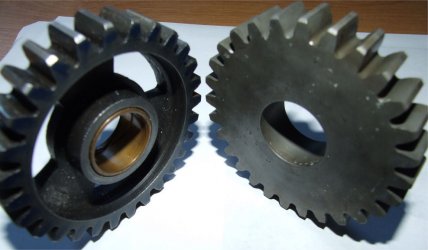
Yesterday I ordered up the bends and pipes to make me a new exhaust system and today I picked up a new gear.

If I learned anything, from it, and I did, it's to not try and cut the drive slots myself next time. I spent many hours on it and although Im happy with the driving faces, I should have let the gear cutter do it all bar make the blank.

I can now look at getting the engine back together, but that'll probably happen after the exhaust is done.
 

Attachments

  • New 4th Gear.jpg
    New 4th Gear.jpg
    85.1 KB · Views: 32
  • New 4th Gear 01.jpg
    New 4th Gear 01.jpg
    63.2 KB · Views: 33
Hi Andy

Any news on that Engine of yours yet ??  ;)

We'll have to see if it works.......... of course now it weighs more than a Laverda Crankshaft !!
 
Hi Rob,
  Well!!!!!!
  Cylinder head went back on and motor was run up on the bench,a few times to bed things in.Problem being that on changing the oil each time I found the oil looking like metallic paint and deposits I assume to be phospher bronze in the oil.
  The head had been fitted with inserts under the valve springs to obtain correct tension on springs,made of a non meallic material,so I sent head back to make sure everthing was OK.Worked on the basis that I'd changed nothing esle.Head OK.
Pulled barrels off to find right hand small end had pick up,you could rock the piston,left hand fine.
  Will split crankcases and inspect gearbox.
I was looking through my notes last night - it was approx 26 years ago that the crank was last removed.I can't complain.
I've already got a pair of carrillo rods to go in,so hopefully within a couple of months should be back up and running .


:D

Andy
 
Don't forget to clean the oil-slingers seriously. If there was so much in the oil, be sure there is a lot that has built up in the slingers, too.
 
Andy
Choose carefully who you get to do your crank. I'm not sure whether Keith is pressing cranks yet. I shall whizz you a PM about my experiences to date.

Rob
 
I am pressing cranks, not right now, right now I am enjoying a robust malt before bed. I'll get back on the cranks in the morning.

  Keith.
 
Back
Top