750 crank balance factors

sfcpiet said:
Paul,

10kgs is very optimistic.

IIrc, a '74-on SFC item weighs in at a tad under 12 kg, don'r remember if that's with or without outer mains..  My own efforts end at 12.2 kg, including outer main bearings.

Quentin,

Excellent food for thought, centering the balancing mass to counter the rocking couple!  I'm in the process of machining a crank for my twisted project, will retain stock centre pin and rods though... not going racing with it.  On the other hand, 2 of my lightened cranks with stock centres have got 2 whole seasons of racing on them without issues.

Here's some of my efforts;

piet

Hi Piet,

Well I am rather optimistic, it's, kept me alive!

All joking apart, my Electronica crank works out at 10,5 kg and I remember the crank I had built for a friends race bike as being a tad lighter than the Electronica.

Paul
 
Cosi said:
The article you read was in the fabled Streetbike mag, long since dissasembled after Seddo was neutered by ACP and then humbly went on to become the porn king

Mid 90's and well i was gonna get rid of my Lav and head to bega to get me one of these RGV Besas, it was called the "Spiteful 810" and used a 650 besa base bored and stroked out to 810, apparently it should blow its brains out, according to monsiuer Zane  :P

A little search revealed the following, looks like old Micky is still at it and his latest incarnation looks a little bit tricker, looks not to disimiliar to one of those exploding thingies

http://www.britbike.com/forums/ubbthreads.php?ubb=showflat&Number=212693&page=all

Talk about Aus bike scene, i met the Beesa bloke when i blew my meat pie up outside of Bega in the late 80's: hey what porn is Seddo the Rebel outlaw into ??

Peter
ps: small hijack, but it should pass
 
Sure it was him and not Boris,Sedo ran a bike show on The Old Rd.It went for a couple of years and died.
There was a 500 Yamaha single cafe racer entered,must have weighed less than 100kg.All sorts of home made bits on it.Mostly carbon when no one know what it was.
Streetbike was my favourite mag,they did some great tech stuff in there day.
 
The center "balance weight" idea reminds me of the Benelli 650 twin cranks.
The end pieces are, I'm pretty sure single forgings with balance weights appropriate for a horizontal single, but they press into a center piece with a whacking great balance weight in the middle.
Makes correcting the balance factor pretty easy - but it's one of the longest twin cranks i've ever seen.
They're 360 deg as standard but given how they shake, they'd be a good candidate for a 90 deg conversion.
 
Paul Marx said:
Hi Piet,

Well I am rather optimistic, it's, kept me alive!

All joking apart, my Electronica crank works out at 10,5 kg and I remember the crank I had built for a friends race bike as being a tad lighter than the Electronica.

Paul

Well Piet, been thinking about this all night!!!
My Electronica crank was more than 10.5 kg, can't remember how much but the crank built by Phils' successor using Phils technique was definitely 10.5 kg.

Ciao
Paul
 
Great to see this thread continuing, and even to get some of the earlier adopters of this into the forum.

Quentin - welcome to the forum, good to hear from you.  I assume your SF was the one with ZZR600 front end (or similar) in Victoria back in the early 90's?  Regarding your question about the SLC, vibration was my number one concern with going the light weight option, but Drmsby reports it is no different to the old bike, and possibly better!?  Not at all sure how that works or whether it's just perception, note all the racing in Oz is sprint racing and he is never on the bike for long periods.  For sure though, if the vibration is worse, it is not so much that it causes us a problem.  The schedule has meant that I've not ridden the bike more than up and down my street to see it doesn't leak and the gears work (...for normal people), probably 2-3km in total and at very moderate pace.  From my recollections of track days with much the same engine in the old frame it smooths out quite well at high rpm - Cathcart was very impressed with the low level of vibration on the old bike in fact.

I figured the vibration would cause me to go the twisted twin route for the new engine whenever that happens, in a lot of ways I'd prefer to keep the 360 just to have the "right" sound, but I am sure the 90 or 76 crank also sounds very cool in it's own way.  If it can be made to make more power that is an essential positive that over-rides sound, and if the vibration is less I can make the bike lighter again.  But I would prefer it doesn't sound too much like a Ducati - which IMO the TRX850 absolutely does.  I was very much looking forward to hearing Housies 76/284 on track at the Sheene, but it seems he's been stumped by taking the primary cover off.  I have had to learn how to do clutch changes in 15 mins with my racer and he's going to have to do similar if it puts out some decent power.

Your comments about the twisted twin vibrating more at high rpm is very interesting and informative, as I'd be looking for exactly the opposite characteristic.  It does not sound like Phil had the same experience with his - what do you consider 'high' rpm by the way Q&P?  I am running the current (tired) engine to 8k and the new one would hope to go somewhat higher.

Cheers
SteveB
 
when are you lot going to get real and just add two extra cylinders to your SOHC twins (at 180 degrees) and one extra one to your triples, also at 180 degrees.
CLEM
 
So is there any way to quantify just how much these new cranks actually produce vibration other than the subjective white finger test at the bars?I kinda guess fame differences will effect this.Revs measured at as well.
 
Vince, finger, seat and foot are the measuring tools for vibration. Those and the number of broken items it causes for the bike.
Phil Irvings chapter on crank balancing in Tuning for Speed makes it very clear just how difficult it can be to determine a suitable balance factor. Vibration manifests itself when more than one item vibrate together (sympathetic vibration). Irving had lots of experience with determining/altering balance factors. Many cranks are much easier to alter than the Laverda ones, with threaded holes etc to change the factor. Cycleparts added to or removed from a frame cause vibration to completely alter character, let alone replacing frames. Irving saw anything from 70% to 20% ideal factors simply because of altering cycleparts. Add to that the fact that not many 40 y.o. Laverdas will not have their main bearings clamped so tight by the cases any more and Quentin?s sheet with arbitrary figures to throw the dart at gets pretty bloody big. The most famous crank balancing man in my memory was an old alcoholic railway mechanic in Melbourne who cut his teeth balancing steam trains, but his bench at work was covered with racing crankshafts. He could within reason set a crank to vibrate in any plane at any revs, but he made it clear that the crank has to cause vibration because it has to be able to flex, the job was to minimise it and get it in a plane and rev range that suited its intended use. The theories he had in his head were never transferred to a computer so are lost to the world. I know of Brit twins he had done and people were dumbstruck, had never dreamt it could have been possible. If only we could have given him an SF crank.
On my side, my SFC crank came from the factory with 69% balance factor in 360deg guise. The outer mains the factory had on it were side thrust fibre caged balls, identical to those in Ducati bevel engines, but the Lav has no possibility to shim the play out of them. My first SFC crank (which I kindly donated to Quentin after I was presented with the new one from the then Oz Lav importer as gratitude) had the same bearings, which had hammered themselves pretty hard over the numerous years I had used it. I now use a special caged C3 ball on each end, but it highlights the battle we are up against hoping to eliminate vibration from a loose crank! As a 360 it was pretty similar in vibration to my original SF crank, but got worse with higher revs (over 6000 being hard to live with hour in/out). In 90deg guise I have it at 55%, set up on knife edges statically, a system that is extremely sensitive so I am confident it is bloody close. You neutralise everything, then work on one journal at a time. You could compare it to balancing wheels on extremely sensitive static jig compared to spinning it on a tyre machine, both will give the same result. Perhaps dynamic balancing a crank with a computer program will save time/money but someone has to write a program and decide what is desired in either case. In the original streetbike guise it was really good, still vibrated but in a completely different frequency. Best range was 3500 to 5500 where it was fantastic. It was quite liveable at higher revs but and went through a phase from 5500 to 6500 being pretty pox but from 6500 up got good again. In my opinion an excellent road crank. With the bike completely stripped and now just used on the track it is completely different, the cycleparts issue raising its head. Now it hates part throttle at mid revs 4500 to 5500 and feels like it will break apart. I am sure this is where I break brackets etc. It only affects me on warm up laps and racing in the wet and outside that range is an absolute sweetie. Luckily being such a gutless slug (63RWHP) I can use full throttle and high revs through most of the track when not hard on the brakes. It does start to get a bit rough again towards 8000 but I get better laptimes riding the torque curve so rarely see that.
Phil, Piet, the broken crank centres Geir has experienced twice he was forewarned about by the bloke in England he took his crank to for setting up (I don?t know who). With "serious" power (Geir has around 70RW), the original centre section will eventually let go. Geir has done about 15 years racing with two breakages and the triple web solution wasn?t around then. It is not necessarily caused by his 90/630 big-bang firing order.
From the seat of the pants it is the torque curve that seems most altered by the conversion. With a 5C or 6C cam you get a much better transition into the power band, whilst keeping the great top end of these cams, so I reckon it is worth the effort for that reason alone. Anyone with a stock SF be warned that to benefit from these cams requires higher compression and a tuned exhaust. Low comp and std mufflers won?t cut it.
Physics dictates that altering the firing intervals can not give you more power, only the way that power manifests itself.
It is great this thread is alive again and we all await the verdict on how the different motors Red has done work out when they get out on the road/track.
 
Just thinking about Steve's lightweight frame - many years ago my brother and I had BSA A10's - his wasa genuine Rocket gold Star - mine was a tuned super rocket motor i put in a Norton wideline frame. My brother decided to have his crank  dynamically balanced by a well known expert near Sidcup i think - Hartley was the name (No - not J R Hartley). I went with my brother and we got talking to Mr Hartley - I told him I had a Norbsa and he immediately said my frame would crack at the top of the downtubes if i didn't have crank rebalanced - of course - i took it that it was just a bit of scaremongering to get extra work.
  A few months later - guess what - the sodding frame cracked exactly where he said it would. He'd explained that the main plane of out of balance forces was different in a BSA engine and a Norton one - the BSA's were put more into the heavy top tube/headstock area - the Norton frame was a double loop of smaller, much lighter tubing. This may help explain why Steve's SLC doesn't vibe more - as the Laverda's out of balance plane is most likely aimed towards the front - where there is no frame. -  Great subject this!! - Regards - Phil
 
Hi all,
I've been following this thread with interest.
I run a Binnion framed Monty (578cc ,180 deg crank)),which has a current rev limt of 10,000 rpm.
The frame weighs approx 15lb,quite light!The crank is lighter than standard,balance
set to 50%.The pistons (Ross 78mm) and gudgeon pin + rings weigh approx 4.5 grams
more than std ,soon (hopefully to be less).The thing is yes it vibrates,but smoothes
out the higher up the rev range you go.The frame has never cracked.
On the track I don't notice any vibration,and if I did I'd assume there is a problem
or I wasn't trying.Mind you the dyno man at the race meetings remebers the bike-
jumping from a say RSV Aprilla to mine,there's a big difference in smoothes.

Less reciprocating weight,espically furthest away from crank axis needs to be reduced
to reduce the vibration effect/intensity.

Andy
 
when we started the 1st 270 engine, we were quite impressed with how smooth it was but of course that is sitting on the bench and under no load
this is the street engine that started life as a late model GTL

House's 284 engine seemed even smoother though it is hard for Mark and I to be certain of that as we did not have a 360 standard engine to compare it to and as we used the same chassis to start both engines we could not compare them side by side

Steve, House has a few issues that have stopped him going to the BSFOS, is not just the clutch.
No money for a start, has to get his Hernia fixed up, he has started to go to the gym every day to lose some weight, he is off the piss, etc
Cams are way out on his engine as well, they have been reground to 5C specs at Tighe Cams in Brisbane and they have stuffed them which is normal for them apparently, both lobes are down on lift, Inlet by 2.8mm from memory, I don't have my notes with me, and the lobe centers have been moved 14 degrees.
I wound up setting the inlet lobe at 106 degrees to try and keep the exhaust lobe somewhere close to where it should be but really, I was surprised the engine ran.
Before we left home I sent 3 sets of cams to Wolfgang to get him to have them reprofiled to 5C specs, am hopeful they are finished when we return, if so it is engine out and build again with new correct cams.

I'd be keen to have a 360 engine sitting next to one of the twisted twins to see how they compare, just happen to know where one is now, they are a bit scarse in Brisbane, everyone owns a triple or 3

Red
 
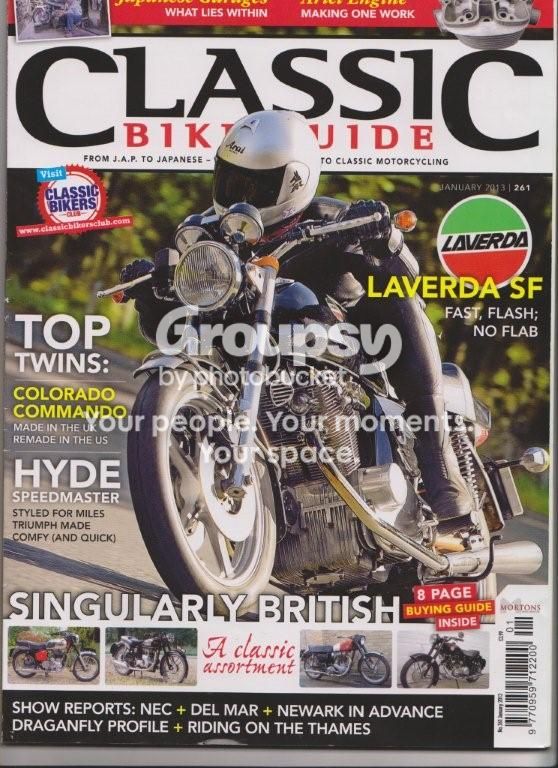
There's a seven page feature in January's Classic Bike Guide comparing Phil's twisted twin with a standard SF. Apologies for the self promotion [I wrote it] but if anybody is interested in rephased Laverda twins it covers the subject in a bit of depth.

CBGcover_zps89a4ed57.jpg
 
breganzane said:
Great to see this thread continuing, and even to get some of the earlier adopters of this into the forum.

Quentin - welcome to the forum, good to hear from you.  I assume your SF was the one with ZZR600 front end (or similar) in Victoria back in the early 90's?  From my recollections of track days with much the same engine in the old frame it smooths out quite well at high rpm - Cathcart was very impressed with the low level of vibration on the old bike in fact.

Your comments about the twisted twin vibrating more at high rpm is very interesting and informative, as I'd be looking for exactly the opposite characteristic.  It does not sound like Phil had the same experience with his - what do you consider 'high' rpm by the way Q&P?  I am running the current (tired) engine to 8k and the new one would hope to go somewhat higher.

Cheers
SteveB
Howy Steve. I'm enjoying my little digital foray back into my workshop  :D
Indeed, my SF1 could possibly have been the one you mention, although there was a guy with a stockish SF with a ZZR front end I met when a journo wanted to feature our modded Lavs in the ill-fated Streetbike - mine has seen numerous guises since I tossed the SF (Super Freni) drum for a used Yamaha TZ 4LS, later replaced by a new TZ 4LS (as an aside, someone on the forum was discussing these brakes, but I discovered they were just a little too light for my extensive road, occasional race, applications; the cast drums would continually warp and eventually separate from the light alloy of the hub outer - super light and fantastic power when it was set up though - there's Super 8 footage hiding somewhere of me outbraking a genuine Imola Rep roundcase SS at the end of Wanneroo's main straight in my very first race  :D ) ... that was a long aside - sorry! My disc front ends went from 35mm Ceriani legs on the original drum brake upper fork assembly, 38mm M1Rs (atrociously set up new from new with no rebound damper piston ring!), Honda VFR 41mm Showas (never set up right, too soft), to current early GSXR750 and 4-spot Tokicos - these went on when I fitted the 17 inch Akronts. Road behaviour has been below par ever since. Final option yet to be fitted, Yamaha FZRR750 USD (Kayabas?), has been in the shed as part of the shelved ongoing project that is my bike these days! Nice pair of 320mm 916 discs and Yamaha monobloc 4-piston calipers to match.
Back to the 270 deg twister. My idea of high revs is around 8,000 - the red I set myself when at a track day or having fun in the real world. But seriously, until I'm convinced my motor is fully sorted in terms of bearing journal wear in the cases and other issues, I won't make any definitive judgement on vibes. I need to see how it behaves with 50% factor when really well put together, then perhaps look at numbers like Phil's 65%. As Tippie says, there are so many other aspects involved in the equation.
i can certainly understand your reticence to alter the sound of the 360 pulse, and absolutely no doubting, a 270 crank sounds absolutely like a v-twin! Just that combined with chain whir, intake throb and the general individuality of a Lav twin's music, it doesn't really sound like a Duke or a TRX (which I rode once, and the motor feels very short in stroke compared to the Lav).
Woops - long post again! And the laptop is about to die of a flat battery!
More soon - keep this thread alive!
Quentin
 
Piranha Brother 2 said:
until I'm convinced my motor is fully sorted in terms of bearing journal wear in the cases and other issues, I won't make any definitive judgement on vibes.
More soon - keep this thread alive!
Quentin

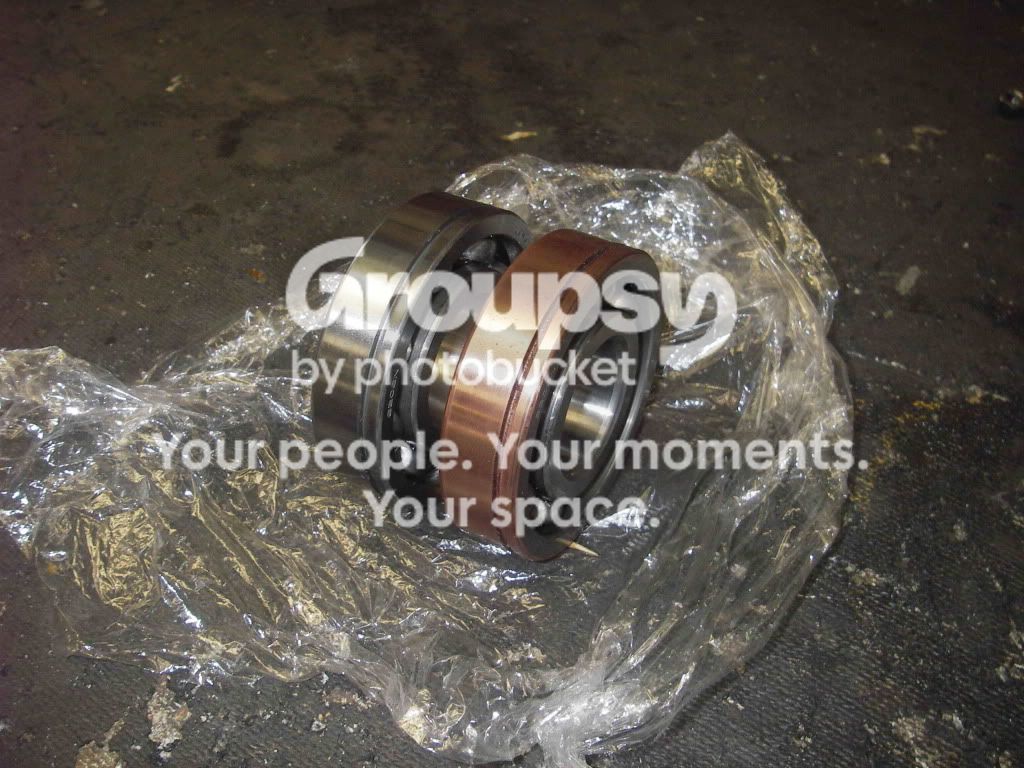
Quentin, it is not too difficult to build up the OD on a set of bearings to take up any slack in the crankcase journals, I had to do one when I rebuilt Maxene's Monty
R/H bearing journal was loose so I built the bearing up 0.07mm with copper, actually built it up 0.12mm and dressed it back to size
you need very accurate measuring equipment to allow you to first assemble the cases, torque them up and then measure the existing bores, inside micrometers are not preferred, you need to use Intrimik style gauges and measure in 3 to 4 different places
I can do all of this for you if you wish or jump on a plane one day with your shite and bring it up home and do it in person

this shot shows the bearing after it was dressed

Montycrankbearings_zps66003221.jpg


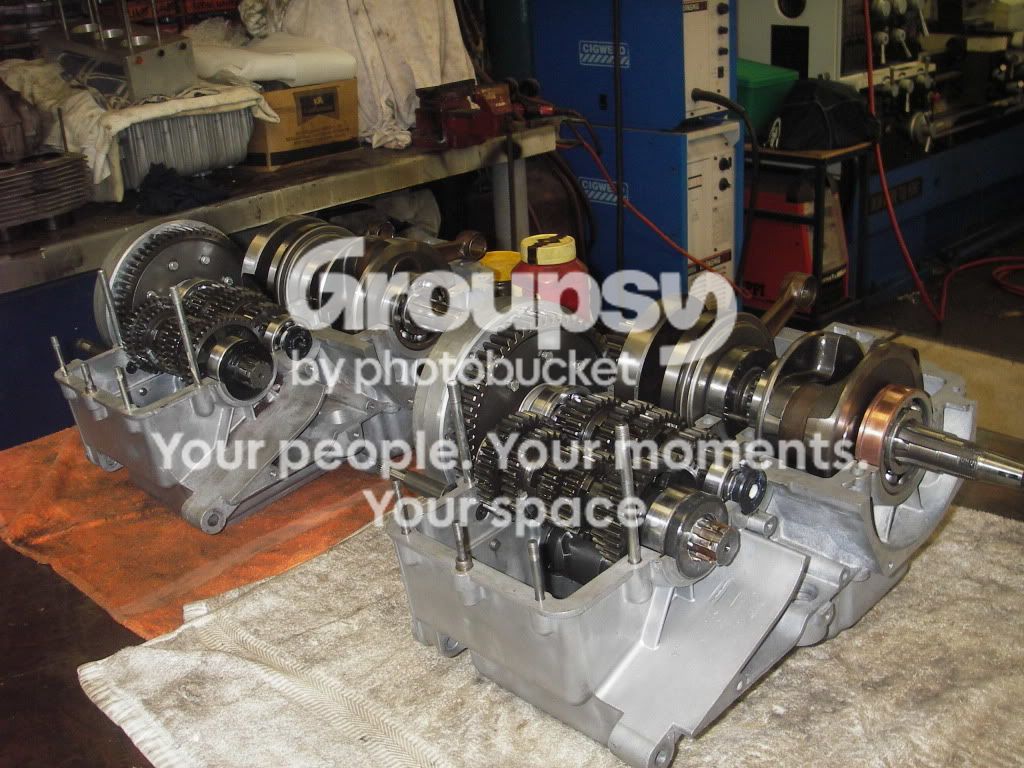
and with lower case ready to assemble, you can see the right hand bearing as a copper colour
Opengearboxes_zps3ac71502.jpg


Back
Top