750 SF2 piston and cylinder wear

Thanks guys and pardon my ignorance- I see 2 holes at the bottom ends of the connecting rods but don’t see any dirt or silt in them, and looking at exploded diagrams of the crankshaft and crank case I see no “slingers”. Stupid question, but would pouring kerosene into the crank case clean out any silt, or blowing in compressed air into these holes? Looking at the Green Book directions for splitting the cases appears intimidating so I’m resisting doing it.
I received the bike at 15k miles and I could tell it never had been serviced and probably never had the oil changed, so hence all the problems I’ve encountered at the current 18k miles. I’m going to wait until I gather enough info and nerve to split the cases.
Take it or have it taken to bits and checked.
The problems you've encountered are due to the rebore and new pistons.
Paul
 
the Slingers are pressed on to the inside of each crank web, they catch the oil and through centrifugal force caused by the spinning crank build up pressure and force the oil through the hollow Big End pin and out into the Big end bearings before spraying the underside of the piston
you would have seized the engine within 50 miles if they are not in place

16th Dec big end pin stops

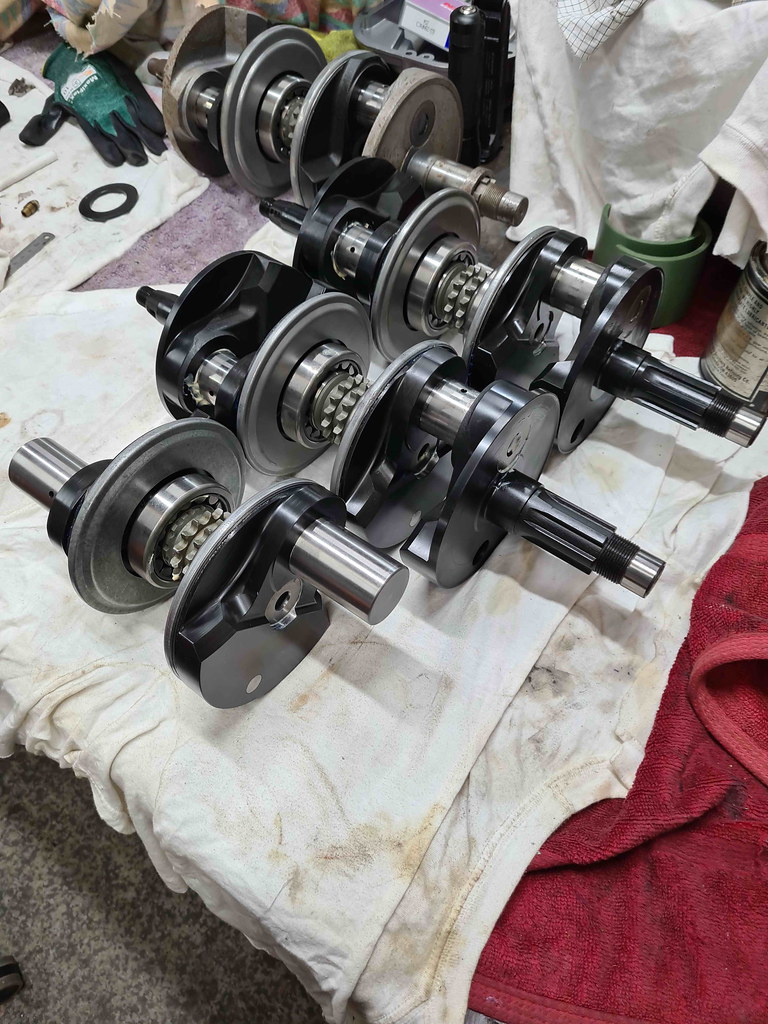
these are 750 cranks that we have twisted to 270 degrees and machined our own inner webs but principal is the same as your standard crank

3 x 750 cranks

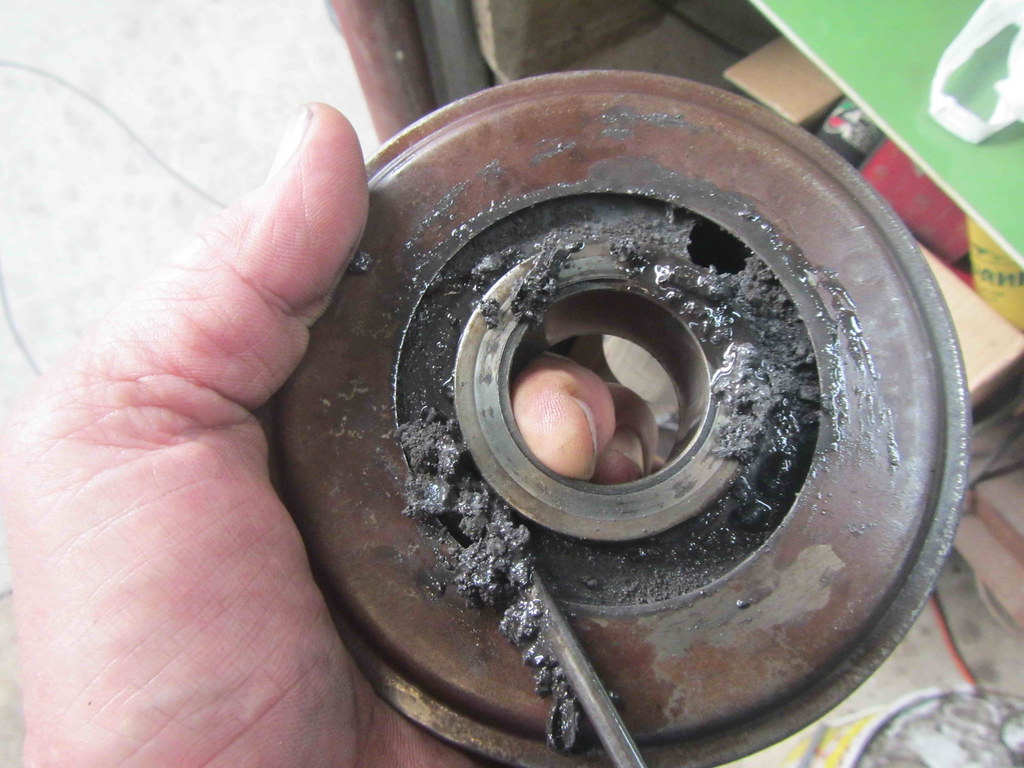
Because of the centrifugal effect they also capture fines that are trapped in the oil and over time fill up with crap
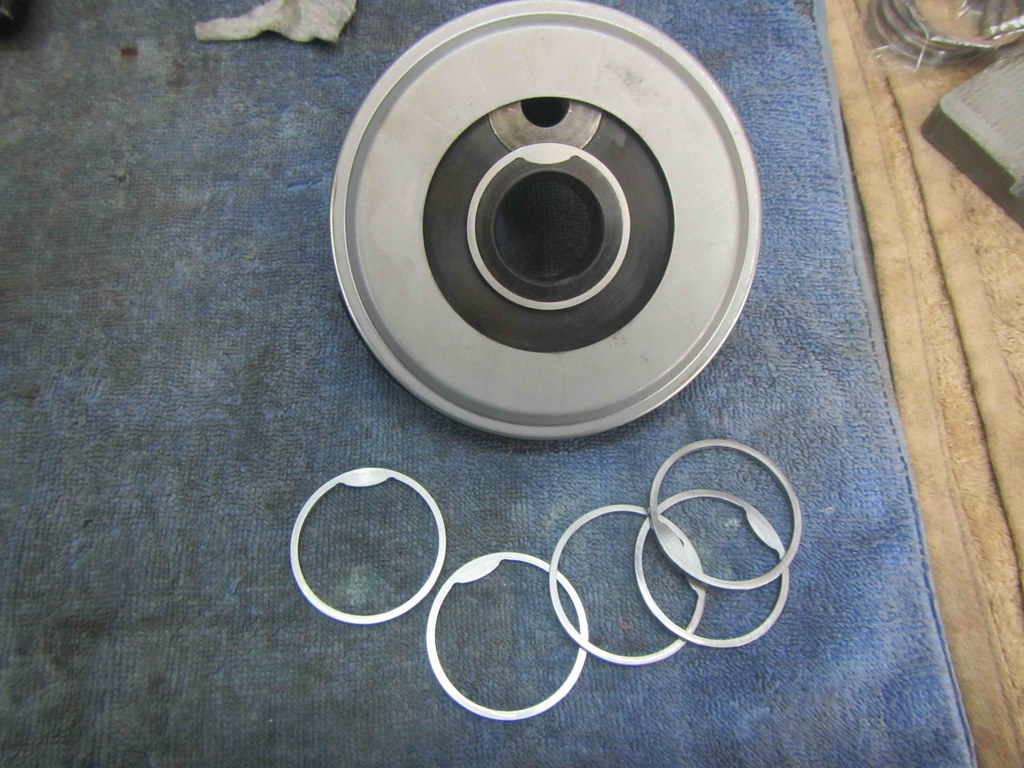
When stripping the cranks you need to clean all that crap out but crank needs to be stripped, is not advisable to try and clean those Slingers without clear access to them
If you disturb that sediment next time you start the engine you will get a bunch of crap go through your Big Ends and sprayed up to the pistons, that is where most of the Liner scoring comes from
But as Rob pointed out, only 15,000 miles on the engine, should still be relatively clean in there

23rd August RP crankshaft oil slingers
 
Last edited:
I received the bike at 15k miles and I could tell it never had been serviced and probably never had the oil changed, so hence all the problems I’ve encountered at the current 18k miles. I’m going to wait until I gather enough info and nerve to split the cases.
So you know for sure that the bike you bought had only done 15,000 miles - in 52 years? This is the big question. Knowing the history of a bike is hugely important.
Slingers are not a factory replacement part. In fact the factory only sold complete crank centres (without the outer webs) as a spare part. Red has made new slingers and set up the machinery to fit them - removal from the web makes cleaning a whole lot easier. I haven't removed mine, but have cleaned the slingers on a disassembled crank - horrible messy job.
 
Last edited:
So you know for sure that the bike you bought had only done 15,000 miles - in 52 years? This is the big question. Knowing the history of a bike is hugely important.
Slingers are not a factory replacement part. In fact the factory only sold complete crank centres (without the outer webs) as a spare part. Red has made new slingers and set up the machinery to fit them - removal from the web makes cleaning a whole lot easier. I haven't removed mine, but have cleaned the slingers on a disassembled crank - horrible messy job.
Phil Todd used a wire coat hanger and a parts washer.
He didn't take slingers off.
He did a lot of cranks in his time.
Paul
 
Many thanks to all,
I've never taken a crank case apart, so this is all new to me, but I'm learning a thing or two thanks to this Forum.
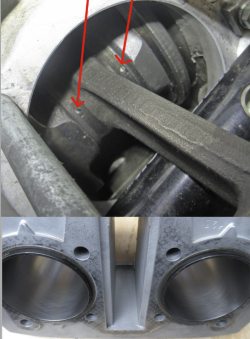
Here is what I'm seeing w/ the top end removed and showing what I believe are the slingers. I’ve read some previous postings about slingers and can visualize how they fill w/ silt, but I see no way of picking it out and understand that may cause it to enter the bearings. So it appears crank removal is needed to do this.
A second machinist examined and measured the bores and said they were true and the correct bore size, but marginally tight. He honed out the wear marks and scratches, and says new 80.5mm pistons will give the .003" clearance, but I'll have him measure the clearance when I get the pistons, and also set the correct ring gap.
I'll take the crank case apart once I obtain more information and nerve.
 

Attachments

  • holes.png
    holes.png
    757.4 KB · Views: 35
Last edited:
Here is what I'm seeing w/ the top end removed and showing what I believe are the slingers.
No, they are the exit holes after the oil has gone into the slingers, once they're spinning and full they overflow into the hollow in the crankpin and exit through holes in the pin, pass through the big end cage and rollers ... then exit through your arroved holes and spray the undersides of the pistons and the cylinders.

Have a good look at the pic Red posted of an inner crank web and the black crud being scraped out of it - THAT is a slinger. It's just a tin plate attached to an inner crank web. They are totally hidden from view (which is why you need to split the cases to even see them).

I too have cleaned slingers without pressing cranks apart - with judicious use of rags or plugs in the crankpin holes and as Paul said, rinse rinse rinse, it can be done. If the silt is so high it's inside the crankpin hole it's a little more complicated - and could mean wear in the big end assembly; you can imagine that lovely grinding paste of oil, metal and carbon would work very nicely in degrading your crankpin, rollers and big ends. But if you're happy to take a risk on acceptable wear, I reckon it could be cleaned and ... rinsed rinsed rinsed.

Out of interest, why does EVERYTHINg in your pics look so damned dry??? Your rods and big ends should have a nice shiny coating of oil (even just to protect the surfaces when not in use).
 
Many thanks to all,
I've never taken a crank case apart, so this is all new to me, but I'm learning a thing or two thanks to this Forum.
Here is what I'm seeing w/ the top end removed and showing what I believe are the slingers. I’ve read some previous postings about slingers and can visualize how they fill w/ silt, but I see no way of picking it out and understand that may cause it to enter the bearings. So it appears crank removal is needed to do this.
A second machinist examined and measured the bores and said they were true and the correct bore size, but marginally tight. He honed out the wear marks and scratches, and says new 80.5mm pistons will give the .003" clearance, but I'll have him measure the clearance when I get the pistons, and also set the correct ring gap.
I'll take the crank case apart once I obtain more information and nerve.
There is nothing to be worried about with splitting the cases. It is a simple job and most of the work is cleaning everything to put it back together. If the crank needs to be pressed apart, you may have to take it to Wolfgang as I don't know anyone in the US who will do it.

If the bike really only has 15,000 miles, the oil slingers should still be OK.
 
Once tried some very expensive synthetic RedLine transmission oils on my car. The gearbox was almost jammed on winter, the stuff just went so thick.
Later needed to change a rearwheel bearing. Took the long drive shaft out, I think it is somewhere around 750mm long.
It was dripping oil and put it standing on the floor. Around one minute later took a rag to dry it, but it was completely dry.
All of the oil was evaporated off.

Haven't bought any RedLine oil since then, but fuel system cleaner and some other fuel system additives that seem to be seriously good.

-Jouni
 
Thanks for the info about the slingers Pirhana,
All the parts appear so clean since the old oil has been drained but I’ve temporarily filled back new oil. To determine if there,s been any gas wash that might’ve damaged the pistons I’m having the old oil analyzed and then consider splitting the cranks.
There’s no way for me to confirm the bikes true mileage other than what’s on the speedo. But again, the bike hadn’t been properly serviced and oil may never have been changed regularly in15k miles which may have caused silt in the slingers.
 
There still should be a notable oil mess everywhere even if the oil was drained off for long time ago, and even then if the oil pump did not worked properly. To my eye all of the pictures look dry like if all of the parts were washed with solvent cleaner. I'm thinking if something very unsuitable oil was used and/or much fuel in oil - and I'm saying this very honestly as this can be easily very non-evident when selecting engine oil.

I'm also thinking about the condition of the oil pump and if all of the oil passages are fully open, also all holes in all of the gaskets, especially on the bottom end gasket.

-Jouni
 
About cleaning the slingers. I tell how we have successfully cleaned the slingers without disassembling a crank in Finland, this at least last 53 years just for Laverda just in my family, some others have used this even longer and even we have used it longer for some other marques.

Needs a some kind of container for the crankshaft that is just a bit bigger than the crankshaft. The container may have some kind of sinkings at the bottom or alternatively a perforated metal sheet at the bottom standing on short stands.
The dirt in the slingers is mostly oil and metal particles. Solvent cleaner take care of the oil and the metal particles sink at the bottom of the container and stay there.
A couple of liters of engine solvent cleaner is needed, needs to be effective, not just anything available. Needs a some kind of device to spray solvent cleaner to the slingers, spray gun with small pressure is excellent or even a 100ml syringe works but is slower. Always fill this with new clean solvent cleaner, do not circulate it. Then it needs steel wire strong enough bent to suitable shape. This may take a couple of days and a lot of patience - give time for the solvent cleaner to do its job, all dirt will not come out at once, needs several attempts and waiting periods for the solvent cleaner. But eventually dirt will come out of the slingers if everything is done correct way.

The best methods used to be to clean them this way after every 100 000 kms. The slinger will normally never get full. Then after 300 000 kms we sent the cranks to the factory exchange program, they replaced all of the bearings and conrods, etc.
Doing this after every 100 000 kms may sound quite demanding nowadays, but we consider that these bikes are not from such an era that this should not be done.

-Jouni
 
Thanks MotoJouni,

The components look dry since the oil was drained days ago which was 3 qrts of BelRay 20/50 mineral and the base gasket was installed correctly with the notch mating to the oil orrifice near the one studs.

It would be amazing if the slingers could be cleaned while still on the crank, but my understanding is that any solvent poured in to clean them would dislodge the grit into the bearings. I had thought about pouring kerosene to clean them but was advised not to do this, but your method sounds plausible.
 
About cleaning the slingers. I tell how we have successfully cleaned the slingers without disassembling a crank in Finland, this at least last 53 years just for Laverda just in my family, some others have used this even longer and even we have used it longer for some other marques.

Needs a some kind of container for the crankshaft that is just a bit bigger than the crankshaft. The container may have some kind of sinkings at the bottom or alternatively a perforated metal sheet at the bottom standing on short stands.
The dirt in the slingers is mostly oil and metal particles. Solvent cleaner take care of the oil and the metal particles sink at the bottom of the container and stay there.
A couple of liters of engine solvent cleaner is needed, needs to be effective, not just anything available. Needs a some kind of device to spray solvent cleaner to the slingers, spray gun with small pressure is excellent or even a 100ml syringe works but is slower. Always fill this with new clean solvent cleaner, do not circulate it. Then it needs steel wire strong enough bent to suitable shape. This may take a couple of days and a lot of patience - give time for the solvent cleaner to do its job, all dirt will not come out at once, needs several attempts and waiting periods for the solvent cleaner. But eventually dirt will come out of the slingers if everything is done correct way.

The best methods used to be to clean them this way after every 100 000 kms. The slinger will normally never get full. Then after 300 000 kms we sent the cranks to the factory exchange program, they replaced all of the bearings and conrods, etc.
Doing this after every 100 000 kms may sound quite demanding nowadays, but we consider that these bikes are not from such an era that this should not be done.

-Jouni
The PhilTodd coat hanger technique.
Plenty of Phil's cranks still out there.
Paul
 
I personally would avoid any technique that could (and probably would) allow slinger silt to enter the crank pin holes. IF the slinger silt hasn't reached the crankpin holes, a small peice of rag stuffed into the pins prevents contamination. Then the scraping out mess will only get into and onto the inner main caged rollers - these are easily flushed and cleaned once the silt is all gone.

Sounds like time to split those cases and have a squiz inside those pesky slingers. Once you've done that you can also pull off the oil pump and squirt oil or whatever into the feed hole/s to the crank and top end.
 
Back
Top