Adding an extra steel to the clutch pack 120 jota

martymoose

Hero member
Hi guys, is there any disadvantage to adding an extra steel to the clutch pack? Springs where short, around 46mm, but plates measure up fine, 1.5 and 3 mm respectively . Slipping above 6000rpm.

Cheers

Marty
 
Marty,

Check if there are short little spacers under the spring retaining screws. These were fitted at some point to decrease spring preload, ie, ease lever pressure a bit. Omit them if you can live with increased lever pressure.

Doubling one of the steel plates will increase spring load. Easier to pre-load the spring with a large ID washer. If you insert the extra plate between the rear-most doubled friction plates, you will increase pressure area but actually decrease specific plate pressure. If you go that route, make sure the pressure plate cannot pop off the hub when clutch is deployed, you're pushing it further out by adding to the clutch pack.

Slipping clutches are usually the result of warped/dished plain plates, sometimes oil contamination. Pays off to check the steel plates on a flat surface, from BOTH sides! ;)

piet
 
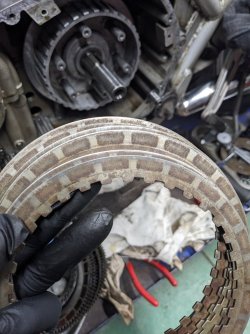
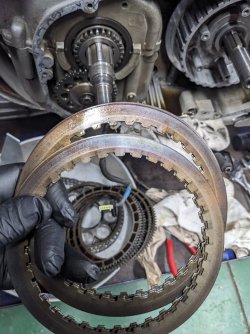
Thanks Piet, yes the spacers where still in place. I have a spare set of steels that will be going in, the original ones, now 125,000km old, have been slipping more than I thought, judging by the blueing.
 
Something I heard years ago about high rev clutch slip, variations in clutch spring condition and tension can cause it as well.
 
I had exactly the same problem Marty. I found the clutch was slipping on the 120° track bike I built a few years ago (now in TTW's possession) despite it having new Redax Kevlar friction plates and new springs. I guess the torque that Red built into the 1172cc motor was too much for the clutch. With Axtell cams, it didn't have bags of top end power like Red's race bikes (it dynoed at about 100HP) but it had a masses of torque at around 6000 RPM. I bought an extra steel plate from Red and it fixed the clutch slip, so it's definitely a worthwhile modification to cure your slipping problem.

The 120's clutch assembly is pretty much begging for an extra steel plate because of the two friction plates that lie against each other without a steel plate between them.

There was just enough room in the clutch basket for the slightly thicker stack of plates. The only disadvantage I can think of is that your clutch pushrod assembly could end up too short (by the thickness of the extra plate) and put the clutch adjustment out of range.

I think I solved that by turning up a a spacer washer to go between the little square clutch toggle bar thingy that the pushrod pushes on, and the pressure plate, to accommodate the additional thickness of the clutch pack. The reason I'm not sure is that I remember doing it to my Jota because of a shortened pushrod. I'm just not 100% sure whether I did it to the 120° as well.

If anyone is wondering why the Jota's pushrod was too short ... After buying the bike, I found that the friction plates were well below minimum spec for thickness. There was almost no friction material left. Rather than buy new friction plates, the previous owner (or at least his dodgy mechanic) cured the clutch slip by stacking washers under the springs to restore clutch pressure. But the worn out clutch plates were so thin that the pushrod assembly ended up being too long, so the resourceful mechanic ground a few mm off one of the pushrods so it would fit the emaciated clutch pack. When I fitted new friction plates, the pushrod system was way too short, hence the need for the spacer washer.

Anyway, if you need to increase pushrod length, the spacer shim washer between the toggle bar and pressure plate is a simpler solution than sourcing round bar of the correct diameter and sufficient hardness to make a longer pushrod.
 
Those pushrods really need to be hardened. I had Eades fit a Shorflex clutch to my 3c with its extended lever when mine started slipping, and said lever ended up touching the engine case when I pulled the clutch in fully. My conclusion was that I needed a slightly longer pushrod, and I had seen a bunch of stainless rods of various diameters on the counter at an engineering shop I visited, so I made one. It lasted 20minutes before munting to be too short. The point load on those rods must be huge. Apparently, the originals are made from Case-Hardened Tool Steel. So I made one the same, and that fixed it. The clearances and geometry of a working to non-working clutch are in the 1 to 3mm range or less.
 
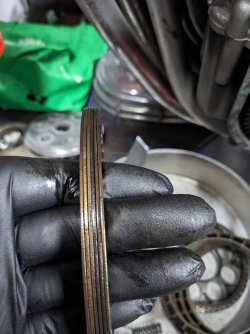
Blued steels are indeed warped, hard to see but definitely dished.
Spare steels out of my blown up 81 jota are flat, and have some good rusty texture.
 

Attachments

  • PXL_20260409_082005117.MP.jpg
    PXL_20260409_082005117.MP.jpg
    138 KB · Views: 22
  • PXL_20260409_081516543.jpg
    PXL_20260409_081516543.jpg
    145 KB · Views: 22
  • PXL_20260409_081457179.jpg
    PXL_20260409_081457179.jpg
    168.8 KB · Views: 22
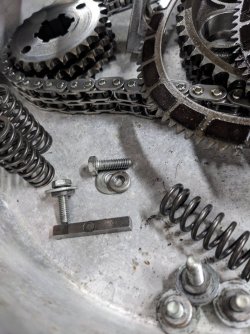
Good set of springs going in from the 81 motor, all measure the same. I might put the spacers back in for now, as the bolts get very tight without them. Suck it and see.

Or I could slow down........nah.
 

Attachments

  • PXL_20260409_082058506.MP.jpg
    PXL_20260409_082058506.MP.jpg
    160.5 KB · Views: 15
For a long while, you couldn't get Kevlar, the war took it all apparenty. Hope this is back as those clutch plates work really well. I would love a set for the Atlas.
 
it is possible to source the Kevlar clutch plates but the cost has nearly tripled, they used to cost me around $30 per plate and I sold them for $32 per plate exchange but now cost is over $75 per plate
I have to source the Kevlar myself which comes from USA pre-cut to size, send the product and plates to BCA in Sydney and have them do the bonding
Not really worth the hassle, I have enough left in stock for my race bikes though in 7 years of racing have only ever changed out one plate
 
For a long while, you couldn't get Kevlar, the war took it all apparenty. Hope this is back as those clutch plates work really well. I would love a set for the Atlas.
Fat Lass is way too heavy for off-road, clutch on mine is ok for the road, neutral not too bad to find...

How many K's have you done now on yours?
 
1000 ks. Probably 300ks off road, just a simple fire trail you could do in a suburban car. It's brilliant on that, slides predictably with ease. That's on 80/20 tyres, 80% road. Hopefully more when I get past some health stuff. I am halfway through replacing the clutch cable, and I have a few washers to pack out the neutral switch after someone mentioned doing that helped them get neutral on a Zane easier. I went to a lot of trouble setting the rear suspension sag to 1/3 of travel, but that resulted in a very high seat height and the bike also being a bit unstable at walking pace and requiring that horse mount technic to get on and off, with the bike being to top heavy its just not manageable. So it's going back to me being able to flat-foot it more easily, and hopefully it doesn't bottom the rear shock too much. It's an absolute hoot to ride, smooth, strong power. Maybe more bottom end would be nice, but it pulls right through its rev range strongly, even if everyone thinks it's a DR Suzuki.
 
Back
Top