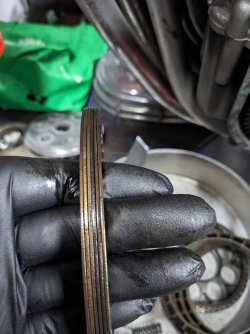
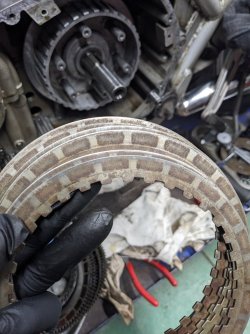
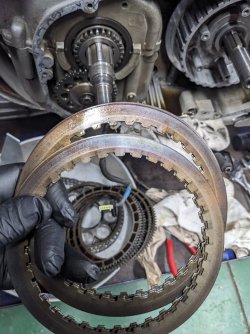
I had exactly the same problem Marty. I found the clutch was slipping on the 120° track bike I built a few years ago (now in TTW's possession) despite it having new Redax Kevlar friction plates and new springs. I guess the torque that Red built into the 1172cc motor was too much for the clutch. With Axtell cams, it didn't have bags of top end power like Red's race bikes (it dynoed at about 100HP) but it had a masses of torque at around 6000 RPM. I bought an extra steel plate from Red and it fixed the clutch slip, so it's definitely a worthwhile modification to cure your slipping problem.
The 120's clutch assembly is pretty much begging for an extra steel plate because of the two friction plates that lie against each other without a steel plate between them.
There was just enough room in the clutch basket for the slightly thicker stack of plates. The only disadvantage I can think of is that your clutch pushrod assembly could end up too short (by the thickness of the extra plate) and put the clutch adjustment out of range.
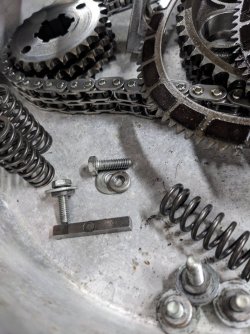
I think I solved that by turning up a a spacer washer to go between the little square clutch toggle bar thingy that the pushrod pushes on, and the pressure plate, to accommodate the additional thickness of the clutch pack. The reason I'm not sure is that I remember doing it to my Jota because of a shortened pushrod. I'm just not 100% sure whether I did it to the 120° as well.
If anyone is wondering why the Jota's pushrod was too short ... After buying the bike, I found that the friction plates were well below minimum spec for thickness. There was almost no friction material left. Rather than buy new friction plates, the previous owner (or at least his dodgy mechanic) cured the clutch slip by stacking washers under the springs to restore clutch pressure. But the worn out clutch plates were so thin that the pushrod assembly ended up being too long, so the resourceful mechanic ground a few mm off one of the pushrods so it would fit the emaciated clutch pack. When I fitted new friction plates, the pushrod system was way too short, hence the need for the spacer washer.
Anyway, if you need to increase pushrod length, the spacer shim washer between the toggle bar and pressure plate is a simpler solution than sourcing round bar of the correct diameter and sufficient hardness to make a longer pushrod.