Adjusting gear box selector for easy neutral?

Grant said:
More like the effect of a running engine, maybe dragging clutch?

Hi Grant

I had the bike tied down and running on the lift, shifting through the gears with the rear tire in the air.

I am not sure what I could do to adjust the hydraulic clutch, it has brand new friction plates and I bead blasted the steel plates, the hydraulics are fully rebuilt. It is still a possibility, as with the bike running, the rear wheel in the air, and the clutch pulled, when the bike is in any gear except neutral the rear wheel spins, so the clutch is dragging a bit, I just don't know what to do about it other than maybe putting the original used clutch plates back in and see if that changes anything.......

Alan's suggestion may have merit, I will check drive chain tension with the wheels on the ground and a rider on the bike, I have had the back wheel on and off the bike several times and might have gotten lax about carefully checking chain tension, we'll see.

weather shifted overnight, yesterday was bright and hot and sunny, hit 28 Celsius, glorious day, but woke up to pouring rain and a very cool morning today. Taking the grandkids for dim sum this morning, my daughter has been in Europe for 9 days now and the 4 year old and nearly three year old have been with me full time, their mother is back tomorrow evening and I may then nap for a couple of days, the little monkeys do not stop moving or talking, but are getting quite good with tools in the garage..... ;) ;) ;)

Paul LeClair
 
'Clutching' at straws here (groan) but what about clutch plate thickness vs standard?
Is the hydraulic clutch bled properly?
I had an odd clutch actuation on the Corsa when I fitted a new clutch m/c once and it was only solved by removing the m/c and inverting it to displace the final air bubbles hanging up at the m/c to hose join, due to it being the highest point.
 
Paul,

There is a great difference between shifting through the gears by hand or with your foot.  The foot is nowhere near as sensitive, and will be hard put to find a specific spot if the change itself is a bit stiff.  I'd persevere with Keiths' suggestion and not only check the neutral switch but also wobble the sprocket cover around a bit to find the true sweet spot.

Adjusting the eccentric only influences the throw of the selector drum.  If all 5 gears can be selected properly and without hitches, that adjustment will be fine.  If you have fitted Laverda rear sets, use the bores offering greatest leverage, ie, put up with the largest lever throw for the time being.

Clutch drag is also very high on the check list.  Remove the M/C from the bars and hold it so any trapped air can travel upwards and give the lever a couple of gentle nudges.  The piston need not travel very far, 0.5-1mm is enough to displace any trapped air.  If you have the cap removed, you might see bubbles rising from the bleed bore of the reservoir.  There should be a bare minimum of noticable free movement of the lever once it contacts the piston of the M/C before pressure is built up.  Other causes for clutch drag can be warped plain plates and/or heavily dimpled clutch hubs and baskets.

Sure, the tolerances involved in the gear selector mechanism are quite generous, but this makes it all the easier to get it all in line again.  Of course, if something is bent, broken or worn, it needs to be rectified first.  I have never required more than 1/2 hour to get a stock twin or triple changing sweetly.

piet
 
sfcpiet said:
Paul,

SNIP

Sure, the tolerances involved in the gear selector mechanism are quite generous, but this makes it all the easier to get it all in line again.  Of course, if something is bent, broken or worn, it needs to be rectified first.  I have never required more than 1/2 hour to get a stock twin or triple changing sweetly.

piet

Hi Piet

laughing out loud, literally........well, there is the difference between someone who really knows what they are doing... and the rest of us. Half an hour you say! I am about 8 hours in so far.

I have used a rubber hammer to shift the outer cover around in every possible direction and test ridden each position without success. No rear sets, just the left side crossover.

Backing off the neutral switch until it leaked did not solve the issue. I have another brand new neutral switch, and am going to put it in with the thickest washer/gasket I can get to fit.

I have spare sets of clutch steel plates, and I have half  a dozen sets of used friction plates, so I guess the clutch is going to get swapped, if bleeding it again does not solve the issue. I will take the master cylinder completely off the bar and rotate it around.

The clutch hub and basket in the 82 1200 only has 10,200 original kms on it as does the rest of the bike, but I guess if I get really desperate I could "borrow" the 200,000 km + clutch hub and basket from the 79 1200 and swap it in, as the 79 1200 shifts beautifully, but that bike is so nice I hate to screw around with it.

I guess I need to go buy another few gallons of oil  ;)

Paul LeClair
 
I seem to remember a post years ago about where the plates are installed eg clocked in the clutch hub.Seems there is a happy place and a less happy place.Don't remember the details but I think Red was involved in the thread.
 
Hi all

I was positive I had another brand new neutral switch in my parts hoard, but if so, I have not been able to find it, bloody hell. I was just searching online (Laverdamania, Motalia, Laverda-Paradies, etc ) trying unsuccessfully to find out the size of the sealing washer that goes in under the neutral switch so I could buy a few more.

Does anyone know the ID/OD offhand? I just re filled the crank case with 3 liters of fresh oil and hate to have to drain it again before I run out to the Fastener Supply Store..... I was hoping to pick up a few more washer's, maybe even some more different thicknesses to try.

I did re bleed the clutch master cylinder as suggested, in the sense that I took the clutch master off the bar, rotated it so that the brake line bolt attachment to the master cylinder was lower than the reservoir, unfortunately I did not get any air bubbles, but I seem to have ruled that out. I am narrowing in on the clutch dragging quite possibly being the cause of my shifting/neutral issue, the bike shifts beautifully with the rear wheel in the air, the shifter mechanism is adjusted very carefully, but when the bike is shifted into gear with the wheel in the air the wheel spins even with the clutch fully pulled... Clutch assembly is coming apart next I guess, so I suppose I need to drain the fresh oil yet again anyway..... :( :(

Paul LeClair
 
did an advanced search here going back to the dawn of time, didn't find anything about any specific orientation of installation of clutch plates, unfortunately. Did find quite a large number of threads on "dragging" clutches, this one sort of made the most sense to me
http://www.laverdaforum.com/forum/index.php/topic,92172.0.html

I wonder if it could be as simple as the very inexpensive Castrol oil I am using for break in miles, maybe the clutch plates are sticking? Hate to turn this into an oil thread but has anyone found a mineral oil I could use for break in that will not make the clutch plates stick together? And yes, I know the clutch is going to have to come apart anyway to be checked and to clean the Castrol oil off all the plates...... :( :( :(

Paul LeClair
 
More likely a warped plate. Sticking plates usually happen on old plates if the bike has been sitting unused for a few weeks. This then manifests itself at the bike lurching forward when you stamp it into gear, even with the clutch lever pulled in.
 
Hi Grant

the bike does not quite lurch forward, but with the engine running and the bike shifted from neutral it has to be "crunched" into first gear at the moment, quite disconcerting, my other two triples do not do that.

I re used the 10,200 km steel plates that were in the bike when I got it, just gave them a light bead blasting, and used a fresh set of Red's Kevlar clutch plates that I had lying around for a few years, but still brand new. I know Red relined used fiber clutch plates, but they looked great. I did put a straight edge on each plate, both steel and fiber, before I installed them, but they are coming out now to be checked. Chilly plus 3 C and heavy rain here to day, worked five hours so far to day on legal work stuff, going to take a break and head out to the heated garage.....

Paul LeClair
 
Paul LeClair said:
Hi Grant

the bike does not quite lurch forward, but with the engine running and the bike shifted from neutral it has to be "crunched" into first gear at the moment, quite disconcerting, my other two triples do not do that.

I re used the 10,200 km steel plates that were in the bike when I got it, just gave them a light bead blasting, and used a fresh set of Red's Kevlar clutch plates that I had lying around for a few years, but still brand new. I know Red relined used fiber clutch plates, but they looked great. I did put a straight edge on each plate, both steel and fiber, before I installed them, but they are coming out now to be checked. Chilly plus 3 C and heavy rain here to day, worked five hours so far to day on legal work stuff, going to take a break and head out to the heated garage.....

Paul LeClair

Perhaps that is the key to your problem Paul.

Blasting the plates is a simple way to get them to grab again, but it can also be contra-productive in that they will always drag slightly when the clutch is disengaged.  Assuming the plates lift off each other completely is wishful thinking... :D

Try a set of new ones.

piet
 
Paul I have used Castrol 20-50 Motorcycle oil in my Corsa on and off for years. I change it regularly typically @ 1000 miles/2000kms or so. Granted, unfortunately where I mostly ride it did does get flogged very hard (unless I am riding the mountains in B.C.).  Anyway I have never had a clutch problem, sticking or slipping, so I doubt that you need to clean it off your clutch disks. 
 
henrywillms said:
Paul I have used Castrol 20-50 Motorcycle oil in my Corsa on and off for years. I change it regularly typically @ 1000 miles/2000kms or so. Granted, unfortunately where I mostly ride it did does get flogged very hard (unless I am riding the mountains in B.C.).  Anyway I have never had a clutch problem, sticking or slipping, so I doubt that you need to clean it off your clutch disks.

Hi Henry

I need to take the clutch apart anyway to check and likely replace the steel plates with new.

For oil, I am having a 20 liter pail of 20W 50 mineral motorcycle oil custom blended here in Calgary for the Laverda. I ordered it yesterday.

20 liters was the minimum order, thought I would give it a try. Check out this Canadian oil operation, BOSS Lubricants (Bulk Oil Sales and Services)
http://www.bosslubricants.calls.net/products  Look under engine lubricant's, then under motorcycle oils. I asked them to do more (or less) of whatever is necessary to make sure a wet clutch is less likely to stick.

If the stuff works, I am going to order a 55 gallon drum blended up........ 8) ;) Maybe I will start custom packaging "Laverda Oil" by the liter :D :D

Paul LeClair

ps

was just chatting with Chris Haerter, he is sending me six brand new steel clutch discs, Wolfgang is still away.
 
Paul LeClair said:
Hi Piet

bloody hell, OK, doesn't pay to try and recover parts for further use obviously, ordering a new set of steel clutch plates......

Paul LeClair

Try wire buffing the steels before you spend more $$

I've had similar problems with non Laverdas where customers have had the plates blasted then suffered clutch creep. A session on the wire wheel usually fixes it.
 
despite Greg's probably excellent suggestion, new steel clutch plates are on their way.

Red's Kevlar lined clutch plates seemed quite generously lined when I installed them, I am wondering if it is worth re installing the original 10,200 km fiber clutch plates with the new steels to see if going with thinner fiber plates and new steels together solve the clutch creep issue? Is there any proper way to recondition the original fiber plates? Sandpaper, belt sander, wire wheel, etc...?

put the 82 1200 on the air lift table, drained the fresh oil, then realized that the RedAx/Ignitech ignition assembly needs to come off the Series 2 engine primary cover before the primary cover will come off, busy marking timing to hopefully get it installed back as it was so painfully carefully timed previously with a degree wheel and TDC stop, hoping not to have to repeat that process if possible.......

Paul LeClair
 
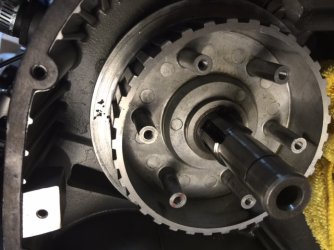
ignition is marked and removed, clutch is removed. Clutch hub appears to have casting flaws (?) and is shedding material, lots of bits and pieces of aluminum embedded in the clutch fiber plates. No idea if that might be causing the clutch to drag, but needs attention regardless. Clutch hub was NOT like that when I installed the new clutch fiber plates....

ran each of the 6 steel clutch plates through a bench mount wire wheel, cleaned them up, they do not appear to be warped.

the fiber plates are interesting. I ran the fine teeth of one of the fiber plates under the big wire wheel, looks like all the fiber plates have some sort of green coating, which I had noticed when they were new. Now I am wondering if the coating is making it tougher for the fiber clutch plates to move in the grooves of the clutch basket, I cleaned all the green coating off the fine teeth of one of the clutch fiber plates and tried it and a still coated fiber plate in the clutch basket, the cleaned plate moves a lot easier, just another thought.....

Paul LeClair
 

Attachments

  • clutch hub.JPG
    clutch hub.JPG
    107 KB · Views: 24
Paul,

Only way to check the steel plates is to lay them on a truely flat surface and try to wobble them, flip them over and repeat.  They can be warped and/or dished, both conditions can cause trouble of one sort or another.

No need to worry about the casting flaw, I see these quite often.  I doubt the shredded material would be from this flaw, search for other signs of wear.  Have a close look at the hub and basket splines for indents, these often prevent the plates from moving freely within the small range they have when the clutch is disengaged.  Deep indents can hold the plates back and thus cause dragging.

Thickness of the bonded plates has no influence on disengagement action, the movement remains the same regardless of plate thickness.  The thickness can have slight influence on spring pressure and where on the hub and basket the plates are situated.

piet
 
Hi Paul,
Put clutch back together and mount a dial indicator to measure deflection of end plate.

Pull clutch in and turn clutch hub round and monitor deflection of end plate ,where the springs are.
I expect you'll find that the end plate is not deflecting evenly.
At the point(s) of least deflection mount a thin washer on the spring mounting bolt to apply more pressure to spring.
Hopefully this should even out the deflection.
I suppose another way if you had the equipment is to test each spring so they all apply the same pressure for a given deflection.
Rig up something using bathroom scales!

Hope this helps,
Andy
 
Grant said:
At least check each spring's free length.

Hi Grant and all

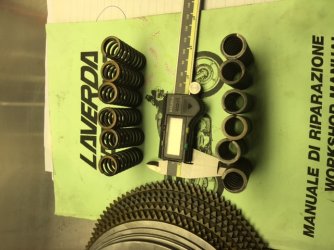
Laverda manual specifies the clutch springs to be NO LESS than 46 mm, does not specify how much longer they can or should be.

Measuring the brand spanking new clutch springs I had installed at time of rebuild with the new clutch plates, and which I was too stupid to measure when I installed them, one of them is 46.59 mm, the other 5 are all longer than 47.5 mm, the longest 48.9 mm, and none of them are anywhere near the same length as any of the others.... bloody hell.

as I do not throw out potentially re useable parts, I dug out the original clutch springs from the 82 1200 that I had replaced as a matter of course, figuring they would have needed to be replaced after sitting without moving in the clutch for 14 years while the bike sat unused.....

measuring the original clutch springs, they are all roughly 46.5 mms, give or take a few miniscule variations of less than 0.04 mms one way or the other. Bloody hell, the original springs are much much closer in length to each other than the brand new replacement spring's. I don't know if the new longer and various length clutch springs are part of the overall clutch dragging issue, but when the clutch goes back together it is going back together with the ORIGINAL springs. From now on I will measure every brand new part like clutch springs BEFORE installation.

Thanks all!

Paul LeClair
 

Attachments

  • clutch springs.JPG
    clutch springs.JPG
    115.7 KB · Views: 9
Back
Top