Adjusting gear box selector for easy neutral?

These days it's likely aftermarket parts from another supplier.
I have seen quite a few things that were not useable straight out of the box.

People like Wolfgang do try to use original suppliers wherever possible, but as he told me Paioli wanted a ludicrous amount to remanufacture the original fuel taps. Now all we have are the crappy Bap all metal taps.
 
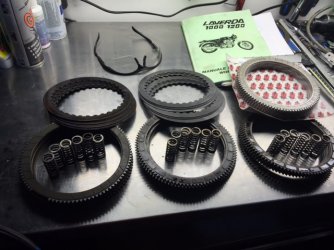
while I have the digital caliper out to measure the clutch springs, I also measured the new clutch plates that have been in the motor for roughly 100 kms.

The manual says MINIMUM thickness of a fiver clutch plate is 2.5 mm, so 8 plates would be 20 mm total. The manual does not say what the maximum thickness of the clutch plates can be, and I have no idea what typical fiber clutch plate thickness is.

The new fiber clutch plates, with roughly 100 kms of use, measure anywhere from 3.25 to 3.40 mm, collective total amongst the 8 plates is 26.56 mm. So the new clutch plates total 6.56 mm thicker than the specified permissible MINIMUM. I wonder what a Maximum permitted thickness would be?

I am about to go digging in my parts bins to see if I kept the original 10,200 km clutch plates. I may not have, unfortunately, but it is worth a look......

Does anyone have any other brand of fiber clutch plate around to measure?

In looking at the various measurements, if I left out one of the fiber clutch plates and only installed 7 rather than 8, I would still have a clutch pack thicker than the permissible minimum of 20 mm for the fiber plates, I would still have 23.31 mm if I left out the thinnest of the new fiber clutch plates, I never could figure out why the Laverda clutch has two fiber plates face to face anyways..... Hmmmmm.........

Paul LeClair
 
Maximun thickness would be the stock thickness when new, so of little relevance.  The manual simply assumes you use new STOCK plates when replacing.  These were around 3.2-3.4mm iIrc.  Rarely find any that are worn below min. specs, typically around 2.8-3mm.  Seems to take ages for them to wear further.  With wear, spring pre-load and pressure decrease, no other reason to replace them really, unless the friction material has worn off completely of course. :D

Only the MkII/120? clutches with the anti-rattle springs have 2 fiber plates against each other.  The hub is specially machined for these to fit.  If you omit one of these, you may eventually end up with no spring pressure as the pressure plate will be resting on the hub instead of the clutch plates.

piet
 
thanks, Piet

then my non stock fiber plates should be fine, all 8 of them, as they are within the thickness range you quoted as your best guess for stock fiber plates. I am still going to use a wire wheel to take whatever the green coating is off all the splines, see if that frees up their movement at all.

just waiting on my new steel clutch plates before I can put this thing back together and test ride. I have wandered fairly far from trying to adjust the shifter eccentric in the search for an easy neutral...... ;)

Paul LeClair
 
Margot Haerter arrived in Calgary, but unfortunately with new Italian Surflex  fiber clutch plates rather than the steel plates I ordered..... Wolfgang is back next week, I guess I will sort new steel plates out then ;) I took the Surflex fiber clutch plates anyway, might as well.

Now I have four full sets of fiber plates, two full sets of used steel plates, and three full sets of clutch springs. The two used sets of clutch springs are all very very close to the same length, the new set of clutch springs that were only int he clutch for 100 kms are wildly different lengths.

I think I am going to put the clutch back together using a mix n match approach to the clutch springs, using the 6 that are closest to each other in length, the best and flattest of the steel discs, and the new set of Surflex fiber plates, and see what happens......

Paul LeClair

ps the 8 new Italian made Surflex fiber clutch plates measure between 2.98 mm and 3.00 mm, dry out of the packaging, prior to soaking in oil.
 

Attachments

  • clutch plates.JPG
    clutch plates.JPG
    121.4 KB · Views: 12
If the spring lengths are so different then it would make me wonder if spring strength was consistent too.
Difficult to measure witbout a proper bit of kit.
In this day and age it shouldn't be necessary to have to go to these lengths with new parts though.
I applaud your perseverence Paul.
 
Paul,

If you are mixing springs, do not only check their free length, but also the wire guage and coil count.  Lots of springs have been on offer, partly to "cure" slipping clutches, so you really don't know what you have until you measure.

piet
 
Hi Paul,

If you don't have a spring measuring device...

When checking springs (approx. rate), you can place them (2 at a time) end to end in a vice and squeeze them. Measure the change in length, from the free length. This will help you sort out any rouge springs (to stiff or soft).

It'll take a while, but you will eventually sort them.

HTH

PaulH
 
Hi Paul H and all

I measured all 18 springs, 12 being used and 6 being new.

The 6 new were a thicker wire dimension than the 12 used, quite a bit longer, and of a relatively wide range of lengths.

I discarded the 6 new springs as a result.

Of the 12 used springs, there was much less variation in length, and all 12 measured as being of the same wire dimension and same number of spring coils. Of the 12 used springs I chose 6 based on all 6 being the SHORTEST available to me (but still longer than Laverda manual specified minimum length by a safe amount) and all 6 closest to the same lengths as against each other.

I soaked the 8 new Italian Surflex fiber plates in fresh oil. They did not seem to swell any, at least not in their initital soaking, and all 8 still measure 3 mm maximum or very slightly less.

Of the 12 used steel plates I had available, I  cleaned up all 12 on a heavy duty wire wheel, then I laid them out one at a time on the flattest surface I have available (a stainless steel bench top) and discarded the 4 of the 12 that were evenly slightly detectable warped/bowed. Of the remaining 8 I picked the 6 that seemed the best as far as I can tell with my primitive rocking/observation technique.

I then took a flat file to the "tangs" on the steel plates and removed any slight imperfections to be sure they move smoothly.

I then took a small triangular shaped file to the many slots in the clutch drum that the small triangular teeth of the fiber clutch plates move in. I only found a couple of slots with obvious issues, but I cleaned them all up "while I was at it".

Then I re assembled everything and put yet another 3 liters of fresh oil in the engine. The bike has now had FOUR complete oil changes in it's first 100 kms of break in and fettling, bloody hell.......

All I have left to do now is time the RedAx/Ignitech ignition rotor/trigger plate in the primary cover. Unfortunately the real world has intruded and I now have to do a bit of paying work this lovely Friday afternoon before I can get back to the bike again, hoping to test ride later today or sometime tomorrow (Saturday). Will report back as to results.....

Paul LeClair
 
Davo said:
If only it was that easy to find neutral on this board, eh?  :LOL:

thanks, Davo!! I am still LOLing so hard I am snorting..........  she'll be right, mate  ::) ::) ::) ::)

Paul LeClair

ps can't test ride as I caused myself a small ignition problem replacing the battery in the 82 1200 last night, I caused a couple of wires in the connector to the Ignitech to come loose from their pins when I removed the Ignitech from its Velcro attachment to the old battery..... bloody hell, entirely my own ham fisted fault. Off to the electronics supplier this morning to try and find a pin removal tool that will help me remove the now bare pins from the connector, really tough to get them out without wires attached to them. And yes, I am the ham fisted fool who crimped and installed them in the first place, obviously not properly.
 
You can get them out if you have a jeweller's screwdriver. You have to slide it in to depress the little tang on the connector that engages in the plastic housing, then the conector will just push out. Done heaps of 'em that way.
 
Paul, if you're talking about Molex connectors or something of that sort, there are tools available for removing the pins from the plastic holders.  Have you looked on eBay? I think they all come from China but hell, the tool is nothing more than a tiny tube of the appropriate size.  In a pinch you might try using a ball point pen refill.  I've never done that but I understand that can be used....
Boa Sorte
 
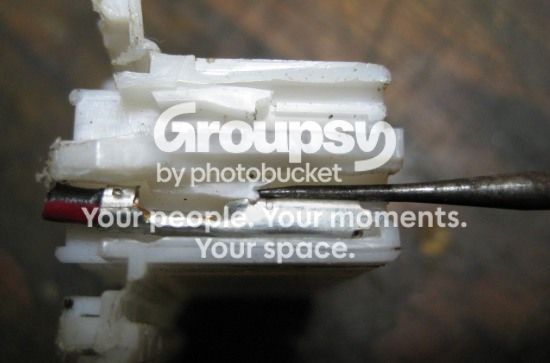
on these connectors, the locking tang is plastic and is part of the connector body, the plastic tang clicks into a depression in the metal pin itself. So, you have to depress the plastic tang from where the wire goes in, and there is not very much room. I know what the Molex pins look like and their removal tool, those are like a tube that slides up the pin from the other end and depresses the two metal arm that stick out of the Molex metal pins themselves, very different from what I am dealing with.

anyway, the Electronics Supply place had lots of the Molex type pin removers, but nothing along the lines of what I need. I have been poking away with various pointy things including orthodontic wire, will go try a variety of different sized jewelers screwdrivers. This is more complicated because the wires have pulled out of the pins, I have nothing to pull on, need three hands or more to both push and pull and hold, if you know what I mean......

Red very kindly just offered to send me a new upgraded wiring harness, I think I will persevere a bit more with what I am working with here before deciding if I need to take him up on that offer, and to repeat, the problem is of my own ham fisted creation......

Paul LeClair

EDIT - two jewelers screwdrivers worked a treat, jammed one down in from the top to push pack the plastic tang in the connector body, used another from the other end to push the pins out, 30 seconds or less..... THANKS!! My Ignitetch setup is one of the earlier ones supplied with a Sasche pickup board and it came with the connectors and wiring needing to be assembled, and Red had supplied extra pins so I have a couple of extra pins to re crimp and re assemble. I understand from Red he now supplies his own pickup board and a complete fully pre assembled and pre wired wiring harness which would take the ham fisted like me out of the equation in current installs..... ;) 8)
 
Paul LeClair said:
, I think I will persevere a bit more with what I am working with here ...,  the problem is of my own ham fisted creation......  Paul LeClair 
Congratulations Paul.  & you have now joined the exclusive 20-pin connector expert club.    (thumbup)

& no. I really don't want to talk about all the intimate moments I've had, learning the ropes, wiring up the bloody thing on Clyde.  :-[
131-20pin%20plug_01.jpg

 
markQLD said:
Congratulations Paul.  & you have now joined the exclusive 20-pin connector expert club.    (thumbup)

& no. I really don't want to talk about all the intimate moments I've had, learning the ropes, wiring up the bloody thing on Clyde.  :-[
131-20pin%20plug_01.jpg

Hi Mark

great photo showing the cutaway......

as you have discovered, you have to go in from the wire end to push back that little plastic tang that is so stubbornly locking into the depression in the metal pin. I used a tiny jewelers screwdriver from the wire end, really had to jam it in there to push the plastic tang back, them used a bigger jewelers screwdriver from the other end to push the metal pin back out of the connector.

Paul LeClair

ps Paul Marx, I agree!
 
Paul LeClair said:
ps Paul Marx, I agree!

I don't.  I reckon the primary chain is the weak point. The clutch can be made to work quite well, if a little heavy at the lever. I suppose it depends on your criteria for assessing the weak link.  It seems reasonable to me to consideer the potential for damage to the rest of the engine if it fails.
 
never thought the clutch was a weak point, can be made to work very well with not much effort
 
Neither do I.  Works well in stock form, providing all is mechanically well.

If it has a weak point, it would imho be the rather crude actuation with the sparsely lubed push rods and cross bar.  But even these hold up to quite some abuse before they fail, much like the rest of the engine.

At most, I'd regard the primary drive design as dated, it's main weakness being the limited service life of the chain.  Provided a decent quality chain is fitted, it gives no problems at all, unless periodic maintenance is regarded as problematic...  ::)

piet
 
Back
Top