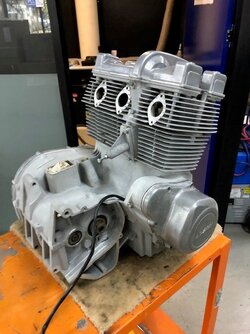
Alloy deep clean

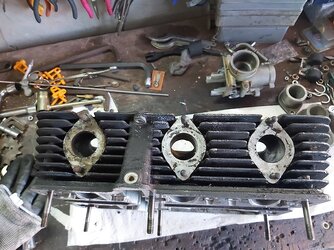
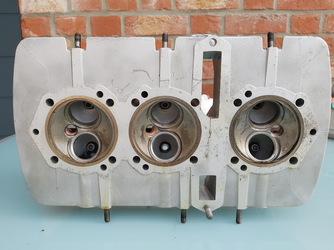
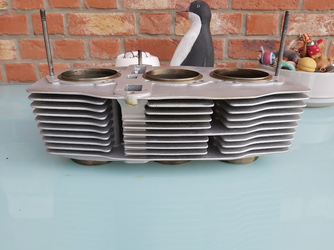
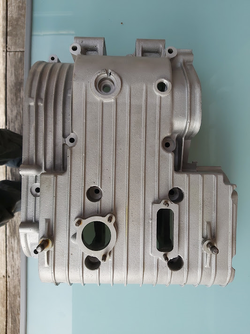
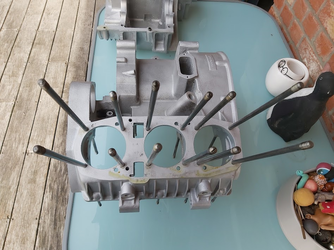
Dropped head, cylinder block, cases off at this place this morning. We'll see.
It looks like a one man operation and the man said that he'd try ultra sonics and if insufficient, soda blasting.
He thought that the head was painted. I had to show him a bit of clean casting near the gasket face.

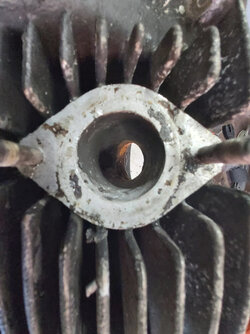
I spent yesterday afternoon digging bits of molten carb spacer from between the fins on the head.
58.jpg59.jpg
 
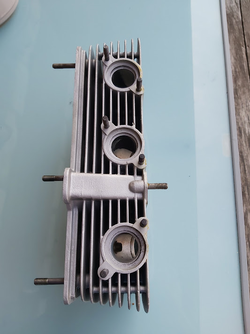
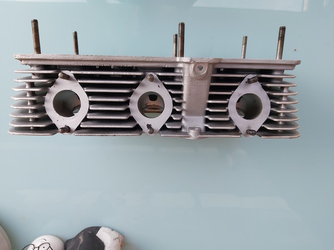
The best solution Paul is Laser Cleaning. I have had all my Laverda motors done. It will give you a factory finish with no metal removal. It is extremely good on carbon, oil etc. Used widely on fire impacted items.

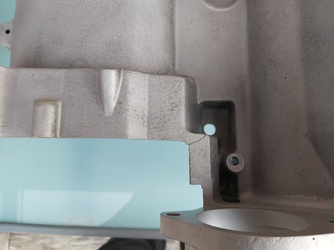
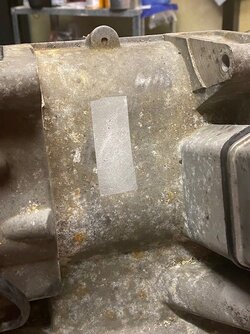
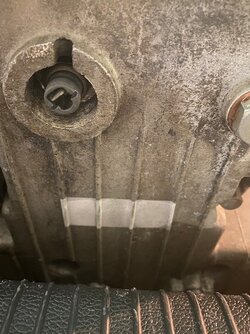
The below video demo’s a few different types of laser. We use the moving circle (as used on Audi head about 50sec’s in) as provides best finish, even power. There is no surface temp, all dirt/oxidisation etc. is vapourised and there is a large suction system around the lasered area normally. You use blue masking tape on anything you do not want lasered (see attached pic where tape was placed) – in fact you can place your hand under the laser while operating. There is no media so no cleanup and can be done to complete motors. Hope this helps.


Attachments

  • Pic1.jpg
    Pic1.jpg
    103.8 KB · Views: 79
  • Pic2.jpg
    Pic2.jpg
    99.2 KB · Views: 81
  • Pic3.jpg
    Pic3.jpg
    80.9 KB · Views: 81
Last edited:
The best solution Paul is Laser Cleaning. I have had all my Laverda motors done. It will give you a factory finish with no metal removal. It is extremely good on carbon, oil etc. Used widely on fire impacted items.

The below video demo’s a few different types of laser. We use the moving circle (as used on Audi head about 50sec’s in) as provides best finish, even power. There is no surface temp, all dirt/oxidisation etc. is vapourised and there is a large suction system around the lasered area normally. You use blue masking tape on anything you do not want lasered (see attached pic where tape was placed) – in fact you can place your hand under the laser while operating. There is no media so no cleanup and can be done to complete motors. Hope this helps.

Thanks.
If my little Belgian company doesn't do the job, I'll look it up.
Paul
 
It's impressive. Two points I'd like to know. Current draw for one. Suitable for home workshop ?
And it's very apparent it generates a lot of potentially toxic fumes. They say a collection and filtration system is used. I didn't see any operators using a mask but I'd have thought it would be a sensible precaution.
 
It's impressive. Two points I'd like to know. Current draw for one. Suitable for home workshop ?
And it's very apparent it generates a lot of potentially toxic fumes. They say a collection and filtration system is used. I didn't see any operators using a mask but I'd have thought it would be a sensible precaution.
Reckon there’s a couple of shots of a vacuum nozzle in there at times.

I hope Paul gets it done, would love to see the results.

It’s the coolest thing I’ve seen in years. Although I think that I’d stay clear of pointing the thing where there’s metal holding my bones together.
 
It's impressive. Two points I'd like to know. Current draw for one. Suitable for home workshop ?
And it's very apparent it generates a lot of potentially toxic fumes. They say a collection and filtration system is used. I didn't see any operators using a mask but I'd have thought it would be a sensible precaution.
The devices are in the 5 diggit range, not sure you would want to spend that for home use... I have seen it working on rusty parts, too. Came out clean as new!

As Chris said, there are nozzles in many of the shots, sucking the fume away. Might be that that is not necessary for every application. Depends on what you remove... Paint f.e. can be very toxic, rust most probably wouldn't.
 
I assume that the correct filtration cartridge in a well fitted mask used in a well ventilated area should suffice. Outside with a big fan at your back ought to do it. I am sure the device maker has recommendations, although toxicity will depend on what you are disintegrating!

Like all electronic equipment, the price will drop over time. Often significantly and rapidly.
 
Hi Team, seems this got your interest!!

It is an amazing process and it should not be too hard to find a business near you who has this equipment as it is widely used for cleaning moulds, smoke damage, rust removal etc.. There are small hand held units and large portable commercial units. I think the unit used on my motors was 2000w but it was doing the job easily at 300w-500w.

A 2000w laser can cut 20mm carbon steel, 8mm stainless steel, 6mm aluminium and 5mm brass for those wanting to know when it's dialled up beyond just cleaning.

The unit used was a top end laser which had numerous head configurations (5) as the beam movement is critical to getting the best results. I believe in this case you get what you pay for and it was +AUD$190K for the complete setup.

For those in Oz, you may recall the fire at the entrance to old Parliament House, well this was the laser used to remove all the smoke damage.

You can set a range of parameters to remove the type of contaminant and once it is removed the laser has no more reaction with the surface and the surface remains cold. To do the barrel fins they changed heads down to 10mm beam to get into this area. It took all of 5mins the setup and do a few test patches and then 3 motors were done.

In terms of fumes all contamination is vaporised and there is a large extraction vacuum system with has a filtering system. The laser gun has a vacuum built in as well so fumes do not feedback to operator. Within the fume room there was also a further 10' pipe on vacuum which could be placed where needed.

Note: it will clean anodised parts and in my experience it will also take some colour as it is impossible to adjust to avoid all frequencies which make up a colour. It does not remove zinc, cadmium or other plating unless our dial up the power and set parameters to remove it so there is no rusty mess a few weeks after being done.

In terms of cost it took around 2 hours per motor and cost AUD$700 - worth every cent.
 
Went to fetch my bits in nearby Belgium.
He did a good job, which cost me a bomb, paid cash, no bill. He said that it was a tough job.
Soda blasted.
Very clean. That won't last, a few layers of cooked cow dung, mud and bitumen will see to that.
I'll get my 12mm drill bit out to drill another hole in the primary compartment to oil the clutch. Just drill in the dotted line.
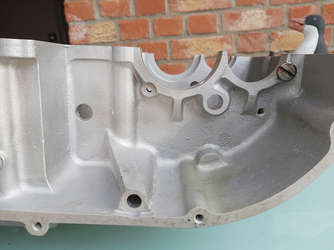
Notice the top case drilled out to take the oversize liners for the 78mm pistons.
The man pointed out a crack I hadn't seen, likely due to a broken secondary chain at some point.
1696678500866.png1696678525299.png
1696678558584.png
1696678585928.png
1696678609264.png
1696678639166.png
1696678800859.png
1696678880173.png
 
Back
Top