Alloy deep clean

I'm a big fan of soda blasting. Was really impressed when I did my own motor using a cheap $40 sand blasting gun and 20kgs of Bicarb soda
Not a fan of using any media that doesn't desolve in water.
After seeing that lazer cleaning video I want one.
 
looks like an early head paul, gasket shape triple ring, not oval slab and square corners to cam chain tunnel etc etc, I would say earlier than your bike, Piet?

if the cases have to be bored for the 78mm pistons and hence bigger OD liners, whats the advantage of not going the whole hog and make it 80mm in the first place, must be some science hiding in there?
Keith?
CLEM
 
looks like an early head paul, gasket shape triple ring, not oval slab and square corners to cam chain tunnel etc etc, I would say earlier than your bike, Piet?

if the cases have to be bored for the 78mm pistons and hence bigger OD liners, whats the advantage of not going the whole hog and make it 80mm in the first place, must be some science hiding in there?
Keith?
CLEM
Keith.
Head is not original to the bike. It was supplied by Keith, the original needed even more work than this one. This one is stamped 75, maybe the year? Bike is 74.
Paul
 
Why have the liners shifted in the barrel casting? Are they not tight?

piet
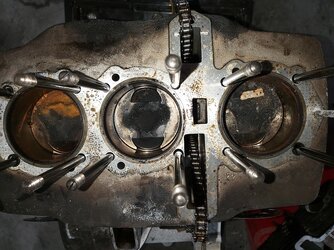
You're right. The liners have crept up. Here's a pic of when Keith did the block.
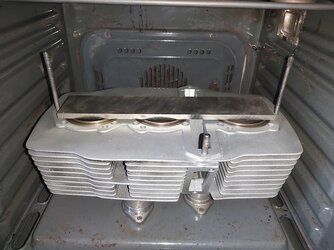
I presume it's a case of heating the oven sufficiently and the letting the block cool with heavy weights on the liners?
The crack above the final drive sprocket wasn't there either when Keith had it. In view of his meticulous work, he'd have welded it.
Paul
1696791185899.png
 
Before trying to move the liners, I'd have another look at the head. Has it been machined for this much liner protrusion ?
Hard to tell from the pics, good though they are.
 
Paul,

The liners do not creep by themselves, they would have been in place when the head was removed. The interferance fit is quite generous, to the order of around 0.06-0.08mm. I have bored barrels for over-size liners, but can't remember exact numbers, would need to check my notes. The massive contact area assures that the liner will not move without a considerable amount of heat being introduced to the casting. They should not move simply by placing the barrel assembly with the liner bottoms on a workbench.

Either the interferance fit was not ample to begin with (which I seriously doubt), or the barrel casting has suffered from the fire, compromising the fit.

Two definite problems may arise from this. Assuming the interferance fit is OK, simply shifting the liner back may distort the bore. Removing said liner completely to check the fit will almost certainly cause distortion! If the liner is too loose, heat transfer from liner to casting will be drastically compromised with possible piston seizure resulting. With the engine running, the barrel will undergo similar conditions as in an oven. Clearance between liner and casting will increase, allowing oil to ingress, which will eventually bake in place, further reducing heat transfer.

Transferring the liners to another barrel casting is also problem-prone. The bores will surely be distorted.

Nothing is as simple as it first looks...

@ Greg, the head is always flat, save for the recess for the liner spigot that fits into the circumference of the combustion chamber. While the height of the spigot is rarely critical, skimming the head excessively can change that. In stock form, there is a gap of about 0.5mm between the upper edge of the liner spigot and the combustion chamber. The liner recess in the barrel gasket surface is filled by the flame ring of the (correct-type) gasket. Besides, in Pauls pic, the 3 liners are clearly all at different heights.

piet
 
Paul,

The liners do not creep by themselves, they would have been in place when the head was removed. The interferance fit is quite generous, to the order of around 0.06-0.08mm. I have bored barrels for over-size liners, but can't remember exact numbers, would need to check my notes. The massive contact area assures that the liner will not move without a considerable amount of heat being introduced to the casting. They should not move simply by placing the barrel assembly with the liner bottoms on a workbench.

Either the interferance fit was not ample to begin with (which I seriously doubt), or the barrel casting has suffered from the fire, compromising the fit.

Two definite problems may arise from this. Assuming the interferance fit is OK, simply shifting the liner back may distort the bore. Removing said liner completely to check the fit will almost certainly cause distortion! If the liner is too loose, heat transfer from liner to casting will be drastically compromised with possible piston seizure resulting. With the engine running, the barrel will undergo similar conditions as in an oven. Clearance between liner and casting will increase, allowing oil to ingress, which will eventually bake in place, further reducing heat transfer.

Transferring the liners to another barrel casting is also problem-prone. The bores will surely be distorted.

Nothing is as simple as it first looks...

@ Greg, the head is always flat, save for the recess for the liner spigot that fits into the circumference of the combustion chamber. While the height of the spigot is rarely critical, skimming the head excessively can change that. In stock form, there is a gap of about 0.5mm between the upper edge of the liner spigot and the combustion chamber. The liner recess in the barrel gasket surface is filled by the flame ring of the (correct-type) gasket. Besides, in Pauls pic, the 3 liners are clearly all at different heights.

piet
Thanks for pointing it out and explaining Piet.
Now I have a problem.
Paul
 
Unlikely Keith would have missed that!
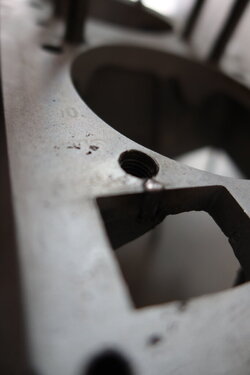
One theory could be that when the hole was drilled out it weakened the alloy at that spot internally. When the bike caught fire the air in the internal crack expanded and thus caused the crack to spread.
Looks like another welding job.
Andy
 
Unlikely Keith would have missed that!
One theory could be that when the hole was drilled out it weakened the alloy at that spot internally. When the bike caught fire the air in the internal crack expanded and thus caused the crack to spread.
Looks like another welding job.
Andy
It's with the welder now who has a laser kit.
Fingers crossed.
Paul
 
I've reread Piet's post and...
Checked the cylinder and head mating surfaces, they're both perfectly flat.
I've dug out some pics that I took before having the castings cleaned. Even though the incidence of the photo isn't optimal, the liners were in place when the head was taken off. They therefore crept up during cleaning which first involved an ultrasonic bath followed by soda blasting. I can only surmise that the ultra sonics caused the liners to move.
I'm going to risk it, heat up the oven and push them back in. We'll see. If I were a professional, I wouldn't do it but the bike is mine to take the risks.
Paul
65.jpg41.jpg42.jpg45.jpg
 
Liners are back where they should be. A few minutes in the oven with 15kg on them and then 3 hours cooling time before taking the weights off.
One less thing to do.
Next week, if I have time I'll be testing home zinc plating.

Many thanks to Piet, Red and Keith Nairn for the help on this.
Paul
103.jpg
104.jpg
105.jpg
107.jpg
Blind Faith
108.jpg
109.jpg
110.jpg
 
Back
Top