Atlas Questions

Sometimes when trying to get a good look at something inaccessible, it helps to poke your phone down there and take a photo.

As mentioned above, I'm not at all familiar with the Atlas clutch, so I'm struggling to understand what you're describing with moveable nipple, threaded pin, etc. My comment about Piet's post was based on theory of simple machines (levers and such) rather than any specific knowledge about the bike.
Cam,

The 500/600 use a clutch cable with a fixed nipple only at the handle bar end. The nipple used at the engine end is a screw clamp type. There is no on-the-go provision for cable adjustment other than at the handle bar lever.

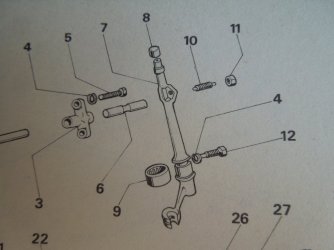
The clutch is actuated by a vertical shaft (#7) with a fixed 90° lever under the crankcase, the shaft passes over the end of the gearbox mainshaft and pushes on the clutch pushrod through a small adjuster screw (#10). With the clutch lever pulled, the included angle of the actuating lever and cable should be close to 90° for maximum advantage, nothing arse about there... ;) The angle of the adjuster screw to pushrod will vary due to clutch pack thickness/wear. Ideally, the screw should end up in line witht he pushrod, but this is seldom the case.

Adjustment is achieved by positioning the lever via the adjuster screw at an angle that will result in the 90° when deployed and sliding/tightening the nipple on the cable to suit.

piet
DSCN1010.JPG
 
Hi Vince,
I would advise , what ever you do, is lock wire the 'solderless nipple' on the end of the cable, to the arm.
Basically if the cable breaks, chances are you'll loose the solderless nipple, so even with a new cable you will not have any way of securing end!
Andy
 
  • Like
Reactions: T.C
Thanks Piet. The arrangement is very clear now. More or less as I'd guessed from the conversation. Vince actually sent me a bunch of photos via SMS. They make sense now.

I'm relieved to see that you concur with my assertion that 90° gives maximum mechanical advantage, rather than maximum pushrod movement. :)

It looks like something of a compromise in design. Lots of scope for not achieving ideal thrust angles at both ends of the vertical shaft. It would need careful setting up to get the most out of it. I've never been keen on solderless cable nipples either, especially for something as heavily loaded as a clutch cable.
 
I am looking into Andy's suggestion about going to Zane Hydraulic. Does anybody know what size Mastercylinder is used in Zanes or Mark 3 Atlass? I remember reading that 13mm masters gave a lighter clutch pull than the std I think 15 or 16, Ideally, I want a very light pull but maximum throw so the clutch doesn't drag and I can easily get neutral when stopped. Be good to match the square master reservoir on the front brake as well.
 
*aaaaahh* - with the symptoms our very first thought should have been for this 'classic Atlas gaffe'.
That (80th style) breather tube drove me crazy. The daily hazzle with tank bags, squeezed tubes, broken tubes, broken nippels, fiddeling the tube back into the 'fork nut hole' at each fuel stop, getting stuck bc of underpressure ( ... tank bag)
A solution had to be found : luckily this '40mm lockable and breathable cap' for 'german mopeds' fitted perfectly. What a relieve ! Adios the hazzles listed above + much easier to open/tighten e.g. with icy fingers - and no passing rascal would pour sand or water into the tank.
Maybe the best of "lite fixes" of "daily annoyances" on my Atlas. BTW it got 'Africa approved' (taking regular fesh fesh showers)
Maybe you can find it in your country:
I ordered one of those caps and it turned up today and it doesn't fit. But that's being a bit anal. After trying it in a couple of ways and eventually working out how it locks some measuring found the original verniered at 45.7mm and the new lockable one comes at 47.4mm across their barbs or tabs. These barbs drop into notches in the tank and allow it to screw down. The locking mechanism results in the cap spinning and not being removable. So I need to file the new caps bars down by 1mm on each side so it drops into the tank hole completely. Easy peasy. Thanks, Franky, it's great to hear first-hand good info.
 
The new lockable fuel cap with its built-in breather now fits and works really well without the old breather hose that would pinch off and stale the engine, 30 minutes of careful filing to avoid damaging its rubber seal and it's a great gadget.
 
The new lockable fuel cap with its built-in breather now fits and works really well without the old breather hose that would pinch off and stale the engine, 30 minutes of careful filing to avoid damaging its rubber seal and it's a great gadget.
Good to know, I might order one myself to try.
 
I did a little test today on my dragging clutch issue. There appear to be 2 conditions that produce this effect, internal and external issues. Internal issues could be warped steel plates or corrugated drum grooves that don't allow smooth plate movement. External issues involve snagging cable or poor adjustment in the cable connections. As a test with minimum cable free play at the handlebar, I snapped a set of vice grips on the vertical shaft at the end of the external bits and bobs to add more mechanical effect. That did nothing to reduce the drag and it still won't select neutral with the engine running, so to me that indicates warped plates. So new plates it is.
 
45.7mm and the new lockable one comes at 47.4mm across their barbs or tabs. .... I need to file the new caps bars down by 1mm on each side so it drops into the tank hole completely.
ahh, that's possible and I had forgotten that little 'detail' ;)
apropos clutch: there's "something wrong" :) A correctly operating Atlas clutch does seperate easily even under load (very high temperature).
have you verified for the correct number/thickness of clutch disks?
Synthetic oil: if you have old NOS disks don't do it. you risk that there won't be drag at all (happened to me) ;)
hydraulic transformation : ask youself if it's worth the efford and the money - maybe first try to find 'the fault'
Happy New Year
 
Hi Franky, I strongly suspect the bike has warped steel clutch plates and I bought a full set of both types of plates from Piet. In the new year, I am going to get the factory 500 twin manual clutch replacement section printed and replace the clutch plates. I am hoping that will allow me to get neutral at traffic lights. That's the last major pain in the arse the bike still has. The tank cap you mentioned worked great, arrived really quickly and was really cheap.
 
I have been thinking about how my clutch plates warped and ways to avoid it happening again and I remember Red drilling my 3c clutch hub years ago, more oil flows through the hub cooling the clutch and helping it function, my 3c has an extended lower lever and it works great plus I easily get neutral on it. So I hope the 4-valve Zane clutch allows room to drill the hub as well.
 
I have been thinking about how my clutch plates warped and ways to avoid it happening again and I remember Red drilling my 3c clutch hub years ago, more oil flows through the hub cooling the clutch and helping it function, my 3c has an extended lower lever and it works great plus I easily get neutral on it. So I hope the 4-valve Zane clutch allows room to drill the hub as well.
hm, gruelly totured the Atlas clutch in fesh-fesh and dunes - it did not get damaged nor warped.
two easy 'must'-tricks though:
- use mineral oil (no synthetic or semi-synthetic) e.g. 20W-50
- replace the original clutch springs with Zane springs: minimum 3 (every 2nd), better is all 6
 
Hi Franky, what effect on pull strength with your hand with that spring change, Does it become even heavier? Could you get neutral before those springs were fitted engine going at traffic lights and did fitting those springs help again with getting neutral? I have a clutch drag problem, mine does not slip.
 
Not sure if it is relevant but when I raced a 500 my tuner had the bike on a rolling road just before I left for a race weekend and the clutch slipped under power.
Not having Laverda springs to hand a set of Suzuki GSX-R 750 race springs went in the clutch and it never bothered me for the rest of the season. Four race starts a weekend.
 
Good info, how was the clutch pull with the new springs
If you are off road I’m sure you will use the clutch much more than I needed to on a race bike - once off the line it was just bang bang bang through the box for six laps. I didn’t think about it as long as it was working as it should, which is a good thing.
I’ve Green Laned a bit, mostly on KTMs, and know the clutch is used in a much different way off road.
Suppose the lever needed some strength but I’m a big lad and as said, it was only six lappers.
 
After months of faffing about, I just fixed my 2 clutch issues with a simple adjustment. I should have known better, as it's not that tricky. I have a frayed cable were the lower grumb screw graps on so moving that along the cable isnt easy. The major issue has been clutch drag, making getting neutral with the engine going impossible and its hand pull is pretty hard. Not typical Laverda hard, but up there. I was thinking about how the lower clutch adjustment works and why I could not get it to activate further inward and reduce the drag on the clutch. So i manged to move the grub screw further toward the end of the cable witch allowed the lower clutch to swing further out, all snugged up with zero upper adjustment and all the slack taken out of the lower adjuster i just got nutral multipal times with the engine going plus the hand presure is now way lighter. I should have twigged earlier. That lower adjuster has a huge impact on clutch throw and the geometry of leverage. All the upper adjuster does is take out tiny amounts of lever freeplay. I had been using the upper adjuster to take out way too much. So I will replace the clutch cable with one without loose broken threads, and Bob's your uncle.
 
Reports of my Mraculus clutch fix were premature. I thought I had been right through trying all the available cable adjustments before, so why the sudden fix? Well, because I had suddenly managed to get neutral with the bike still sitting up on its 600mm x600mm plate jack and both wheels in the air. Penny dropped just before I pulled the old cable off. With the bike on the ground and engine running, it's still impossible to get back into neutral. So it's back to fitting new plates to see if that reduces the clutch drag. I definitely never want to replace a clutch cable on the side of the road on this bike; it took me 45 minutes to just pull the old cable off. The cable has a heat-proof sheath over it for where it gets close to the exhaust. Pulling that through the big rubber clutch and choke rubber cover was painful. How to turn a 5-minute job into a 45-minute nightmare, not looking forward to fitting the new clutch cable with all that flapping about.
 
Back
Top