Been there done that. I have had a bearly turning over engine on cold starting for a while. It's a Deka ETX16L that's at a guess maybe 5 years old. A buddy load tested it a couple of months back and it was maybe 95% ok. So even with it being on my Smart Charger it nearly spins the motor but at least it does start but I am surprised at that. With the engine warm it starts all day long fine. This is a PROBLEM waiting to happen. It's exactly what happened with my previous battery, that MASSIVE Oddysy I had then. They're so expensive I get gun shy buying a replacement and that not fixing this reluctance with cold starting. I checked all the connections and all were clean and tight, tomorrow it's another load test. I just wish you could get a complete answer, eg battery is toast but you never seem to. What has me moving towards a new battery is the dash voltage metre starts at 12.5v but 3 seconds after holding the button down this drops to 8v, and I think other than zero spins that voltage is below the ignition threshold for the ignatec to fire. BTW this battery retails at $235oz and I bet that will happen in a day or so. BTW this is with the full 240watt alternator and ignition kit. MUST SPEND MONEY on a new battery.

You are using an out of date browser. It may not display this or other websites correctly.
You should upgrade or use an alternative browser.
You should upgrade or use an alternative browser.
Borderline Battery
- Thread starter Vince
- Start date

martymoose
Hero member
- Location
- Sydney, Australia
Bring it up to the workshop vince and ill load test it, closer than taking it to blacktown.
I was heading to Battery World at Chatswood, less drama than taking up your time Marty. One thing I should have tried is Jumping the bike off my car. If that worked then it's probably the battery being a dud in the bike. But after the last 130mm of rain, my yard is like crossing a full-blown swamp on the bike. There used to be a Dirt Bike enduro in the USA Called The Black Water. Enjoy

mauricejota7604
Hero member
- Location
- Victoria Australia
Maybe its not your battery but your starter motor Vince.
I remember hearing how slowly it cranked your engine at Dalgety thinking here comes a push, but it fired..
I remember hearing how slowly it cranked your engine at Dalgety thinking here comes a push, but it fired..

Beucars
Hero member
- Location
- Central Europe
Did you check overcharging which could reduce battery life? Especcially important with these kind of batteries
I just did a search, that battery could be either 4 or 10 years old or anywhere in between. I hooked up with a mate, Yogi who had an account and bought it at wholesale after he asked here. He asked both 4 and 10 years back, Good point about overcharging, I was having Regulator issues for a while, charging at 15.3. Now fixed but it maybe cooked at that rate and just now died. That voltmeter on the dash really is a good thing.

The Sock
Hero member
- Location
- London, England
Check the condition of your starter cables (battery to relay and relay to starter motor).
I ran mine for too long, forty plus years.
The copper was migrating to the negative ends of the lead, increasing the resistance and, consequently, the heat until the insulation stared smoking!
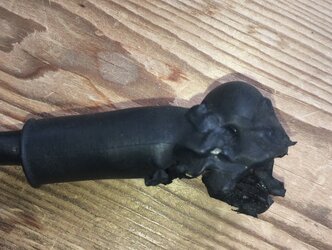
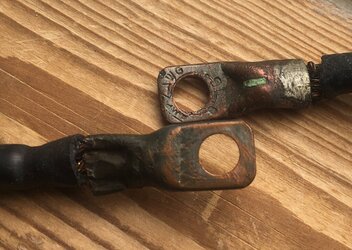

I ran mine for too long, forty plus years.
The copper was migrating to the negative ends of the lead, increasing the resistance and, consequently, the heat until the insulation stared smoking!
Last edited:

40 years is a very long life for a battery! What make was it?Check the condition of your starter cables (battery to relay and relay to starter motor).
I ran mine for too long, forty plus years.
The copper was migrating to the negative ends of the lead, increasing the resistance and, consequently, the heat until the insulation stared smoking!
View attachment 61395View attachment 61396View attachment 61396View attachment 61400View attachment 61401
Paul

Dellortoman
Hero member
- Location
- Tasmania, Australia
Blimey, I didn't know that was even a possibility.The copper was migrating to the negative ends of the lead, increasing the resistance and, consequently,

Electromigration - Wikipedia
Hey Vince. My last battery problem turned out to be the starter motor. Cranking of the engine got slow and feeble over time until I eventually couldn't start it at all. I assumed the battery was on its last legs. But when I attached some jumper leads from my car (known good battery) it still wouldn't crank over and the starter motor got very hot. Worth checking.

I reckon you'd need to be running it 40² years for that to become an issueCheck the condition of your starter cables (battery to relay and relay to starter motor).
I ran mine for too long, forty plus years.
The copper was migrating to the negative ends of the lead, increasing the resistance and, consequently, the heat until the insulation stared smoking!

So today I needed to be close to Marty's shop and he kindly load tested my battery after it sat on my Repco 7 stage smart charger all night. That's on the Gel mat setting it gets a Desulphation, soft start, Bulk charge then an absorbent charge, battery test, reconditioning and then it floats. Marty load tested it twice and it passed both tests. I went home and refitted it and the bike started well. I will leave it a few days and see how it goes. Maybe it was just flat a bit and it's sat for too long unridden. I had charged it a couple of times while it sat but was not connected overnight, just till it showed full charged. So I will see in 3 or 5 days how it goes.

Andy
Hero member
- Location
- Auckland, roughly
Looks like classic corrosion to me. Recrimping the ends may have fixed it, although moisture tend to capillary along the cable, as well as into the old crimp.Check the condition of your starter cables (battery to relay and relay to starter motor).
I ran mine for too long, forty plus years.
The copper was migrating to the negative ends of the lead, increasing the resistance and, consequently, the heat until the insulation stared smoking!
View attachment 61395View attachment 61400View attachment 61401
Copper migration? Dunno… either way you’re right to replace them


Incorrect crimp tool for the lug, should be a hex or octa compression crimp die implemention. You can clearly see that only a limited cross section of the copper cable is actually in parallel compression, more a mechanical retaining process than electrical best conductivity connection. Ditto the "faston" style 6.3m/m lugs, proper constant compression ratchet crimp tools are lower cost than the days of $450 crimps. I use $35 ( trade ) ratchet crimps, and have the $450 ones also, no real difference overall. If you have those skinny type crimps ( mild steel formed ) leave them outside to rust, as garden artifact...j BTW seen Laverda with aluminium starter cables, supply connection. Crimping these require special compounds. Do run a high current return cable from stater motor mount fastener to direct battery negative terminal, welding cable with proper crimp is good.Check the condition of your starter cables (battery to relay and relay to starter motor).
I ran mine for too long, forty plus years.
The copper was migrating to the negative ends of the lead, increasing the resistance and, consequently, the heat until the insulation stared smoking!
View attachment 61395View attachment 61400View attachment 61401
Last edited:
Batteries, et al. Treat them as consumable items, every 20 fills of the gas tank, replace the battery...yes yes piddly joke yet the premise remains. Pretty much what i did with the inner circle, every 2 years, $150-180 for a proven brand of battery, ongoing supply of that proven battery is another hurdle.... clever chargers aside ( have a ctek 2500 and an old Arlec 80amp unregulated charger ) defer to the Arlec 80% of the time, works for me as i have test equipment aplenty, including non invasive amp meter for starter motor stall and running armature/field consumption. Tired batteries cost too much on the open road. HTH j.
The Sock
Hero member
- Location
- London, England
Those are the OEM cables, John.Incorrect crimp tool for the lug, should be a hex or octa compression crimp die implemention. You can clearly see that only a limited cross section of the copper cable is actually in parallel compression, more a mechanical retaining process than electrical best conductivity connection.
Yes i know, have factory cables here removed. Mechanics/engine/bike builders worry me no end, of the belief electrical work is the same as mechanicals, suppose sort of, the factory was poorly advised or subbed out the cable/lug. While is was serviceable for some considerable period, the crimping was inferior to correct process from the start. Myself, was caught out using improper process when i used to presolder wire ends then mechanical crimp, Utilux proper sales engineer said the solder cold flows in time. Lugs became electrical higher resistance as the crimp pressure failed. Obvious though not obvious to me in the 70's. j.Those are the OEM cables, John.
Last edited:

Legs
Hero member
- Location
- Adelaide Hills
Did have a problem once where the brush holders had rotated a bit on the mounting rivets, might be worth checking out.
The Sock
Hero member
- Location
- London, England
Been there, done that.Myself, was caught out using improper process when i used to presolder wire ends then mechanical crimp, Utilux proper sales engineer said the solder cold flows in time. Lugs became electrical higher resistance as the crimp pressure failed. Obvious though not obvious to me in the 70's. j.
I was put right by some F1 engineers I was flying out to a testing session. They told me "no solder joints are used in F1!", and why.
Dellortoman
Hero member
- Location
- Tasmania, Australia
I don't have one of those $450 crimping tools for large cables that John was talking about. I just solder the lugs on. It relies on the solder joint to hold together, but I've been doing it that way for donkey's years and not had one fail yet
If you want to do your own this way, you need to find a lug that's a nice snug fit on the cable for a neat result. Direct the flame at the flat part of the lug and allow the heat to conduct to the barrel part. Once the solder starts to flow it'll carry the heat through to the conductor. Don't get the gas flame anywhere near the cable or you'll burn the plastic sheathing. Slip a bit of heat shrink sheath over it to cover the exposed metal and the job's done.
Here's one I prepared earlier. If memory serves, it's the cable from the battery to the starter relay on my Benelli triple. I use red heat shrink to identify live 12V terminals. Mainly as a reminder not to earth it with a spanner. The barely adequate original cable with its crappy lugs is next to it for a size comparison.
The bigger starter and battery cables made a significant improvement to engine cranking and starting reliability. When trying to start with the old cables, it would struggle to crank over compression and would sometimes kick back, putting horrendous impact loads on the starter gear. It hasn't done that since I installed the larger cables. The cable from the starter relay to the starter motor is about 800mm long, so the original skinny one had significant voltage drop. The poor cranking meant more time with the thumb on the starter button before the engine would fire, so the cables used to get quite hot.

If you want to do your own this way, you need to find a lug that's a nice snug fit on the cable for a neat result. Direct the flame at the flat part of the lug and allow the heat to conduct to the barrel part. Once the solder starts to flow it'll carry the heat through to the conductor. Don't get the gas flame anywhere near the cable or you'll burn the plastic sheathing. Slip a bit of heat shrink sheath over it to cover the exposed metal and the job's done.
Here's one I prepared earlier. If memory serves, it's the cable from the battery to the starter relay on my Benelli triple. I use red heat shrink to identify live 12V terminals. Mainly as a reminder not to earth it with a spanner. The barely adequate original cable with its crappy lugs is next to it for a size comparison.
The bigger starter and battery cables made a significant improvement to engine cranking and starting reliability. When trying to start with the old cables, it would struggle to crank over compression and would sometimes kick back, putting horrendous impact loads on the starter gear. It hasn't done that since I installed the larger cables. The cable from the starter relay to the starter motor is about 800mm long, so the original skinny one had significant voltage drop. The poor cranking meant more time with the thumb on the starter button before the engine would fire, so the cables used to get quite hot.