I never really got the point of timed breathers, I would have thought a bloody big hole would be the least restrictive as long as you don't lose oil. I think Phil Tod would add a breather up top as well The Guzzi blokes love there windage trays, any point for that in this case. No oil cooler coming?

You are using an out of date browser. It may not display this or other websites correctly.
You should upgrade or use an alternative browser.
You should upgrade or use an alternative browser.
Building a race bike
- Thread starter julian
- Start date

interesting observation on crankcase pressure, I would probably be the only person to have actually set up a crankcase pressure gauge on a Laverda triple to see what they do
My sensor measures 0-10psi on my engine test bed, under load on a 180 triple the needle fluctuates from 3psi to just under 8psi depending on how much you load the engine with the water brake
On a 120 engine needle barely moves from 3psi no matter how much you load the engine but to me I struggle to even understand why you would even bother trying to load up a 120 engine
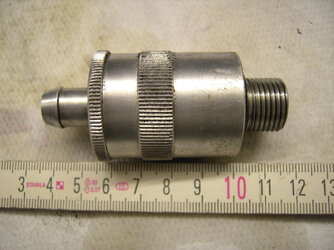
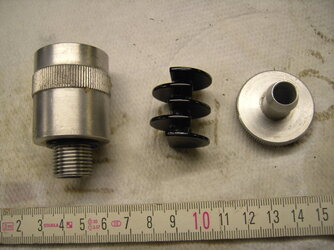
Is why I machined up a reed valve breather from a Kawasaki 2 stroke (thanks Greg T) that bolts on to where the starter motor goes on a triple, you don't have that luxury on a 750 engine case
I still use the standard ball operated breather as well so have two on the race engines
I like to look at what drag racers are using as they are chasing minimal gains and the serious ones always have vacuum pumps evacuating their crankcases to gain power

Exmoor beast
Hero member
- Location
- Minehead,Somerset, ENGLAND OF COURSE
We went through a spate of cutting a window or port in the lower part of the liners to aid “Windage” as the yanks call it.
I built a ZZR1100 with nitrous oxide and also a YZF750/850 .
I built a ZZR1100 with nitrous oxide and also a YZF750/850 .

The aim is to create close to a vacuum within the cases with (hopefully) more air going out than coming in. A fine line though, a high vaccuum will cause much the same resistance than high positive pressure, only in the other direction of piston travel. In no case should much of a positive pressure arise, see piston blow-by through worn rings/bores. This quickly causes oil to be blown out the breather.I never really got the point of timed breathers, I would have thought a bloody big hole would be the least restrictive as long as you don't lose oil. I think Phil Tod would add a breather up top as well The Guzzi blokes love there windage trays, any point for that in this case. No oil cooler coming?
"Negative" pressure in the cases also helps in keeping gaskets oil tight.
My long-stroke 750 benefitted greatly from a second breather installed instead of the oil filler plug/dipstick. Apparently the stock breather copes with the stock amount of air being moved around, but not much more. Some works SFCs had a similar setup.
piet

GregT
Hero member
- Location
- Christchurch NZ
I've been using a reed valve on Peter's 1200 simply as a matter of course. anything I build that has big pressure fluctuations in the cases is a good candidate for a reed valve.
The aim is as big a difference as possible between above piston pressure and below. A big pressure differential will aid ring sealing.
To go back to the Aermacchi's - after a reed was put on, the plug looked like we'd gone 10 leaner on the main. Cylinder head is much cleaner when it's lifted too.
The aim is as big a difference as possible between above piston pressure and below. A big pressure differential will aid ring sealing.
To go back to the Aermacchi's - after a reed was put on, the plug looked like we'd gone 10 leaner on the main. Cylinder head is much cleaner when it's lifted too.
GregT
Hero member
- Location
- Christchurch NZ
At the WSB round here in '89 I got pulled aside by the Doyle bros and shown the drawings for the case and barrel mod for the ZX7. I had a customer one running in WSB - and I was also running a F3 500 Kawa that was winning, so they must have thought I was worth talking to,lol.Hi Chris,
They had early problems with the race bikes due to returning the head oil down the centre cam chain tunnel, at sustained high revs the chain whipped the oil into a froth and threw it out of the gaskets and starved the oil pump. This was cured by changing the oil drain and later on the race bikes having a sub sump like I am planning. We did the same on some of the pre-war race engines we tuned and had/solved the same problem.
You also have a phenomena that is concerning internal air movement.
Imagine 4 cylinders, two up two down, the two going down move a lot of air into the crankcase, the two moving up allow it to go up, however this is a lot of air movement, 750cc x 12000 = 9000 litres of air movement per minute inside the crankcase. The Muzzy ZXR Kawasakis actually modified their crank cases internally to make them more aerodynamic for less power sapping and it gave them a couple of hp apparently. I am trying to consider all of this in my build. Especially with the twisted crank it will be a more violent air movement, we will see.
I may also use an air box, I am considering this as air box resonance can be worth good HP.
Regards,
J
It was 2 10mm deep X 20mm wide holes cut in the barrel base and a matching pair in the cases, between 1 & 2 and 3 & 4 cylinders.
I'm afraid i laughed and said Suzuki have had bigger holes on the GSXR for years.

Interesting thoughts,
I was reading about the Muzzi kawasaki developments trying to squeeze every last drop of power out of a basically outdated design and they did a lot of testing of airflow. They found little power from pressure or vacuum changes but substantial power gains from helping the movement of the air. Of course sealing gaskets and seals will be a different conversation. I had always believed that negative crank case pressure was good but never actually measured it or the power changes it made so interesting to read other peoples findings.
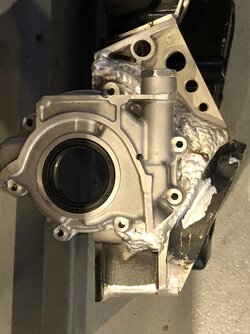
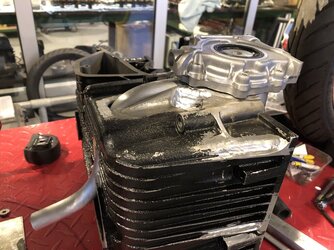
My thoughts are to aid the airflow internally as much as sensibly possible, and I will be using three breathers, one on the head (although I can't use the std position due to the frame.) one on the oil dipstick, machined larger for a 1" hose. and one on the rear of the gearbox, on the blanked casting that was made for some reason at the factory. and my aim is to have as close to zero pressure/vacuum as possible.
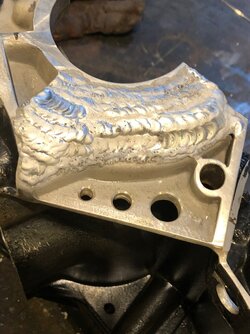
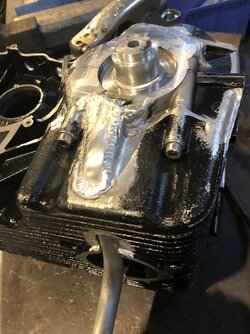
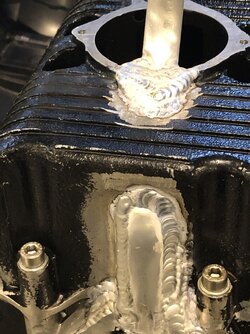
Added a little weight to the engine last night, (will have to take it back of somewhere else now )
Pics attached.
J
I was reading about the Muzzi kawasaki developments trying to squeeze every last drop of power out of a basically outdated design and they did a lot of testing of airflow. They found little power from pressure or vacuum changes but substantial power gains from helping the movement of the air. Of course sealing gaskets and seals will be a different conversation. I had always believed that negative crank case pressure was good but never actually measured it or the power changes it made so interesting to read other peoples findings.
My thoughts are to aid the airflow internally as much as sensibly possible, and I will be using three breathers, one on the head (although I can't use the std position due to the frame.) one on the oil dipstick, machined larger for a 1" hose. and one on the rear of the gearbox, on the blanked casting that was made for some reason at the factory. and my aim is to have as close to zero pressure/vacuum as possible.
Added a little weight to the engine last night, (will have to take it back of somewhere else now
)Pics attached.
J
Attachments
Last edited:

Laverdalothar
Hero member
- Location
- Germany
would it be hard to change the thing to a dry sump? This would cure a lot of the pressure thing as you have more space for the air and also the crank not running in oil removes resistance. just like on Porsche 911 or - Laverda V6 engines... ;-)
Crank design would need to be changed though I think... Or you'd need oil jets to get oil into the slingers...
Crank design would need to be changed though I think... Or you'd need oil jets to get oil into the slingers...
Hi Lothar,
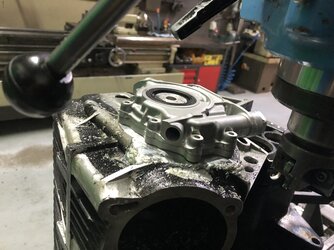
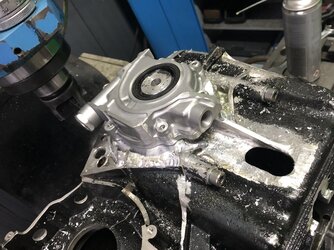
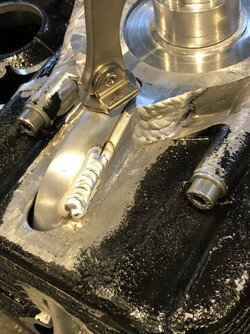
Well actually it will be "Half" of a dry sump engine,
The crank stroke is 61mm so it is tiny and well out of the oil.
It will have a really close oil / crank scraper to direct the oil into the sump which will be totally enclosed like a good well designed dry sump, only it will carry the oil in the bottom of the engine.
It will also have a sub sump under the normal sump that the oil pump picks up from,
Dry sump systems usually cost a couple of HP over wet sump units and I have actually measured power losses between the same engine in both configurations (and well designed with only 1.5L of oil in suspension @7k under load) due to extra scavenge sections and pipework etc costing power. And they weigh more also. (substantially more in the case of a light weight motorcycle)
They do for sure have their advantages but not enough in my opinion in this particular case.
Crank will be in plain bearings and need fed so no problem with slingers.
Regards,
Jules

piranha-bro2
Hero member
- Location
- Melbourne
Some serious mods going down there Julian! How big is the sub sump going to be? You'll need room for the race regs obligatory oil catch pan under there somewhere.
Hi,
Yes, "just a few changes"
The sub sump will be about 40mm lower than the main sump and about 10mm of extra fins.
Full length of the engine and about 120mm to give me about 1.5L extra oil.
So far in the regs for the classes I will be racing in there are not compulsory nappies, however I am aware these may come into place and have room if needed, After all, between the wheels is not generally a problem for ground clearance, only sideways. But making a 1.5mm ally lower fairing section to house a nappy should not pose a problem if need be.
The rules over here at the moment state
"NOTE: Vintage and Classic machines (prior to 1973) racing exclusively in their own race or event are exempt, at the discretion of the organiser."
Hope they stay that way.
J

Are you planning to race with the CRMB Julian?Hi,
Yes, "just a few changes"
The sub sump will be about 40mm lower than the main sump and about 10mm of extra fins.
Full length of the engine and about 120mm to give me about 1.5L extra oil.
So far in the regs for the classes I will be racing in there are not compulsory nappies, however I am aware these may come into place and have room if needed, After all, between the wheels is not generally a problem for ground clearance, only sideways. But making a 1.5mm ally lower fairing section to house a nappy should not pose a problem if need be.
The rules over here at the moment state
"NOTE: Vintage and Classic machines (prior to 1973) racing exclusively in their own race or event are exempt, at the discretion of the organiser."
Hope they stay that way.
J
Paul
Hi Paul,
Possibly but the larger races are what I am interested in. However it all depends on how much fun is to be had.
Vince,
There is still a lot of room for the exhaust under the engine, the sub sump wil only lower it by 2 inches max and that still gives me loads of room for the exhaust. In fact it helps me as the exhaust needs to be fairly long for the power I need and dropping it 2inches will help with placement. I don't like side exhausts on race bikes, I find them a bit ugly and not nice for the rider either. I also need to run (at the moment) a 2 into 1 so side exhausts are not easy to have looking period and equal length. The sub sump will not pose me any issues in my opinion.
Once the head is totally finished and I have final exact flow numbers (the mock up shows extremely good figures and am confident the final finished item will flow even more as the seats are not nearly as good as they could be for a start) I will then do the final design and analysis of the exhaust configuration, it is very critical and so far the exhaust has been the biggest single influence on power by far. Even more so than cam timing. This has born fruit for me on many occasions so am looking forward to this part. But due to the nature of the beast, I can only do final designs of certain things in order and only basic analysts and basic designs at this stage.
Followed by shit loads of real dyno work later. and lots of track testing.
Regards,
Jules
piranha-bro2
Hero member
- Location
- Melbourne
Can't recall, but is the motor running a 270 or 360 crank, Julian? I've spent many hours 'thinking' exhaust systems and I formed the opinion that my 2/1 didn't function at high revs with the (5C) cam anywhere near as well once I went from even pulse 360 degrees to uneven 270. I've gone with a 2-1-2 but may go to a 2-2 (two separate systems) after comments from Greg in NZ.
I'd love to spend the many dyno hours Red did developing the Mule's system but that's not going to happen. My dyno work can only extend to carburation at this stage, although swapping to my 2/1 for some sort of comparison will be easy. I'm not looking at your power and revs and my std stroke and 880cc mean my motor is very different from the one you're creating.
I'd love to spend the many dyno hours Red did developing the Mule's system but that's not going to happen. My dyno work can only extend to carburation at this stage, although swapping to my 2/1 for some sort of comparison will be easy. I'm not looking at your power and revs and my std stroke and 880cc mean my motor is very different from the one you're creating.
Maybe use modern 270 degree twins as inspiration. TRX850s used two separate pipes with a balance connection but were hardly tuned for high power! KTM 790/890 twins might be a better example, two separate pipes to a collector box then a single exit. Dunno what's in the collector however. But they claim 100hp from the 790.Can't recall, but is the motor running a 270 or 360 crank, Julian? I've spent many hours 'thinking' exhaust systems and I formed the opinion that my 2/1 didn't function at high revs with the (5C) cam anywhere near as well once I went from even pulse 360 degrees to uneven 270. I've gone with a 2-1-2 but may go to a 2-2 (two separate systems) after comments from Greg in NZ.
I'd love to spend the many dyno hours Red did developing the Mule's system but that's not going to happen. My dyno work can only extend to carburation at this stage, although swapping to my 2/1 for some sort of comparison will be easy. I'm not looking at your power and revs and my std stroke and 880cc mean my motor is very different from the one you're creating.
cheers,
bazzee

Tippie
Hero member
- Location
- Dr?bak, Norway
A 270 motor would be fine with a two into one. Ducati/Guzzi et al, all the Aprilia Milles that race classic superbike here (not too far from those degrees) run 2/1. My mates 90 deg big bang Laverda had to have separate exhausts.
Hi,
I have spent many years looking at exhausts in many configurations and studying papers and trends etc to see and learn what happens. In recent (past 10-15 years) there have been massive leaps in simulators etc and from that dyno testing to check results and the modern theory is that cylinder to cylinder interference (positive or negative) is minimal at anything over 5k revs, Far more important is the pull down from exhaust opening and high gas speed and pull from the finite amplitude pressure waves returning in the primary, this argument has shown to have very strong legs in both in simulation data and my real world testing. Under 5k however does seem to be effected by cylinder to cylinder interaction quite substantially, depending on cam duration and engine concerned etc, some more than others obviously. We are struggling a lot with our old cars where exhausts are concerned as they always need to look period and not completely out of place when in view. Not an easy problem when the exhaust is generally in full view.
Some exhausts we have developed have ended up completely opposite to std thinking and expectations and on occasion I have needed to take a big leap of faith to make something that "Should work" and believe in myself rather than what is the std thinking. Its always a bit of "suck and see" but in most occasions we have got the results we wanted.
My motor will be 450/270
I have been doing weeks of sims on both 2 into 1 exhausts and separates but so far I cant get a separate pipe system to work well enough throughout the rev range I need. the 2 into 1 gives me a very wide torque / power curve and the single pipe system drops off heavily at one end or the other due to pipe size needed to keep the gas speed correct and take advantage of the finite amplitude pressure waves. Single pipes did show me a very high peak power but it would have been totally unridable.
Interesting stuff.
Jules
While I was doing a small reno on Chrispin's place he showed me his Computer-driven engine sim, plug-in engine spec data and get power and toque results. This was maybe 10 years back. It theoretically produced exciting results, MAYBE too exciting. Time moves on and I bet there much better now. Reading some of those exhaust design formulas re waves had savaging results in very small rev bands. The old English race bike builders used to talk off Megaphoneitise. Probably the same thing. The 2 best exhaust stories seen here had them built, then tested on Dinos and chopped a bit and tested quite a few times before they worked at their best. Lots of work.