Need to make an extractor for Gt cam. Would the threads of this Laverda bolt be the same. I believe the bolt came off one of the right covers. I can tighten it in by hand only 1 1/2 turns. Already tried a Bolt place but not sure about the thread pitch. Flanges are stuck together. Unless someone knows a good way to separate flanges I need some kind of extractor.

You are using an out of date browser. It may not display this or other websites correctly.
You should upgrade or use an alternative browser.
You should upgrade or use an alternative browser.
cam extractor gt?
- Thread starter Evan
- Start date
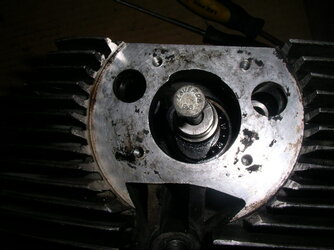

If you intend changing at least the outer cam bearings, having heated the head, hit the outer bearing cages from the inside with a metal bar of some sort, aka screwdriver.Need to make an extractor for Gt cam. Would the threads of this Laverda bolt be the same. I believe the bolt came off one of the right covers. I can tighten it in by hand only 1 1/2 turns. Already tried a Bolt place but not sure about the thread pitch. Flanges are stuck together. Unless someone knows a good way to separate flanges I need some kind of extractor.
Paul
Outer bearings are out. No way to hit inners but they have to come out. Flanges are tight on sprocket like they are welded! Tried tapping thin & brittle electronic type screwdriver tips to break flanges from sprocket but broke tips of screwdrivers. In other words the flanges are just not falling apart. I Will spray flanges w/ rust buster. Doing it now. Anyway the Laverda bolt looks like it may be the right thread for the cam end. If I brace the sprocket on top w/ wood (its secure on bottom w/ the sprocket on head wall) should come out w/ extractor. Question is will that Laverda bolt fit the threads of the cam tip???????????? See pic.........Unless somebody knows something else I could try...

Thomas aus LAU
Hero member
Hi Evan, please keep your cylinder head alive.
Rule number 1: No brutal force!
Rule number 2: Do not hit hardened tools on hardened shafts!
Rule number 3: The right tool makes (working) life easier.
If you jam the camshaft and bring it off center line when removing it, you will widen the bearing seats of the camshaft bearings by removing chips or by expanding = not good.
The job (with the rocker arms removed) is stress-free in 10-15 minutes to do, if you have an expeller/extractor that you can (have) build yourself.
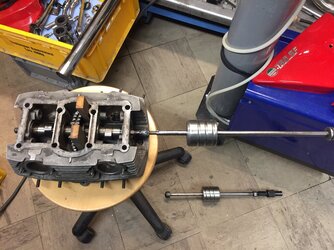
A simple steel axle with the appropriate thread for the camshaft on one side. A weight that has been drilled through is then placed on the shaft (here a doorstop from a hardware store). Finally, a stop is welded or screwed onto the other end.
Procedure:
1. Put your head on a solid surface that does not scratch (cardboard, wood, ...)
2. Open the nuts of the three connecting studs and remove all 6 nuts.
3. Heat the cylinder head to approx. 120 degrees in the stove ((important: It is better to send your wife/girfriend/friend to go shopping beforehand))
4. Put on gloves
5. Clamp two (!) wooden blocks between the sprocket wheel and the head.
6. Screw the expeller/extractor min. 10-15 mm (8 mm M8 ISO) into the right end of the camshaft as far as it will go and pull out the right-hand camshaft with 1-3 firm taps to the right.
7. Now insert the two wooden blocks to the left of the gear wheel so that the gear wheel can be supported.
8. Now insert a brass or wooden stick from the right side through the right side bearing holes and tap out the left camshaft half to the left with a medium sized hammer.
The gear wheel is also "pulled off" in the process.
9. Done. Smile and drink a bottle of beer/wine or mineral water ((for Paul)).
If you leave all bearings on the shaft when removing, there is less risk of tilting. It may sound complicated, but it is simple. With the extractor you can easily reinstall the shaft.
At the bottom of the picture there is an attachment on the puller/extractor with which you can pull the needle bearings out of the clutch side cover on the left.
Chair is only for photo, not for working on it!
Thomas aus LAU
Rule number 1: No brutal force!
Rule number 2: Do not hit hardened tools on hardened shafts!
Rule number 3: The right tool makes (working) life easier.
If you jam the camshaft and bring it off center line when removing it, you will widen the bearing seats of the camshaft bearings by removing chips or by expanding = not good.
The job (with the rocker arms removed) is stress-free in 10-15 minutes to do, if you have an expeller/extractor that you can (have) build yourself.
A simple steel axle with the appropriate thread for the camshaft on one side. A weight that has been drilled through is then placed on the shaft (here a doorstop from a hardware store). Finally, a stop is welded or screwed onto the other end.
Procedure:
1. Put your head on a solid surface that does not scratch (cardboard, wood, ...)
2. Open the nuts of the three connecting studs and remove all 6 nuts.
3. Heat the cylinder head to approx. 120 degrees in the stove ((important: It is better to send your wife/girfriend/friend to go shopping beforehand))
4. Put on gloves
5. Clamp two (!) wooden blocks between the sprocket wheel and the head.
6. Screw the expeller/extractor min. 10-15 mm (8 mm M8 ISO) into the right end of the camshaft as far as it will go and pull out the right-hand camshaft with 1-3 firm taps to the right.
7. Now insert the two wooden blocks to the left of the gear wheel so that the gear wheel can be supported.
8. Now insert a brass or wooden stick from the right side through the right side bearing holes and tap out the left camshaft half to the left with a medium sized hammer.
The gear wheel is also "pulled off" in the process.
9. Done. Smile and drink a bottle of beer/wine or mineral water ((for Paul)).
If you leave all bearings on the shaft when removing, there is less risk of tilting. It may sound complicated, but it is simple. With the extractor you can easily reinstall the shaft.
At the bottom of the picture there is an attachment on the puller/extractor with which you can pull the needle bearings out of the clutch side cover on the left.
Chair is only for photo, not for working on it!
Thomas aus LAU
Last edited:

Procedure 1, " put your head on solid surface..... reminds me of the old work safety poster...."when i nod my head...you hit it!!
Love your experience Thomas, please dont think the worst of me....just very funny your exact instructions, willingness to help others obvious the many times.... i just enjoyed reading the funny side into a practical instruction....much grinning here.
Procedure 3, you too! I did that exactly, valve guide removal and liner removal from barrel.... back from shopping "whats that smell...my reply...must be next door cooking something bad j
Love your experience Thomas, please dont think the worst of me....just very funny your exact instructions, willingness to help others obvious the many times.... i just enjoyed reading the funny side into a practical instruction....much grinning here.
Procedure 3, you too! I did that exactly, valve guide removal and liner removal from barrel.... back from shopping "whats that smell...my reply...must be next door cooking something bad j

1200ts
Hero member
- Location
- USA - Riverside CA
I never understand why people think getting the head or other aluminum parts up to the temperature of boiling water is hot? The head gets hotter than this when you are riding the bike! Yes the wife needs to be away when you use the oven to heat the part but it needs to be at least 175 to 200 degrees C and the rocker shafts and cams will slide out without needing a puller or bashing it with a drift. If a puller is required to remove some part which is a shrink fit in to aluminum, it is not hot enough. Obviously this does not apply to valve guide removal.
Finally the flanges should be a very, very tight fit on the cams. If not they will come loose.
Finally the flanges should be a very, very tight fit on the cams. If not they will come loose.
Last edited:
Thomas aus LAU
Hero member
Ok, short after Christmas i´ll spend you some additional degrees. The last 43 years it worked with "around 100°C" without brutal force and scratches in the bearing area. My fingers are more comfortable at 110 degrees than 180 degrees.I never understand why people think getting the head or other aluminum parts up to the temperature of boiling water is hot?
The expeller/extractor is primarily there to pull the shaft straight out and to separate the two halfes.Yes, when you want to remove the sleeves or valve guids you need a a higher temperature as the situation (wall thicknesses) ist differend.
But of course everyone can do it as they want - there are many ways to get to Rome.
Thomas aus LAU
p.s. 1200ts: Next time i´ll test your "about 190°C" and give you my feedback.
Last edited:
1200ts
Hero member
- Location
- USA - Riverside CA
Hello Thomas,
I have seen in a number of workshop manuals (not just Laverda) about heating parts up to 100C degrees to extract shrink fit parts in aluminum. But what I never understand is where this temperature came from as the motor is running on a warm summer day hotter than this. The cylinder head is getting up to at least 150 degrees if ridden hard.
On my old BMW twin I would see 135C degrees oil temperature on a very hot day (45C). The cylinder heads were much hotter than this, probably about 175C is my guess. When the oil is smoking on the head in the oven is the temp I am looking for to remove parts.
I have seen in a number of workshop manuals (not just Laverda) about heating parts up to 100C degrees to extract shrink fit parts in aluminum. But what I never understand is where this temperature came from as the motor is running on a warm summer day hotter than this. The cylinder head is getting up to at least 150 degrees if ridden hard.
On my old BMW twin I would see 135C degrees oil temperature on a very hot day (45C). The cylinder heads were much hotter than this, probably about 175C is my guess. When the oil is smoking on the head in the oven is the temp I am looking for to remove parts.

Ernesto
Hero member
- Location
- Hamburg, Germany
Standard metric pitch. If it just says M8, it's standard pitch.what about thread pitch
If it was fine pitch, it would say M8x1(xlength).
Ernesto

Tippie
Hero member
- Location
- Dr?bak, Norway
He is not trying to remove the flanges from the camshaft in this operation, simply removing the camshaft from the head. The stubs og the cam that sit into the duplex sprocket sometimes sit a bit tight, but they are not a "press fit". I have never needed to heat a head to 200 degrees like you mention, it should not need that for operations like this. Aluminium expands far more than steel and from my experience, as soon as the head is warm the cam bearings move freely, thus the need for supporting the sprocket. I have always simply supported the sprocket as shown and carefully knocked the side of a lobe with a soft metal bar, once the sprocket is loose the cam virtually comes out quite easily, I have never needed a puller but if you have one then use it. I would never remove the outer bearing first, as Thomas points out you risk getting the cam cock-eyed and damaging the head.Finally the flanges should be a very, very tight fit on the cams. If not they will come loose.

piranha-bro2
Hero member
- Location
- Melbourne
How hot the parts get when at operating temps is totally irrelevant to the process of removing steel parts (like a cam) from aluminium parts (like ahead). You start from cold everything, heat the (head) and the aluminium expands a lot quicker than the steel, as already mentioned.
Thomas aus LAU
Hero member
Aluminium expands more than the steel at the same temperature..... and the aluminium expands a lot quicker than the steel, as already mentioned.
As some time ago desrciped it helps to work fast, when you heat the head and start to "implant" the frozen camshaft into the head or flanges.
The greater the temperature difference, the lower the pressure between the two parts. That's why you have to be as quick as possible during installation.
Thomas aus LAU
1200ts
Hero member
- Location
- USA - Riverside CA
Aluminum does not expand quicker than steel it expands more as it has a higher coefficient of expansion. There is no way to get the head hot without the bearing also getting hot. Math does not lie. The number below were easily calculated using standard formulas. The numbers are not perfectly exact as we don't know what aluminum alloy Laverda used for the castings.How hot the parts get when at operating temps is totally irrelevant to the process of removing steel parts (like a cam) from aluminium parts (like ahead). You start from cold everything, heat the (head) and the aluminium expands a lot quicker than the steel, as already mentioned.
For the above example of removing the cams:
The cam bearings are 47mm diameter at room temperature. A normal and usual fit for a bearing this size in aluminum would be a .05mm shrink fit. Laverda may have used a tighter fit than this as the bearings used are C3 clearance. I don't have a head apart at the moment to measure.
So going with a .05mm fit the bearing bore in the head would be 46.95mm at room temp.
At 100C the bearing diameter would be 47.048mm and the bore in the head would be 47.033mm so the bearing is still bigger and we still have a shrink fit. That's why you need a puller.
At 150C the bearing diameter is 47.07mm and the bore in the head would be 47.085mm so the shrink fit is gone but not much room to work with.
At 200C the bearing diameter is 47.109mm and the bore in the head would be 47.137mm and now we have more room to work with and the cams will come out easy.
Now putting the cams back in, yes put them in the freezer and you don't need to get the head as hot, but you need to work fast.

arancia
Senior member
- Location
- Arizona, USA
For what it's worth, I use the outdoor gas barbeque grill and get it to where it shows in the 400-450 Fahrenheit range on the thermometer on its cover to drop wheel bearings out of hubs, cam bearings out of heads, etc. on my Laverda bits and still sometimes have to give wheel bearings a bit of a thump.

"C3" bearing clearance relates solely to internal play, ie, between the balls/rollers and races. It has no bearing on fit to shaft or bore, these are the same as any other bearings of the same denomination, with or without a "C" suffix.
Removing an outer bearing first is a big mistake, how it's even possible is beyond me. Such drama can easily be avoided by consulting a parts book or a search here on LF, basic and minimum requirement for any vehicle maintenance imho.
Rarely does a 750 head need to be heated to much more than maybe 70-80°C to enable (easy) cam removal, the bearings are a firm sliding fit in the head casting when cold. Later, after a few removal/replacement procedures, they become a loose sliding fit... and almost fall out by themselves once the sprocket studs are parted. Heating the head avoids unnecessarily shaving metal from the casting when the cam goes cock-eyed.
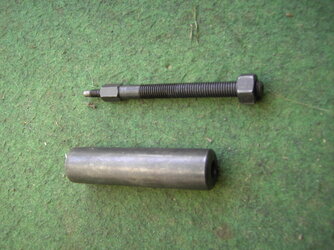
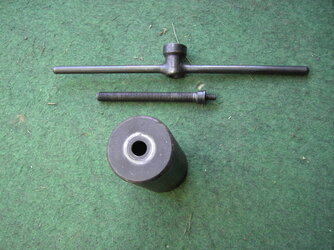
Below are the factory tools for the job of extracting the RH cam and the rocker spindles. LH cam is knocked out from the opposite side with a (soft) metal bar. Very early RH cams did not have the provision for a puller attachment, factory manuals show a large screwdriver being used against the side of a cam lobe to bash out the shaft...
piet

Removing an outer bearing first is a big mistake, how it's even possible is beyond me. Such drama can easily be avoided by consulting a parts book or a search here on LF, basic and minimum requirement for any vehicle maintenance imho.
Rarely does a 750 head need to be heated to much more than maybe 70-80°C to enable (easy) cam removal, the bearings are a firm sliding fit in the head casting when cold. Later, after a few removal/replacement procedures, they become a loose sliding fit... and almost fall out by themselves once the sprocket studs are parted. Heating the head avoids unnecessarily shaving metal from the casting when the cam goes cock-eyed.
Below are the factory tools for the job of extracting the RH cam and the rocker spindles. LH cam is knocked out from the opposite side with a (soft) metal bar. Very early RH cams did not have the provision for a puller attachment, factory manuals show a large screwdriver being used against the side of a cam lobe to bash out the shaft...
piet

breganzane
Hero member
- Location
- NSW Australia
<Piet replied while I was in the shed measuring, but will send anyway>
Not to be a pedant, but given that aluminium has a coefficient of thermal conductivity roughly 4-5 times higher than steel, it's very likely to expand both more, and more quickly.
Secondly, they run considerably less than 50 micron interference fit in the head. I've only worked on one 750 head (my racebike's, which has probably had a hard life) but all I had to do was warm the head on an oil column heater (probs not much more than 50C) and they came out with only light effort with a slide hammer. Someone like Piet who has likely done hundreds would be the best to clarify, but nobody seems to need any more than "warm to hot". I've just measured two other bare heads I have here and they're 47.98 and 47.02 respectively!
Back to Evan - go back a few steps, take a deep breath and follow accepted practice. I would perhaps try to reinstall the outer bearing onto the cam so as to keep things aligned better. Should be possible by warming the head. The thread in the end of the cam will be M8x1.25 (standard metric) and must surely be available even in America. Please don't use the Laverda script bolt for that - they are rare as hens teeth! Don't try to remove the flanges from the cam before it's out of the head (that's the bit that IS meant to be tight!). I reckon yours is just stuck in the cam sprocket or keyway a little, or has gone sideways. Further force will likely only bring more damage. Deep breath, tread carefully and ask back here as you go!
Aluminum does not expand quicker than steel it expands more as it has a higher coefficient of expansion.
Not to be a pedant, but given that aluminium has a coefficient of thermal conductivity roughly 4-5 times higher than steel, it's very likely to expand both more, and more quickly.
Secondly, they run considerably less than 50 micron interference fit in the head. I've only worked on one 750 head (my racebike's, which has probably had a hard life) but all I had to do was warm the head on an oil column heater (probs not much more than 50C) and they came out with only light effort with a slide hammer. Someone like Piet who has likely done hundreds would be the best to clarify, but nobody seems to need any more than "warm to hot". I've just measured two other bare heads I have here and they're 47.98 and 47.02 respectively!
Back to Evan - go back a few steps, take a deep breath and follow accepted practice. I would perhaps try to reinstall the outer bearing onto the cam so as to keep things aligned better. Should be possible by warming the head. The thread in the end of the cam will be M8x1.25 (standard metric) and must surely be available even in America. Please don't use the Laverda script bolt for that - they are rare as hens teeth! Don't try to remove the flanges from the cam before it's out of the head (that's the bit that IS meant to be tight!). I reckon yours is just stuck in the cam sprocket or keyway a little, or has gone sideways. Further force will likely only bring more damage. Deep breath, tread carefully and ask back here as you go!
1200ts
Hero member
- Location
- USA - Riverside CA
Hello Piet,
I agree with all you say. You and many others on this forum have no doubt worked on more Laverda's than I ever will. And I understand what a C3 clearance bearing is. If the application has the outer race of the bearing being compressed from a shrink fit and the inner race being expanded from a press fit on a shaft, you need a bearing with extra clearance. I have taken apart over the years a number of 750 heads, and the ones that were not touched since they left the factory have a very tight fit on the cam bearings. You have to get the head very hot or the bearings won't move. On heads where previous owners have worked on them and pulled or bashed the bearing out on a head not hot enough, yes the shrink fit goes away. At that point, I agree, heating the head up to very hot is not necessary. On my 1968 750GT after 54 years of only me taking the head apart, the cams bearing are still very tight in the head.
I have re-sleeved the main bearing bores on a number of Triumphs, BSA's, Nortons and other bikes over the years where the bearings fall out of the crank cases even cold. The owner would say I got it hot with a heat gun or boiling water and the bearing would not come out so I used a hammer and punch. The old bearing on inspection now has a coating of aluminum on it.
I guess I should have said in my previous post "this only applies if your head has never been touched".
The head above with the 47.98mm bore is scrap unless you re-sleeve it. Almost 1mm is a lot of clearance!
I agree with all you say. You and many others on this forum have no doubt worked on more Laverda's than I ever will. And I understand what a C3 clearance bearing is. If the application has the outer race of the bearing being compressed from a shrink fit and the inner race being expanded from a press fit on a shaft, you need a bearing with extra clearance. I have taken apart over the years a number of 750 heads, and the ones that were not touched since they left the factory have a very tight fit on the cam bearings. You have to get the head very hot or the bearings won't move. On heads where previous owners have worked on them and pulled or bashed the bearing out on a head not hot enough, yes the shrink fit goes away. At that point, I agree, heating the head up to very hot is not necessary. On my 1968 750GT after 54 years of only me taking the head apart, the cams bearing are still very tight in the head.
I have re-sleeved the main bearing bores on a number of Triumphs, BSA's, Nortons and other bikes over the years where the bearings fall out of the crank cases even cold. The owner would say I got it hot with a heat gun or boiling water and the bearing would not come out so I used a hammer and punch. The old bearing on inspection now has a coating of aluminum on it.
I guess I should have said in my previous post "this only applies if your head has never been touched".
The head above with the 47.98mm bore is scrap unless you re-sleeve it. Almost 1mm is a lot of clearance!
Last edited:

Dellortoman
Hero member
- Location
- Tasmania, Australia
I hope Evan reads this before he blunders deeper into the mire of dodgy mechanical work.Back to Evan - go back a few steps, take a deep breath and follow accepted practice. I would perhaps try to reinstall the outer bearing onto the cam so as to keep things aligned better.
I remember seeing a camshaft with a chip busted out of one of the cam lobes. It was a mystery at the time but now I know how it happened. Thanks for solving that puzzle.I have always simply supported the sprocket as shown and carefully knocked the side of a lobe with a soft metal bar