Ceriani front forks rebuild

Lyndoneil

Full member
Location
Towcester uk
I know this is a subject that has been oftern discussed, sometimes in more detail than I really need to get into.
I have 2 bikes with 38mm ceriani front forks, a Ducati 860 and a Laverda 750 sf2. The Ducati front end rides perfectly, the Laverda however feels harsh and likely to change direction on bumpy roads.
To the best of my knowledge, both sets of internals are standard.
So I'm going to strip down the Laverda forks to see if they can be improved.
I'm curious as to what I am actually looking for in wear and tare, and which parts usually might need replacing?
It might be obvious on disassembly.
I don't want to go down the new racetech or similar emulator route or anything that's going to complicate my life, but purely slightly to improve the feel of the bike.
 
Some model Laverdas had a very unusual set of triple trees with a 1-1/2-degree out-of-parallel offset, which has a big influence on steering feel. It will be interesting to see what you find.
 
I don't want to go down the new racetech or similar emulator route or anything that's going to complicate my life, but purely slightly to improve the feel of the bike.
Other than removing the fork legs, waiting a few weeks, opening your wallet and replacing your fork legs, you could let Maxton sort out your suspension for you. I, and many others, can confirm that there is a vast improvement, on worn OEM internals, to be enjoyed.
I've DM'd you my experience with the upgrade.
 
The main reason for the 38mm Cerianis becoming harsh (next to damage such as bending or corrosion) is the internal damping piston swelling and consequently jamming in the stanchion. This piston is made of a zinc alloy and can actually swell when exposed to moisture (contaminated fork oil?) for a prolonged period. A NOS piston laying un-protected in a storage box for a couple of decades was rendered completely useless to the point it started cracking up... think crusty old carbs pulled from a leaky barn after 30 years.

If this is the case and they do not yet show any sign of dissolving, the pistons can be machined back to size, aim for about .3mm clearance to the fork stanchion ID. Alternatively, one can be made from a good grade aluminium, pretty straightforward.

Second reason is too tight oil seals, I've often reverted to ditching one of the 2 each side and making up a spacer insted. This helps reduce stiction to a degree. I use regular seals, some work absolutely fine while others remain a sticky pita. Why Ceriani and Marzocchi decided to fit 2 seals on each leg is a mystery to me, maybe they thought the forks needed to last a million miles without blowing a seal.

Another reason is general wear and tear, fork oil was not high on many maintenance schedules! Check the lower ends of the stanchions for signs of wear, the sliders will have similar wear, not much to do about that except looking for replacements. Depending on how bad, the stanchions can be turned 90° or 180° to offer a fresh surface for the sliders to grind down...

piet
 
The main reason for the 38mm Cerianis becoming harsh (next to damage such as bending or corrosion) is the internal damping piston swelling and consequently jamming in the stanchion. This piston is made of a zinc alloy and can actually swell when exposed to moisture (contaminated fork oil?) for a prolonged period. A NOS piston laying un-protected in a storage box for a couple of decades was rendered completely useless to the point it started cracking up... think crusty old carbs pulled from a leaky barn after 30 years.

If this is the case and they do not yet show any sign of dissolving, the pistons can be machined back to size, aim for about .3mm clearance to the fork stanchion ID. Alternatively, one can be made from a good grade aluminium, pretty straightforward.

Second reason is too tight oil seals, I've often reverted to ditching one of the 2 each side and making up a spacer insted. This helps reduce stiction to a degree. I use regular seals, some work absolutely fine while others remain a sticky pita. Why Ceriani and Marzocchi decided to fit 2 seals on each leg is a mystery to me, maybe they thought the forks needed to last a million miles without blowing a seal.

Another reason is general wear and tear, fork oil was not high on many maintenance schedules! Check the lower ends of the stanchions for signs of wear, the sliders will have similar wear, not much to do about that except looking for replacements. Depending on how bad, the stanchions can be turned 90° or 180° to offer a fresh surface for the sliders to grind down...

piet
Thanks for that info, it at least gives me an idea what to be checking for.
 
im for about .3mm clearance to the fork stanchion ID.
If you have to replace the stanchions, consider that new ones have a slightly bigger wall thickness.
So not only the piston but some other parts will have to milled down a bit.
But concerning the piston, I'm with Piet:
one can be made from a good grade aluminium, pretty straightforward.
Check also if a spring is broken.
Ernesto
 
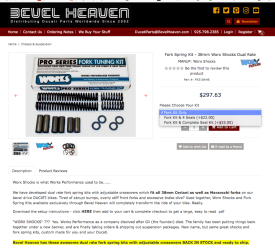
I also have 38 mm Cerianis and experienced very harsh pogo like stiffness and all good info above I might explore. I changed the fork fluid to 5 wt and filled to specs, which softened it up- there,s a Ducati spring upgrade I,ve seen advertised.You mentioned wandering, so Cheek your steering head bearings and make sure the forks are aligned to the wheel, along w recent tires and correct tire pressure.
 
On this Forum is a superb step-by-step guide for improving 38mm Cerianis with the installation of 'Gold valve emulators, along with the required Race Tech springs. You can download the guide and print it up. It is very well written by Alex McCreary, it includes diagrams, part numbers, and contact telephone numbers
.https://laverdaforum.com/resources/gold-valve-installation-and-setup-in-ceriani-forks.158/
 
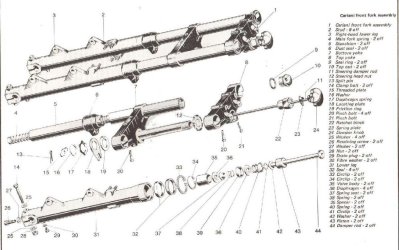
Part number 37 can be very worn and not control rebound damping properly, any lathe operator could spin up new ones. I am on my third set. These are still used even if emulators are installed.
Stiction is a major problem with this type of fork. If you jack the bike up with everything in place on the sliders (wheel, guard, etc) and the springs out, you can check how free it moves through it's travel. If you fill new fork oil you can check the damping in each side by pulling down on both together (with the wheel, guard etc removed), it will show up if they are very uneven.
You said you didn't want to go the upgrade route and despite getting lots of upgrade suggestions you can get them pretty good if everything is as it should be. It is likely to need new springs at this age unless it is very low mileage.
 

Attachments

  • ceriani_fork.jpg
    ceriani_fork.jpg
    120 KB · Views: 29
I rebuilt a pair of Ceris recently and discovered that one damping assembly had been installed upside down, which meant heavy damping on compression and practically none on rebound - to the eye, they looked identical, but it was the valve washers and springs inside that were wrong. The bike had exhibited the same symptoms as yours: harsh. Once set up properly they were transformed.

But my money is on the swollen damper piston.
 
Back
Top