Chain Chatter Issue

ghwallice

Hero member
Location
Ipswich
Referring to Zane 750S, but I think very similar to the earlier 500. They seems to have quite a lot of backlash at the sprocket, about 30 degrees. I rebuilt a motor (crankshaft) and after about 1000klm I started to get quite a bad gearbox noise above about 80klm/hr. I don’t remember this bike ever doing this, and I came to believe that it was chain noise reflecting back up into the gearbox.

I checked for tight spots, or stretch. I tried different amounts of adjustment slack, between the minimum of about 20mm out to about 60mm, replaced the outrigger bearing, check the wheel bearings, alignment, new clutch and rear wheel cush rubbers, ect ect. Nothing seems to resolve it. It really sounds quite harsh.

Not long ago I had it on a dyno and I could see the chain "vibrating" at times, and at other times it ran without vibrating. Vibrating. Lets say it's a high frequency oscillation between the extremities of the adjustment slack, which correlates with the noise.

By 3000klm I couldn't live with it any more. I stripped the motor again to look for damage, wear, or any kind of evidence marks, and to check shimming. Nothing out of place, but I have fitted it with completely different gearbox internals and clutch. Unfortunately other issues have stopped me from putting this bike back on the road.

Instead, I had a 2nd of 750S in the shed with zero klm on a rebuilt motor (another crank rebuild), so, again, gearbox with about 20,000klm on it. So I fired it up, and after about 200klm I can hear the same thing just starting. But then I am quite sensitized to this issue at the moment.

The vibration, or high frequency oscillation, is, to me, a harmonic being caused by something.

Both bikes have 520 chains that don’t demonstrate stretch, a DID zvmx, and Japanese unbranded 520. The first is running 15/43 gearing, the 2nd 15/40.
They only thing I can think of is to try and break the harmonic by using a different gearing, I have a 16/48 combo I could try. Or a different weight chain.

Any ideas or advice? Someone must have suffered this before….

Thanks! Greg
 
Not something I have come across, but to me a 15 tooth front sprocket is fairly small, seeing that breganze machines run a 19. I would try a larger Front sprocket for a start
 
Not something I have come across, but to me a 15 tooth front sprocket is fairly small, seeing that breganze machines run a 19. I would try a larger Front sprocket for a start
With a 19T front, Greg would need 45-55 rear!:rolleyes: 15 & 16T are more-or-less standard. Same with just about every other modern crotch rocket out there!
Reckon a 16/48 pairing would be far more inclined to throw up some sort of harmonics. Ideally, ratios should be "odd", ie, 2.97:1 instead of 3:1 to prevent the same teeth and links being engaged at the same time over and over. At least the chain should have an uneven link count to aid wear spread.

A "good" example is the 16/34T sprockets and a 88 link #630 chain on late triples. Both sprockets generally show wear on the sides only on every second tooth, no real rotation of links/teeth going on. Perhaps a reason the bloody heavy #630 chains tend to knacker themselves prematurely.

The extreme lack of flywheel combined with the 180° phasing on the Zane engines causes lots of crazy loads on all parts of the transmission, all the more accentuated in the 750s. I decided long ago it was something I didn't want to live with...

piet
 
Last edited:
Piet,
Some interesting points there. The gearing design, tolerances, seems quite archaic. With an open engine case and the gear shafts sitting in place the looseness, which would translate into backlash, seems excessive. And that is not something shimming would fix.

I also heed your point about "even" ratios. I'm thinking of sourcing a 45 rear to run it with a 16 front and see what happens.

Another thing I could try is fitting a 650 crankshaft drive gear and a 650 clutch basket. The 750 has a 37/89 (2.4054:1) combination, whereas the 650 has 37:76 (2.054:1) combination. This would allow me to run something like an uneven 15/50 combination. I don't know what other issues would be created by speeding up the transmission shafts (by about 400rpm at 5000rpm) using the 650 crank/clutch combination.

Thanks for the thoughts! Regards, Greg
 
Its something ive contemplated as a last resort, and the one of my Sherpa T 350 wont fit. Currenty changing the gearing to from 15/40 to 16/45 with another chain.

It's the top, the side under tension, that oscillates.....but it might work...so might a heavy chain, the DID chain for 1400cc motorcycles....
 
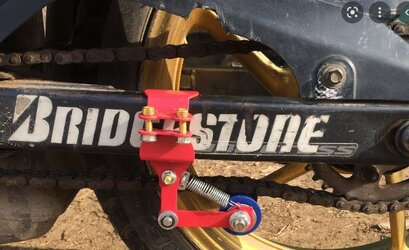
High-speed video of chains in use shows dancing crazy movements. Those chain tensioners were mandatory when long-travel suspension first arrived and countershafts were big distances away from swingarm pivots, in those cases chain tension would go from bow tight to virtually dragging on the ground. We smashed a countershaft bearing support out of the crankcases of a Montessa once, it had no mid tensioner and it was either a tight chain or the chain coming off the sprockets. Cost a bomb to weld the cases back in shape to hold the bearing.
 
Greg those teeth numbers don’t seem right - 6th gear is pretty tall as standard on my Formula and I have I think a 42 on the back

How many links in your chain ?
I dont know, its dark outside and I cant see to count, but it was 3500rpm for 100klm/hr, and it was too tall, This is a bike I have just put together ....the 16/45 combo is great, ratio wise. I'll take it for a 150klm run in the morning..and then respond.
 
Not long ago I had it on a dyno and I could see the chain "vibrating" at times, and at other times it ran without vibrating. Vibrating. Lets say it's a high frequency oscillation between the extremities of the adjustment slack, which correlates with the noise.

The vibration, or high frequency oscillation, is, to me, a harmonic being caused by something.

It's the top, the side under tension, that oscillates..
The top chain run will do strange things on a Dyno, it’s to do with the Weight/ inertia of the drum.
A Dynajet drum weighs about 875lb and acts like a massive flywheel once you’ve spun it up.
I helped develop a quick shifter with the boffin who designed it, the ignition cut time was far less than that needed on the road because of the drum inertia putting slack in transmission. Hope that makes sense, Jason
 
The top chain run will do strange things on a Dyno, it’s to do with the Weight/ inertia of the drum.
A Dynajet drum weighs about 875lb and acts like a massive flywheel once you’ve spun it up.
I helped develop a quick shifter with the boffin who designed it, the ignition cut time was far less than that needed on the road because of the drum inertia putting slack in transmission. Hope that makes sense, Jason
Now you've got me scratching my head. I wouldn't have thought the the drum on a dyno would have more inertia than the earth when the bike is moving along a road.
 
Is the dyno drum actually driving the wheel on the overrun before evening up as they slow as opposed to the earth only producing drag? I would have thought both effects would be pretty constant whereas Greg's effect, could be an off and on oscillation? Guess on an envelope.
 
Thinking about the dyno drum is a brain tease. Does my head in.

BIG difference with the 16/45 vs 15/40. Part of it is the ratio change, I can feel that through the engine but the extra diameter for that extra tooth I think is making the bigger difference, but it is still lurking there in the background....

I'm going to rework my suspension setups tomorrow. Make sure static sag and rider sag is correct, perhaps a bit hard, and then the compression and rebound. I'm assuming that the more the suspension drops the looser the chain gets, and I'm thinking it's parabolic, not linear????

I wonder if I can use that friction coating Red uses to reduce gearbox back lash.....and is 2 sets of new soft cush rubbers (clutch and rear wheel) actually beneficial in this situation???
 
I had a set of carb slides Teflon coated, first heard about from the bloke who does Cape York Trail Bike Tours to tale up wear from lots of sand riding up there. Worked great on my 350 Husky with its Delordo carb, it had a horrible action jerking off idle and after it smoothed takeoff really well, but failed on my Laverda carbs as they blistered for some odd reason. Done by the bunch in Melbourne. It adds bearly microns to sizes and tiny tolerances in carb slides. That's my experience with it, not that expensive to get done. Cost a lot to replace those 3 carb slides in the end.
 
Is the dyno drum actually driving the wheel on the overrun before evening up as they slow as opposed to the earth only producing drag? I would have thought both effects would be pretty constant whereas Greg's effect, could be an off and on oscillation? Guess on an envelope.
Exactly- on the road the rear wheel will start to slow immediately - ignition cut for a millisecond, drive train goes lose, change gear, power on, seamless full power gear change. On Dyno when checking fuel on a cruise/ constant throttle the drum starts to play catch up and introduces wave/ chatter in top chain run- similarly when using quick shifter/ ignition cut ,the drum inertia delays the time the drive train takes to tighten up.
 
I'm assuming that the more the suspension drops the looser the chain gets, and I'm thinking it's parabolic, not linear????
"suspension drop" is an ambiguous way to describe it. Do you mean the wheel dropping away from the bike as the suspension unloads? (on centre stand for example). Or are you referring to the reduction in ride height as the suspension compresses?
Chain normally gets tighter as the suspension compresses under load.
 
Chain normally gets tighter as the suspension compresses under load.
Only gets tighter until it reaches the point where the engine sprocket, swingarm pivot and rear axle are directly in line, slackens again as it goes beyond this point and the rear wheel ascends (up under the mudguard).
 
Mmm, you might have no damping in your rear shock Greg allowing the rear to constantly bounce having the chain tension and slack off and then having the chain twitch like a guitar string, eg chatter. I would have thought that would be very noticed though. The seat going up and down or maybe the chatter hides it.
 
Is it normal to run a dyno as you describe on a cruise mode? Whenever I have used a dyno it has been done under load, usually at full throttle. Sometimes done at partial throttle openings but always to start from low revs, under power until power drops, then shut the throttle and the drum pulls the engine until revs drop way down, never just on a feathering throttle. So either the engine is working hard to increase drum speed or vise versa. Under power the suspension squats heaps, off power it extends (on normal bikes).
 
Is it normal to run a dyno as you describe on a cruise mode? Whenever I have used a dyno it has been done under load, usually at full throttle. Sometimes done at partial throttle openings but always to start from low revs, under power until power drops, then shut the throttle and the drum pulls the engine until revs drop way down, never just on a feathering throttle. So either the engine is working hard to increase drum speed or vise versa. Under power the suspension squats heaps, off power it extends (on normal bikes).
If you don’t check you could have either a lean or rich cruise- probably where most people spend their time riding- perhaps not so much a concern on a pure race bike. Point I was originally trying to make is a Dyno is not the real world, similar but not the same.
 
Back
Top