fast_eddie
Full member
- Location
- SYDNEY
I have copied the below from the laverdamania page. I have some questions as I am currently investigating my backfire on start and sooty plug issues. Im pretty sure I will end up buying a new ignition / charge system from red, but while I work out how to explain the cost to the wife im doing a bit of analysis.
1978 Laverda Tripple 1200
BOSCH HKZ ignition
- Check the ignition coils: Disconnect the black wire (bikes before the end of 1973) or the red wire (bikes after 1973) from the
junction box under the tank. Connect an ohmmeter tothis wire and to earth. Resistance should be of 250 to 400 ohms. If not,
change the coil.
I have done this and the reading is 280 ohms, quite low, is this bad?
- Check the pick-ups: For bikes before the end of 1973, disconnect one of the violet wires from the junction box under the tank.
Connect an ohmmeter to this wire and to earth. Resistance should be less of 100 ohms. Check the other violet wire. If resistance
is higher than 100 ohms, change the stator. For bikes after 1973, disconnect the two wires coming from each pick-up. Connect an
ohmmeter to these wires. Resistance should be less than 100 ohms. If not, change the stator.
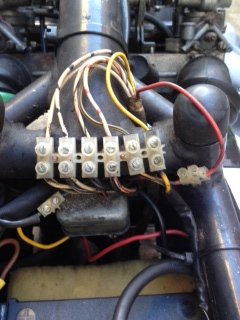
What does it mean each pick up? The coils? I dont have violet wires, from my picture which ones is it pls?
- Checking the original charging system (1000)
- Disconnect the yellow/black and the yellow wires from the junction box under the tank (two yellow/black wires for bikes before the
end of 1973). Connect an ohmeter, resistance should be very low. If there is no resistance or, at the contrary, a very high resistance,
change both charging and lighting coils.
Looks like I have yellow/black and yellow next to the red wire at the end. Will check this tomorrow. Just started raining.
- Checking the Bosch rectifier
- Disconnect the two red wires and the earth wire on the rectifier. Connect an ohmmeter (+ and -) successively to the two positive
and to the negative, resistance should be very low. Reversing the ohmmeter connections, resistance should be infinite. If not, replace
the rectifier.
I think I can manage this one.
Has anyone produced a colour wiring diagram for this era?
Many thanks for your help.
Ed