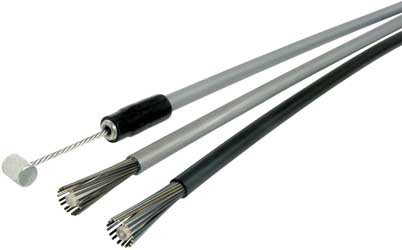
Clutch cable lube

Thanks for all your answers.
Cable was new in April or May and was mounted without lube. Action was delightful until about 2 hours of oncoming lorries throwing walls of water at us drowned it.
Will try silicon. graphite is probably great but I see no means to get graphite all along that cable.
I have spare cables if the worst comes to the worst.
Paul
 
I use Toolstation PTFE spray on my mountainbike gear set, exposed cable runs and pedal clips.
The propellant carries it in and leaves a dry film which seems to be good at repelling muck.

Used to buy dry powdered graphite in a small needle nosed puffer bottle from radio controlled model shop.
Miniature exposed universal joints and pivots lasted much longer once coated.

P.S.
On the recommendation of local MX lads I have also been using Wurth dry chain wax for a while and it seems to work well
running smmothly with much less crud build up on chain and sprockets. 
 
sonicboom500 said:
On the recommendation of local MX lads I have also been using Wurth dry chain wax for a while and it seems to work well
running smmothly with much less crud build up on chain and sprockets. 

I am using the Wurth chain lube as well, all of the above - bloody excellent stuff.
 
31bLwXC5XAL.jpg


http://www.motionpro.com/motorcycle/custom/

If you can get a clutch cable made..get one that is a longitudinally wound type. Not near as fussy about binding. The problem can be the oil based lubes attract dirt and it can gum up the cable. With a wound type cable the problem is worse as there many places for the debris to accumulate in the housing. A LW cable will tend to eject the grime and dirt. I use a teflon lube on the cable.

The difference between the two being that instead of a single strand of wire wrapping around the inner liner and wire making up the housing as in a coil wound housing you have several strands of wire with the LW housing that run parallel with the inner wire and liner. You end up with a cable that has a smoother operation and resists housing compression over time, which leaves you with less adjusting over time and better performance.

I had my 3C cable made by motionpro.com back in 2008..and it still is working just fine. Much easier effort to use the clutch and near adjustment free.
 
I've been pondering this for days now  :( do you have any easier questions ?
 
I think this problem put paid to James W-Cs" Eagle going to Breganze last year,Venhill cable.Sure he"ll confirm.

Is WD40  any good or wrong.???
 
my fave for cables...

http://www.toolandfix.com/action-can-1948-sl90-viscous-lubricating-oil-with-ptfe-500ml-aerosol.html?utm_source=google_shopping&gclid=CL-Fh6yN3ccCFUcTwwodWSQJUA
 
Rusty Spokes said:
31bLwXC5XAL.jpg


http://www.motionpro.com/motorcycle/custom/

If you can get a clutch cable made..get one that is a longitudinally wound type. Not near as fussy about binding. The problem can be the oil based lubes attract dirt and it can gum up the cable. With a wound type cable the problem is worse as there many places for the debris to accumulate in the housing. A LW cable will tend to eject the grime and dirt. I use a teflon lube on the cable.

The difference between the two being that instead of a single strand of wire wrapping around the inner liner and wire making up the housing as in a coil wound housing you have several strands of wire with the LW housing that run parallel with the inner wire and liner. You end up with a cable that has a smoother operation and resists housing compression over time, which leaves you with less adjusting over time and better performance.

I had my 3C cable made by motionpro.com back in 2008..and it still is working just fine. Much easier effort to use the clutch and near adjustment free.
It's called 'compressionless cable housing' and is used on virtually all indexed bicycle gear cabling, as the longditudinal forces in a wound (brake type) housing would allow too much play and negate the very fine increments a bicycle gear cable must transmit to give accurate shifting (think up to 11 cogs in the latest bikes, with about 2mm between each one).
Problem is, you CANNOT use compressionless gear cable in brakes, as the forces applied are greater and there is a risk of the casing bursting.
I didn't know they made clutch cable like this, but they must have ensured it could withstand the forces being applied through the lever. Makes very good sense - transmits every millimetre of lever travel to the clutch pushrod, no spongy loss through compression of a wound casing. Might make up my own with stainless cable and silver solder if I can source the stronger casing.

Not sure I agree that it's less prone to binding - internally it's very similar and any gunk in the casing can't enter the liner unless it's been damaged. It's benefit is in its compressionlessnesss ... like that one  8)  not in being less prone to binding.
 
Oh, and forgot to mention - silicon spray seems to be pretty effective on all nylon-lined bicycle cables with no ill-effects. Hard part is getting it in through the full length - those old cable oilers were good for that, but you had to choose your lube carefully.
 
Perhaps the silicon has clumped the grit and crud still in the cable making it stickier.

In the past I have flushed cables by heatshrinking the nozzle from a can of GT85 or similar onto the liner end and giving it a blast through
then hung it up overnight to see what drained out.
 
I reckon it should be poss to seal the cable ends in some way to prevent anything getting in in the first place - my bicycle gear cable used to dud out after any ride in heavy rain because grit washed into it - fitted a fully sealed bellows contraption (called a Nightcrawler, made by Avid) that stops water running down the cable and entering the casing, and it hasn't had a problemo since. I'm sure some of the stuff made for bicycles, like brake cables (similar size to Laverda clutch) can be adapted for the job.
QF
 
All my cable clutch bikes use the faxtory original rubber bellows cover as the cable enters the clutch lever pivot bracket. Rain doesn't affect the cable then.
 
Changed cable for the last Venhill/Todd I had in stock.

I sold my last Venhill clutch cable on 8th March 2003 - so 10year warranty now void Paul.

  Saw some posts about graphite - here's a true story about it's other use on a motorcycle:-

  When I was 16 years old and in my 1st driving ban (For riding underage) - I'd pulled a girl in Hastings where my parents had a caravan a few miles inland. I used to borrow my friends 600 Norton twin to take her about - the big ends had "gone " so as my mate was a smidgeon tight fisted - he used to grind up pencil leads and add them to the oil tank - bike ran for months like that. He also had the 1st "automatic" Norton - you could put it into gear without it stalling without pulling in the clutch lever - then also pull away without (too much) clutch slip - it was almost a  perfect balance and, of course, saved forking out for new plates before he'd had full value from the originals! - Th'old bill did pull me one night on it and I successfully lied my way out of it by pretending to be my mate! - happy days!! - regards - Phil
 
Grant said:
All my cable clutch bikes use the faxtory original rubber bellows cover as the cable enters the clutch lever pivot bracket. Rain doesn't affect the cable then.


Yes it does. Have just tested.
Paul
 
Then yours must be special.
I fit new ones and they are a tight fit.
 
Back
Top