Love my extended lever, sorry John. I made one for a Montesa Dirtbike many years ago so I knew its concept but with all the gubens hidden inside the case I didnt click till I saw it mentioned in a Classic Bike article sourced from some bloke in Pommyland called Phil Todd. Never heard of him before that. I was so keen I made my first overseas phone call to him for the size details, before that, I was breaking 3 and 4 cables a year and suffering intense wrist pain and losing hand feeling. I rerouted brand new cables, lubed cables, used one of those hand exercisers to build squeezing strength, tried to get used to it and also sacrificed a chicken while naked and facing the moon, O NO I HAVE MADE ANOTHER INSENSITIVE JOKE. Nothing fixed it. Mine works great, easy to get 1st gear, no physical injuries and no more broken cables. This has been done to death over the years, more power to you if your bike doesn't need it, mine did. There are virtually handmade bikes with lots of variation in the way they go. There is a way to use these without cutting the case, but if I mention it feathers will be ruffled. Before fitting mine I loved the bike but the hard clutch pull was destroying my left hand, I absolutely needed to do it.

You are using an out of date browser. It may not display this or other websites correctly.
You should upgrade or use an alternative browser.
You should upgrade or use an alternative browser.
Clutch sticking issues on a 3CL 1980.
- Thread starter Charley
- Start date

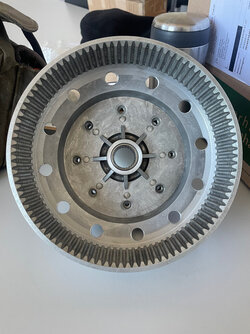
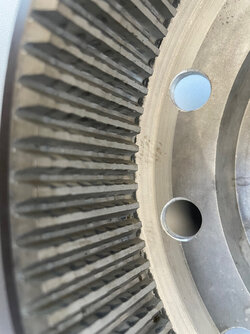
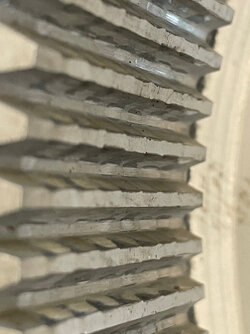
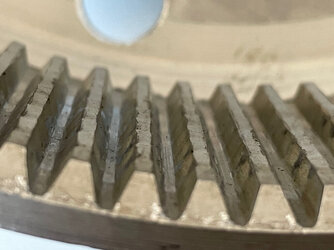
Clutch drum back from the machine shop next door.
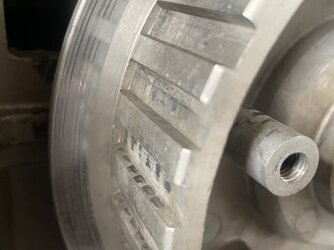
As is, I hope, shown clearly in the photos, there is very little wear and tear in the drum.
These photos are all 'pre' clean up.
I will just touch them with a needle file and or 3M ScotchBrite.
I'm lucky, I guess, I've never had a bike including this one where the clutch has been too heavy for me.
I have had, ridden bikes with heavy clutches but a working life of spanner spinning and manual labour has had it's advantages.
I've never needed to go the route of extending levers etc.
On my Triumph Trident, I did have to ensure that the correct hand lever was used as there are several original British and pattern variations of hand control levers and clamp pieces, the wrong combination of which can make things more difficult than necessary.
Pivot to control cable nipple distance can be critical.
I will however be making every effort to make the clutch action as light and smooth as possible.
New heavy duty Venhill clutch cable lubricated with Silkopen (Fuchs graphite loaded spray lube)
All pivot points to be cleaned and lubicated with appropriate grease and rods cleaned, polished and lubricated.
Clutch friction plates received one last clean in 'brake cleaner' before being soaked in 20w50 Wagner mineral oil,
prior to putting the bike together.
Attachments
This will be a great experiment to see if your optimising makes a big difference, BTW I am a Chippy with decades on the tools and moving stupid heavy crap and my pre-extended clutch broke me. I don't mind admitting it. It's a shame you didn't put a load meter, spring balance on it and actually measured the pull to see how it changes with the work.

Nothing on there that would induce excessive sticking.Clutch drum back from the machine shop next door.
As is, I hope, shown clearly in the photos, there is very little wear and tear in the drum.
These photos are all 'pre' clean up.
I will just touch them with a needle file and or 3M ScotchBrite.
I'm lucky, I guess, I've never had a bike including this one where the clutch has been too heavy for me.
I have had, ridden bikes with heavy clutches but a working life of spanner spinning and manual labour has had it's advantages.
I've never needed to go the route of extending levers etc.
On my Triumph Trident, I did have to ensure that the correct hand lever was used as there are several original British and pattern variations of hand control levers and clamp pieces, the wrong combination of which can make things more difficult than necessary.
Pivot to control cable nipple distance can be critical.
I will however be making every effort to make the clutch action as light and smooth as possible.
New heavy duty Venhill clutch cable lubricated with Silkopen (Fuchs graphite loaded spray lube)
All pivot points to be cleaned and lubicated with appropriate grease and rods cleaned, polished and lubricated.
Clutch friction plates received one last clean in 'brake cleaner' before being soaked in 20w50 Wagner mineral oil,
prior to putting the bike together.
Paul
Vince, I had no reason to concern myself with the weight of the clutch as right from the outset it’s been fine for meThis will be a great experiment to see if your optimising makes a big difference, BTW I am a Chippy with decades on the tools and moving stupid heavy crap and my pre-extended clutch broke me. I don't mind admitting it. It's a shame you didn't put a load meter, spring balance on it and actually measured the pull to see how it changes with the work.
The only issue has been the ‘sticking’ of the clutch so I’m doing all I can’t to alleviate the issue.
But you are correct, it would be fun to know how much difference there is now it will have to be a subjective guess
My bad
Paul,Nothing on there that would induce excessive sticking.
Paul
The only issue I see is the age, the amount of time, the plates have been pressed together.
Some were very much glued together, so separating, cleaning, glaze removal and re oiling, will I think make the difference.
Well, I hope so
Fingers crossed for you.Paul,
The only issue I see is the age, the amount of time, the plates have been pressed together.
Some were very much glued together, so separating, cleaning, glaze removal and re oiling, will I think make the difference.
Well, I hope so
Paul

mauricejota7604
Hero member
- Location
- Victoria Australia
In certain cases no matter how much cleaning you do those friction plates will read here themselves to the steel plates, I have thrown out many sets of friction plates from Laverda’s that have sat for long periods of time it’s almost like the friction material turns into glue!

All noted Vince, finding best solution is in the eye ( and left hand ) of the beholder. Avoiding a protracted to and fro here, inherited a number of ruined ( by the extended arm mod ) outer clutch casting, every time i looked at any of the rides i had, staring me in the face was the slot of sacrifice. When i straight lined the clutch cable and lever on a broom handle the clutch pull required, much diminished. All sorts of aftermarket clutch cables, lined with PTFE and low cost garden variety bowden assemblies. There was a cable maker out here whom did vintage cars, having many types of heavy duty bowden cables, that had greater demands than a Laverda clutch.Love my extended lever, sorry John. I made one for a Montesa Dirtbike many years ago so I knew its concept but with all the gubens hidden inside the case I didnt click till I saw it mentioned in a Classic Bike article sourced from some bloke in Pommyland called Phil Todd. Never heard of him before that. I was so keen I made my first overseas phone call to him for the size details, before that, I was breaking 3 and 4 cables a year and suffering intense wrist pain and losing hand feeling. I rerouted brand new cables, lubed cables, used one of those hand exercisers to build squeezing strength, tried to get used to it and also sacrificed a chicken while naked and facing the moon, O NO I HAVE MADE ANOTHER INSENSITIVE JOKE. Nothing fixed it. Mine works great, easy to get 1st gear, no physical injuries and no more broken cables. This has been done to death over the years, more power to you if your bike doesn't need it, mine did. There are virtually handmade bikes with lots of variation in the way they go. There is a way to use these without cutting the case, but if I mention it feathers will be ruffled. Before fitting mine I loved the bike but the hard clutch pull was destroying my left hand, I absolutely needed to do it.
So it ended there for me, proper fit for purpose cable, proper routing, manageable clutch ensued. j.

Coming in very late on this, but I'm with Paul: changing between synthetic and mineral oils has a long history of causing clutches to stick.Paul,
The only issue I see is the age, the amount of time, the plates have been pressed together.
Some were very much glued together, so separating, cleaning, glaze removal and re oiling, will I think make the difference.
Well, I hope so
Hopefully the friction plates aren't contaminated too bad, and the brake cleaner has resolved the problem. Please let us know ...
(For future reference, paraffin - 'kerosene' to you Septics - is the cleaner of choice for this job).
Thank you Ventodue,Coming in very late on this, but I'm with Paul: changing between synthetic and mineral oils has a long history of causing clutches to stick.
Hopefully the friction plates aren't contaminated too bad, and the brake cleaner has resolved the problem. Please let us know ...
(For future reference, paraffin - 'kerosene' to you Septics - is the cleaner of choice for this job).
As I have access to brake cleaner that's what I used.
If I have to do this again I will search for paraffin.
I was not aware that the change from semi to full mineral would cause the problem. Interesting.
I have assumed that it is not what has caused the issue in this case, only because I had the issue before changing from semi to full mineral.
The issue started or at least I became aware of the issue some weeks after buying the bike and running it for at least 1000 kms on semi.
I've had the same problem of sticking clutch with brand new plates.
I've tried everything, including cooking the clutch though it'll be a while before I can test that option.
Since the engine will be coming to bits, I'll drill a nice 2cm hole between the primary and the gearbox, level with the floor of the primary case.
These early ones run nearly dry.
Paul

I've tried everything, including cooking the clutch though it'll be a while before I can test that option.
Since the engine will be coming to bits, I'll drill a nice 2cm hole between the primary and the gearbox, level with the floor of the primary case.
These early ones run nearly dry.
Paul

Laverdalothar
Hero member
- Location
- Germany
Hope you get that one running again, what a poor looking bike... Good on you for restoring them one by one!
Thanks Lothar. This time, it'll be two by two. I have a 125 Sport ready for a bit of welding and then, paint chrome, wheel building etc...Hope you get that one running again, what a poor looking bike... Good on you for restoring them one by one!
Paul

Dellortoman
Hero member
- Location
- Tasmania, Australia
Since the engine will be coming to bits, I'll drill a nice 2cm hole between the primary and the gearbox, level with the floor of the primary case.
These early ones run nearly dry.
I think that might be a bad idea Paul. It could actually reduce lubrication within the primary case.
I'm not 100% sure about the following interpretation, so you might wanna check with someone who knows these engines and their lubrication systems better than me. Someone like Piet or Red.
A hole through into the gearbox at the bottom of the primary case will be above the oil level in the gearbox, so oil is unlikely to flood into the primary case via that hole. Oil will actually drain the other way, from the primary case into the gearbox sump.
I presume the factory's thinking with the early triple is that some of the oil pumped into the left crankshaft bearing will find its way into the primary case. And since there's no drain hole near the floor of the primary case, the case will fill up to the level of the upper hole, or at least somewhere above the floor of the case. That ensures there will be a pool of oil retained in the primary case that will be picked up by the chain and flung around everywhere. The resulting oil mist will lubricate the clutch. Drilling a hole near the bottom of the primary case will drain that oil pool back into the sump, causing the primary case to run dry.
Later bikes that have the low-level drain hole also have a pumped feed that squirts oil directly onto the primary chain, so it gets plenty of oil being slung around the case from the primary chain, creating the oil mist to lubricate the clutch. That oil then drains back into the sump through the hole near the floor of the case.
If you want to improve clutch lubrication, perhaps a better idea would be drill a series of holes in the clutch basket to allow the oil mist to enter more easily. Many of us have done that.
Some folks with the early bikes have adopted the procedure of leaning the bike over after an oil change (including draining of the primary case) to ensure it has a pool of oil in the primary case to start with.
You have a point.I think that might be a bad idea Paul. It could actually reduce lubrication within the primary case.
I'm not 100% sure about the following interpretation, so you might wanna check with someone who knows these engines and their lubrication systems better than me. Someone like Piet or Red.
A hole through into the gearbox at the bottom of the primary case will be above the oil level in the gearbox, so oil is unlikely to flood into the primary case via that hole. Oil will actually drain the other way, from the primary case into the gearbox sump.
I presume the factory's thinking with the early triple is that some of the oil pumped into the left crankshaft bearing will find its way into the primary case. And since there's no drain hole near the floor of the primary case, the case will fill up to the level of the upper hole, or at least somewhere above the floor of the case. That ensures there will be a pool of oil retained in the primary case that will be picked up by the chain and flung around everywhere. The resulting oil mist will lubricate the clutch. Drilling a hole near the bottom of the primary case will drain that oil pool back into the sump, causing the primary case to run dry.
Later bikes that have the low-level drain hole also have a pumped feed that squirts oil directly onto the primary chain, so it gets plenty of oil being slung around the case from the primary chain, creating the oil mist to lubricate the clutch. That oil then drains back into the sump through the hole near the floor of the case.
If you want to improve clutch lubrication, perhaps a better idea would be drill a series of holes in the clutch basket to allow the oil mist to enter more easily. Many of us have done that.
Some folks with the early bikes have adopted the procedure of leaning the bike over after an oil change (including draining of the primary case) to ensure it has a pool of oil in the primary case to start with.
We discussed this in length with Ian on the ILOC forum. Ian having the same symptoms on his drummer as I ended up drilling the hole. I can't remember if it was useful or if Ian has ridden enough to test it. Drilling holes in the clutch is on my to do list now that the whole thing is coming to bits.
I did use the leaning the bike to the left technique but forgot to switch the engine off. (don't tell my insurer)
It didn't remedy the situation. Insufficient clutch lift was part of the problem. I was testing the bike after having taken the DAM kit off when I was rammed. It did seem better.
Paul
Paul
Another bit of work carried out on the 3CL.
I cleaned up the clutch hub, there was no real issue with wear or notching but a clean up with some Scotch Brite extra fine will not have done any harm.
Clutch push rods cleaned, polished, checked for length and ball bearings checked.
Greased up and replaced.
Standard length lever was cleaned and regress along with its support and pivot points.
Friction plates were soaked in 20w50 mineral engine oil. The oil I will be using once the engine is buttoned up.
I heated the oil and plates up to 70 degrees as the temperature in the shed where I'm working was cold enough to make the oil thick.
I thought if I'm going to get any oil into the plates I needed to thin it some what.
They were soaked for approximately 24 hours and during that time were warmed up and allowed to cool naturally three times.
Clutch and its release mechanism went back together without issue.
A triangular needle file was used to line up the plates.
Drum went on nicely.
Primary chain and chain wheel was a little bit of a struggle.
Given it came off easily without the need to disturb the crank sprocket, I was a little annoyed and needed to stop for a coffee.
I went back and released the clutch and the drum must have shifted a fraction as when I rotated engine and gear box the chain wheel slipped on nicely.
Shock absorber rubbers in and there I stopped.
Unfortunately in my haste to make sure I had all the parts I needed for the rebuild and finishing pre Easter break work, I failed to check received parts and the proposed replacement circlip arrived but turned out to be for a 20 mm diameter shaft and not the required 22 mm diameter shaft circlip I need.
I just can't bring myself to button up the engine with a potentially tired old circlip.
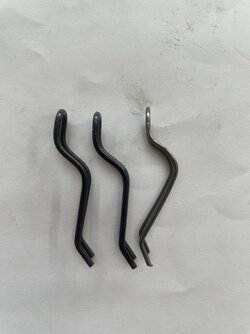
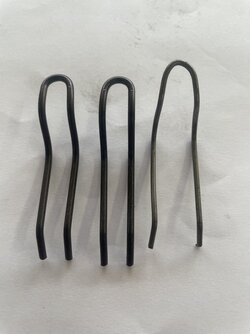
The second issue is the return spring on the primary chain adjuster, again in my haste I ordered a number of small parts from two different suppliers both suppling the spring for the primary chain adjuster.
These are heavier gauge wire springs to what I call the original, the 'original' being the one I found in the bike when I took it apart.
The shape of the new spring is considerably different to the original ('original' is shown on the right of the pictures).
Also the spring tension is far greater.
I'm unsure whether to continue using the 'original' or try to put it together with one of the new springs.
The new springs really are a lot stronger.
So that's it for now. I've got it together with the 'original' circlip, and can now pull the clutch in, with what feels like slightly more pressure, no doubt due to the new springs and can slip the clutch, testing carried out by putting the bike in gear, pulling in the clutch and turning the rear wheel by hand.
Not much of a test but at least it works.
Work will continue tomorrow assuming I can find a 22mm circlip.
Attachments
-
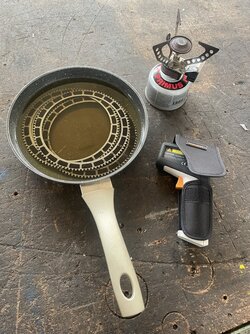 Clutch plate oil bath_0524.JPG272.8 KB · Views: 29
-
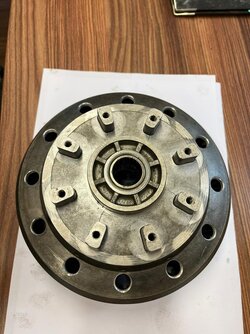 UQVO3370.JPG165.8 KB · Views: 29
-
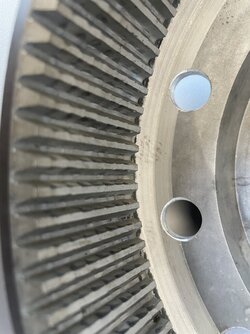 Clutch drum drilled_0517.JPG126.8 KB · Views: 28
-
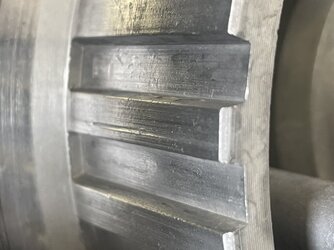 Clutch hub_0536.JPG117.3 KB · Views: 26
-
 Clutch hub_0529.JPG99.6 KB · Views: 29
-
 Primary chain adjuster springs_0550.JPG94.3 KB · Views: 29
-
 Primary chain adjuster springs_0549.JPG98 KB · Views: 28
Just to pick up and round off this thread if it helps someone else.
I've now covered a few hundred kilometres since I stripped and cleaned the clutch on my 1980 3CL and I'm enjoying it a lot.
With a new Venhill clutch cable carefully routed to allow gentle curves.
The new clutch springs have made the clutch heavier but to no great detriment.
The clutch no longer sticks after an extended motorway trip.
Starting in the morning is no longer fraught with the effort of freeing plates and after an extended period of not using the bike, the plates have not welded themselves together.
Clutch operation is smooth and progressive.
Thanks to all for the tips and advice.
I now have a bike that I can live with.