Conrod failures

sfcpiet

Administrator
Staff member
Location
Germany
I've always wondered why Laverda rods are so susceptible to failure. Most people I've spoken with regarding rods venting the crankcase were adamant that the failure happened at low to medium revs, with little to no load on the engine. This coincides with my own "rod experience" when the LH rod of the 750 works engine decided it had had enough.


I stumbled over this article, especially interesting is the bit about Allison V12s, I'm thinking this could be a cause for Laverda rods failing. In stock form, Laverda rods are quite sturdy and should get the job done, but many busted crankcases later, we all know they have their insufficiencies. Seems also that it's mainly old, worn engines that throw a rod, not low-mileage or freshly-overhauled engines. Worn crank bearings allow a lot of flex in the crank, I'm thinking excessive bearing clearance might add up to the condition explained in the article. Pre-damaged rods through hydraulic lock probably also play a large part in many failures, but that can't be all that is to it...

Any thoughts?

piet
 
Interesting article. I'd never considered rotational oscillation of the pistons (twisting the rods) as a problem. To answer that question in relation to Laverdas, I reckon you'd need to set up a test rig to determine the natural frequency of torsional oscillation of a Laverda piston/rod combo.
 
Interesting article. I'd never considered rotational oscillation of the pistons (twisting the rods) as a problem. To answer that question in relation to Laverdas, I reckon you'd need to set up a test rig to determine the natural frequency of torsional oscillation of a Laverda piston/rod combo.
Thinking a little deeper about it, it's beginning to make sense Cam. I find a lot of uneven wear at piston ring lands, suggesting bent rods. But, I very rarely find bent or twisted rods! Bent rods also steadily create one hell of a racket, besides a bit of excessive clatter, there's rarely much to be heard from worn engines.

Worn main bearings can show 0.08mm or more radial clearance, resulting in noise and vibration. A new C3 class bearing has a little more than 0.02mm. I'd imagine a worn crank to have completely different harmonics to a fresh one.

piet
 
It also seems to be a fault that affects triples 99% of the time - your works engine doesn't count because the rods had been shaved to within an inch of their lives, Piet! I've heard a theory that the agricultural ignition system and sudden jump in ignition advance in old triples could contribute to rod stress.

750's (yes, even with points, Paul!) have a steady and gradual advance system - of course SFs also have a double row, wider big end - but 74 and Elettronica SFCs have the same big end as a triple. Not sure if SFCs are as notorious as triples for doing rods, but if they were raced, then that's a different story again from the habit of triples to throw the rod - Lee has done something like 12 seasons on his stock SFC crank. I fitted std factory rods to my SFC crank that came out of a UK-based SFC being raced in the late 70s. The owner replaced them every season as a matter of course. I did probably 100,000km on them (could be much more - no speedo), often very fast open road and track day stuff. The bike was used for everything, including commuting and touring.

I'll have a read of the article when i get time. Love a good engineering article!
 
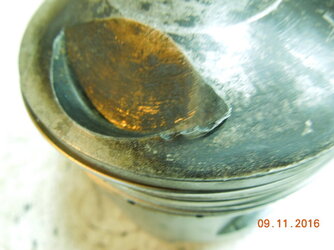
The bit about the 19000rpm Honda F1 engines also makes a lot of sense regarding my 750 works engine. When I opened that engine, I found the valves had contacted the edges of the piston pockets. I put this down to a machining error, but didn't investigate further due to time constraints (preparation for the 2017 Eastern Creek event). Due to horrible ergonomics and not knowing much about the engine, I kept revs to 6000 at Eastern Creek. For the 2018 Paul Ricard event, I modified the ergonomics for considerably more comfort and gradually upped the revs to 7500, at which the engine felt to be perfectly happy (and pulled like a train!). The rod let go at around 4000 exiting the final chicane on the cooling-off lap.

Quentin, yes the works rods are extreme, Marnix had warned me they were dangerous. But, I've seen slimmer rods hold up and the crank was absolutely perfect, and I figured if Marco, Virginio and Roberto had thrown 110 or 120% effort at that engine, it would easily shrug off the 80% of which I'm capable.

Now that the engine is still in bits, I'll have a closer look at that piston machining. In any case, the rods will be replaced by a pair of Carillos.

piet
 
But, I've seen slimmer rods hold up and the crank was absolutely perfect, and I figured if Marco, Virginio and Roberto had thrown 110 or 120% effort at that engine, it would easily shrug off the 80% of which I'm capable.

piet
Maybe there's your cause?! :eek: The corrodori italiani had set you up nicely with a failure waiting to happen? Chi lo sa? Very innaresting thatit happened at 4000 ... we naturally assume rods go at suspersonic revs.
 
Maybe there's your cause?! :eek: The corrodori italiani had set you up nicely with a failure waiting to happen? Chi lo sa? Very innaresting thatit happened at 4000 ... we naturally assume rods go at suspersonic revs.
That's exactly the point, Quentin.

I haven't yet heard of a Laverda rod let go at WOT, it's usually low to medium rpm. That is what got me thinking... and doubting.

The works rods may be everything, but most certainly not stiff! Had I read such an article back in 2016, I could possibly have saved myself a load of grief!

piet
 
It's little more than intuitive speculation, but I'd guess that stiffer rods and lighter pistons would increase the natural frequency of the rod/piston system. So maybe your new Carillos will fail at 6000 rpm rather than 4000 ;)

Stiffer rods would also reduce the amplitude of any torsional rod vibration. Hopefully keeping it within tolerable limits.
 
The range of the dangerous frequency just needs to be shifted.

Both rods and pistons will end up a bit heavier than stock, will be a lot of shifting going on.

piet
 
My SFC threw it's R/H rod with less than 800 miles on the clock. Damaged the Generator and the starter motor venting through the cases.
New cases, new crank, new starter and new generator. Wasn't riding it at the time so have no idea what revs but I doubt it would have been high revs given the fact it was being run in at the time.
 
The range of the dangerous frequency just needs to be shifted.

Both rods and pistons will end up a bit heavier than stock, will be a lot of shifting going on.

piet

Be careful. The crank and rods are an integrated system. Change the resonant frequency of one and you change the frequency of the total mass.

I can provide an example. Locally a GP Delage engine went from one restorer to another when it changed hands. A straight eight of 1500cc with a one piece crank running on split roller bearing mains and 2 piece rods with again split roller bearings.
Restorer one made a new crank as a copy of a cracked original. Material used was as close as he could get to OE.
Restorer two said - that's not good enough, we'll make one from latest super steel. And they did.

When it was at last fired up after a long and expensive restoration it cracked the one- piece irreplaceable cast iron block...

Extensive analysis showed that the OE cranks survived by flexing - which accomodated the movement of the long, thin engine. When the crank wouldn't flex, something else broke.

It now survives with the first replacement crank, flexing happily under a stitched repaired block.
 
Considering your worn crank bearing theory Piet. On SF at least it seems to be very common on high mileage hard run engines that the bearing lands in the cases have also worn allowing the outers of the bearings to also move about considerably (rotate and hammer) in the cases. This combined with old, looser than spec C3 bearings will allow even more movement, but SF don't seem to throw rods nearly as often as triples. Perhaps it is the length of the triple crank that exacerbates it.
There are lots of bikes with one-step ignition advance and they don't all throw rods. It would be interesting to know the percentage of triples that have had the rod failure, it is not something I ever associated with triples back in the time I worked on them when the bikes were up to ten years old.
Like everything it would seem to be a combination of factors, including vibration frequencies and flexing.
At the end of the article he says that they effectively banned the hollow rods, I imagine Honda had more than minimum diameter hole.
 
Unusual engine design.
Delage were the 20's equivalent of possibly Honda. The very successful GP straight 8 had followed a 2 litre V12. Also very successful.
Straight 8's are unusual now but as late as the 1950's Mercedes thought that was the way to go in F1. And at the time, it was.
Mercedes published figures from their records showing that straight engines were lighter for their capacity than V arrangements. They had of course built both types.
 
Be careful. The crank and rods are an integrated system. Change the resonant frequency of one and you change the frequency of the total mass.

I can provide an example. Locally a GP Delage engine went from one restorer to another when it changed hands. A straight eight of 1500cc with a one piece crank running on split roller bearing mains and 2 piece rods with again split roller bearings.
Restorer one made a new crank as a copy of a cracked original. Material used was as close as he could get to OE.
Restorer two said - that's not good enough, we'll make one from latest super steel. And they did.

When it was at last fired up after a long and expensive restoration it cracked the one- piece irreplaceable cast iron block...

Extensive analysis showed that the OE cranks survived by flexing - which accomodated the movement of the long, thin engine. When the crank wouldn't flex, something else broke.

It now survives with the first replacement crank, flexing happily under a stitched repaired block.
Don't know if you're familiar with stock SFC rods, Greg. Here's a pic of the failed works item, crazy thin compared to the stock type, of which do not have a "failed" pic. Snapped at both ends, everything between big and small end went out the window, so it's rather speculative what gave up first. The remainder of the crank is basically what became the standard SFC crank, just a bit of additional lightness in this case (probably to accomodate the superleggera rods).

Using tried and tested rods and pistons with this crank isn't anything really special, haven't heard of any cases of Carillos giving up or causing concern. Stock cast SFC electronica pistons were fitted. Will just need to rectify balance with the Carillos and slightly heavier forged Assos.

Yeah, lots of straight-8s back then, Alfa, Bugatti, Duesenberg, etc, etc. If only the manufacturers had used a couple more main bearings...

There's been a fair share of 750 rods venting the cases Lee. I really don't consider triples throwing rods "often", "now and then" might be a bit more appropriate. :rolleyes: Unfortunate, in any case though.

pietDSCN8915.JPGDSCN8910.JPGDSCN7407.JPGDSCN7409.JPG
 
The question for me would be: what is the first part that gives up? is the piston the source for the conrod to break or is the conrod or the bearing the cause for the piston to break?
 
I have often mused, but never concluded, whether the motor being closer to max BMEP/VE/Torque is the related to conrod failures at mid range rpm rather than max rpm. Of course, if cruising, the motor is being held back by the throttle at mid rpm, so the pressure at the piston face is reduced, so it doesn't really follow than forces onto the conrod are maximized in that 'I was just cruising along and it went pop' moment.
 
Back
Top