Cracks in the head!!

ah , the dreaded cracks in the cylinder head! sadly a very normal situation with earlier laverda triples.
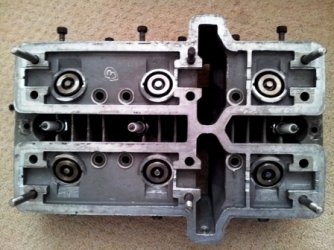
They crack through the sharp corner of the cam chain tunnel area , a rather basic mistake to make on the part of laverda, any student of mechanical design would know to avoid sharp corners for this very reason, take for example the unexplained losses of 'liberty' ships during the battle of the atlantic in ww2
and the tragic losses of the early 'commet' airliners ,square corners! , not good.
later machines had radiused and strengthened castings in this area and were less prone to problems of this type.
yes it is possible to make a good repair by welding ,but it needs to be done by somebody that knows what they are doing or, 'B' find a late model head with the improved casting.
while on the subject of laverda's and cracks , frames that crack around the headstock area , a problem from the first triples right up until the very last and the early cast wheels were not so hot .Oh and exhaust roses and inlet stubbs!...
  Laverda triples , they just crck me up !
But and this is the problem they get under your skin ,I could not part with mine it is just superb despite all its flaws.
 
Hope you get it sorted Rob,calm advice from Phil and Keith,though hyperdermic needles and solvents always readily available in Glasgow :D. fit an RGS head and forget!
LJ
 
caratacus said:
ah , the dreaded cracks in the cylinder head! sadly a very normal situation with earlier laverda triples.
They crack through the sharp corner of the cam chain tunnel area , a rather basic mistake to make on the part of laverda, any student of mechanical design would know to avoid sharp corners for this very reason, take for example the unexplained losses of 'liberty' ships during the battle of the atlantic in ww2
and the tragic losses of the early 'commet' airliners ,square corners! , not good.
later machines had radiused and strengthened castings in this area and were less prone to problems of this type.
yes it is possible to make a good repair by welding ,but it needs to be done by somebody that knows what they are doing or, 'B' find a late model head with the improved casting.
while on the subject of laverda's and cracks , frames that crack around the headstock area , a problem from the first triples right up until the very last and the early cast wheels were not so hot .Oh and exhaust roses and inlet stubbs!...
   Laverda triples , they just crck me up !
But and this is the problem they get under your skin ,I could not part with mine it is just superb despite all its flaws.


Since we can not solve the cause of the problem, I think anyway the Problem comes from a mixture of:
Not enought Material in this Part;
Head problems, the hot Enginepart between Airfunnels;
Vibrations from Crank/Piston (Compression) and Cams.
Since it is the highest Part from the Engine, it shows also that the whole Engine starting from the Enginecase is bending!
Looks like it is the Vibrations of 180? espacially...

 
I think Caratacus was spot on the money.

Stress concentration on sharp corners, combined with expansion and contraction by heating and cooling cycles would start a crack.
A nice radius instead of a sharp corner on the inside of the tunnel without adding any thickness probably would have prevented the crack.
Not sure if vibration is the primary cause.

Even so! With the crack there it is not going anywhere else is it? Unless it goes much deeper, which after all these years is unlikely.
The crack is a means for the head to get rid of stress, if you weld it up the stress is back with avengeance surely?
 
SimonR501 said:
I think Caratacus was spot on the money.

Stress concentration on sharp corners, combined with expansion and contraction by heating and cooling cycles would start a crack.
A nice radius instead of a sharp corner on the inside of the tunnel without adding any thickness probably would have prevented the crack.
Not sure if vibration is the primary cause.

Even so! With the crack there it is not going anywhere else is it? Unless it goes much deeper, which after all these years is unlikely.
The crack is a means for the head to get rid of stress, if you weld it up the stress is back with avengeance surely?


Just like ceilings.
Paul
 
Simon,

The early heads were more crack-prone than the later versions.  At least 4 different castings were used over the years, each subsequently getting a bit stronger in the problem areas.

Don't think vibes have anything at all to do with it.  Once it's running, you don't feel any at the engine itself, only through the frame and ancilleries.  Fit an early head to a 120 and it will crack just as readily as on the engine it was built for...

Heat cycles paired with poor design and casting techniques are the culprit imho.

Does piss a fair amount of oil if not attended to.  No further problems with laser-welded heads from the past 4 years, so no additional stress it seems.

piet
 
Well we'll have to see if the Loctite290 and JB weld does the trick in fixing the oil leak. Don't have any $$ left in the budget to replace the head and as I've got nearly 2k oz dollars spent on this head I'm going to make this one do. I'll wait for someone to start producing billeted heads before I think about replacing it so that should be awhile then!!. If anyone wants to go down the head casting road I'll be happy to make a pattern out of wood.
 
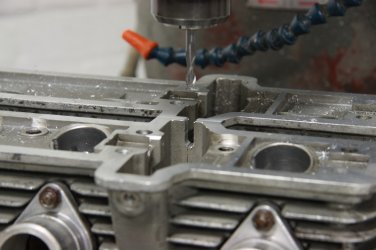
This is a low milage 1975 head that had not yet cracked, was bent like a bannana but that was addressed with the press and a bit of light machining. While it was up on the mill I removed the material that causes the problem. Time will tell if it cracks now or not but I recon it will be fine.


    Keith
 

Attachments

  • 009_1.JPG
    009_1.JPG
    92.2 KB · Views: 127
The head I used on POP had that bridge machined away due to cracking.
I was assured by Gijs this would not cause further issues.
 
Hey Kieth,

If you go a little deeper with that mill you will have a cool looking Twin!!


No?
I'll fuck off then  :D

Julian
 
Reading all this made me worried and curious so I decided to take the head off my Jota today jut to check it is ok. It didn't take too long and thankfully all seems to be ok as I can't see any cracks.


only kiddin it's a spare head  :D
 

Attachments

  • jota head.jpg
    jota head.jpg
    107.7 KB · Views: 74
Took the head to Perth last week, Engineering mate measured it on his surface table. the head to barrel face was 2 thou high in the middle, not enough to worry about. The top face, well that's a different story :o
From the #3 ex cam block to #2 was +6 thou and back to zero on the #1. Mate wasn't keen on surfacing the top, reckon I would be better off lowering the centre cam blocks which I did on the inlet and got the cam running free so I think I'll do the same with the exhaust. Really didn't like having all them shims under the #3 ex block. This head is doing my head in!!!
What I can't understand is how this happened. When I took the head off the cams ran free, no sign of those cracks, though there, they weren't obvious and definitely no step across the crack.
The engineer who replaced the guides, refaced the valves, sent it off for ceramic coating and supposedly set the cams up with correct shims didn't spot it and I'm still wondering how he set the shims up with cams that were binding in the bearing blocks.
Could the ceramic coating process have an effect on the head??
So I guess I'll refit the head again and spend many hours cams in cams out trying to get them running freely.
Not fucking happy!!
 
go back to your engineering mate and get the top surface decked by 0.20mm or whatever it takes to get it flat
0.006" = 0.15mm so should clean up at 0.20mm
I'll be home in 2 weeks and I'll send you a set of 0.20mm offset billet alloy cam blocks, I have one set left in stock and 3 sets ordered
that way everything is back to normal position and you have not wasted your money on that head

don't go removing material off the bottom of your existing billet alloy blocks as they are then no good to me, I cannot use them on something else as they will be too low
if they are still untouched send the standard ones back and I'll just do you a straight swap

Red


Back
Top