

Ian Short
Full member
- Location
- Cambridge Ontario
Thank you for that Lothar, I'm not in a hurry to do any engine work to my RGS unless it's required. It still surprises me to no end at how sensitive some engines are to exhaust systems and how the factories paid so little attention to it. Harley's in particular suffer from this.Ian, if you are looking for efficiency, modify your head to the CR-specs. I had the head of a project engine at a specialist for head tuning and he found basically 5 things that kept the original 1000 Jota head (same as the RGS Head) from breathing as it should:
1.) the valve seat ring protrudes into the inlet channel, building a "step" in the inlet channel. the 40,5 or 41mm valve seat rings are larger and hide in the material of the channel, so that they do not have that step
2.) the valve size of the inlet valve was 39mm, he suggested 41mm
3.) the valve stem is relatively thick and the valve guide also protrudes into the inlet channel quite much; a shorter guide (that is longer at the top below the tappet cup) would help on the flow
4.) overall inlet channel diameter to narrow (was 32mm) and not optimally shaped
5.) combustion chamber not optimaly shaped, sharp edges should be smoothed out to reduce heat nests.
There was much more he said is not ideal but he said that between a standard 3C/3CL head and the possible optimum, there are easily 10 HP found - on each cylinder (assuming carburation and exhaust are in sync with the head!). And he was right... records show that even with the standard 1000 SFC engine, just different carburators and Exhaust, we had 110HP on the 1000 SFC compared to the claimed 84HP of the RGS. To be fair, a lot of it was the Exhaust, which is crap on the RGS/1000 SFC. It kills midrange and limits peak power.
The same friend who does my head porting for me also does all of my dyno work as well (Dynojet 150 inertia dyno). We had my RGS on the dyno a week or so ago and we got 71hp @ 7000rpm at the rear wheel. Carbs were acting up a bit and I didn't want to take it much higher until I calculated piston speeds and found out the big end and roller diameters. There is little doubt in my mind that 82-83 @ 8000rpm rear wheel horsepower is correct for a stock RGS. We also feel safe spinning the RGS up to 8500rpm. As an aside I was also quite surprised when I calculated the rod/stroke ratio at 1.97:1.
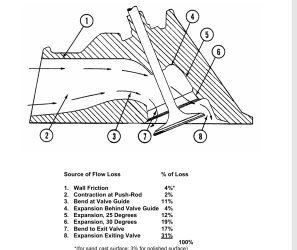
The pic below is from the Superflow Manual and illustrates how much velocity (over 60%) can be lost/disrupted in the valve and valve seat area.
Attachments
Last edited:


