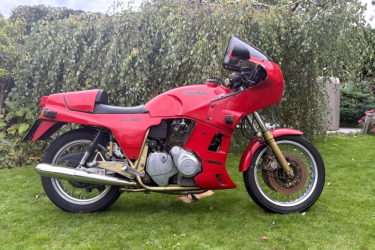
Cylinder head marking

LOS56

New member
Location
Malmö, Sweden
Hi, I have a question about cylinder head marking. I know that a Corsa head normally have a “CR” marking which I also have on my Corsa. However, I have a Mirage which is said by previous owner to have Corsa head, it’s marked with “C” only. I haven’t had the head off so I don’t know. Anyone know what the “C” stands for?

Regards Lars

Attached pictures of cyl head from my Mirage and my Corsa
 

Attachments

  • 20250310_135302283_iOS.jpg
    20250310_135302283_iOS.jpg
    111.1 KB · Views: 37
  • 20250310_135414245_iOS.jpg
    20250310_135414245_iOS.jpg
    145.3 KB · Views: 37
Hi Lars, can be actually anything from a factory stamping where they forgot to stamp the R to self made after a revision/rework of the head to a fake.

Are the Inlet channels 36mm? If so, there is a chance it is a Corsa-Spec head (factory or reworked). If they are still 32mm, almost certain it is a fake.

Carbs are easy to take off or if you have an endoscope camera, you can even leave them on the bike, lift the sliders and go down the inlet. 1st indication would be a step between head and inlet if the Carbs are 32mm and manifolds are not tappered.

Second indicator: on standard heads, the valve seat ring protrudes into the inlet channel and has a noticable step, too. On 41mm inlet valves, the rings are larger and "hide" in the casting of the inlet channel.

HTH
 
"Corsa" heads fitted to late SFC1000's were not stamped by the factory at all. That "C" looks too big and wrong to me, so as Lothar suggests, but in more detail, off with the carbs, out with the vernier, and measure the inlet port throat size, this can still be a non factory modification, but unless you take the head off, you won be able to measure the valve sizes.
CLEM
 
"Corsa" heads fitted to late SFC1000's were not stamped by the factory at all. That "C" looks too big and wrong to me, so as Lothar suggests, but in more detail, off with the carbs, out with the vernier, and measure the inlet port throat size, this can still be a non factory modification, but unless you take the head off, you won be able to measure the valve sizes.
CLEM
Clem, you actually can identify it indirectly as described above. If the inlet valve seat ring is protruding into the inlet channel, there is a very fair chance it is a small valve head. To be 100% sure though - I agree - you need to take it off and measure it properly. Still, ANY head can be altered to Corsa specs. That is basically how they built them - use larger valves and bore out the inlet to 36mm.
 
"Corsa" heads fitted to late SFC1000's were not stamped by the factory at all. That "C" looks too big and wrong to me, so as Lothar suggests, but in more detail, off with the carbs, out with the vernier, and measure the inlet port throat size, this can still be a non factory modification, but unless you take the head off, you won be able to measure the valve sizes.
CLEM
To my knowledge Clem, all SFC1000 heads were thus marked, at least those that originally came to Germany. Many of these bikes passed over my workbench, all carried the "CR" stamp. Some engines were also stamped at the rear lower LH mounting lug. The RGS Corsa was never officially offered here due to trademark disputes with GM/Opel.

One of the first actions when one of these rolled into the yard was to verify the CR stamping in order to know exactly what we were looking at.

Not proclaiming there aren't any fakes out there... :rolleyes:

piet
 
I have had several SFC1000's here Piet, bought on behalf of pals, they were all one owner from new bikes, with verifiable untouched engines, and the lack of "CR" mark allways made me suspicious one of them is with Per Erik in Alta who you visited recently and another with Preben Ingermason (probably spelt wrong sorry Preben) in Denmark, interestingly the ex Paul Mullholland Corsa (i also sold that) is still in the UK with... damnit cant recal his name , he is 4 km from Coxy. also has no CR and that is a Corsa, currently in bits, deffo a "CR" head but not stamped. My own Corsa was stamped "CR" and is only 4 numbers away from the one in bits, sold that as well (Owen Smith did a superb rebuild) Years ago as in decades, Henry Morgan UK, damaged the head on his Jota and bought a new casting from Slaters, it was a Corsa head, existing valves did not fit and that also was a "CR" head with no stamp, Slater said at the time that this was the only head Moto Laverda were selling, (or was the cunning old git aiming at selling six valves?) the earlier head was said to be being NLA. that Jota is now in Aus, unless that changed in the last 25 year
CLEM
come forward if you have a late SFC1000 without the stamp, and for that matter a Corsa.
 
A bit like 3CE's, they should have "3CE" stamped diagonally mid way in the chassis number, but do they all?????
CLEM
 
As Clem already mentioned I have an SFC (3424) without the CR stamping on the cylinderhead. Aquired with great help and support from Clem in 2007 (happy days Clem👍) It was sold new from Windy Corner in UK in december 1988.
Right now my SFC is completly apart due to a cosmetic restauration. So I have just taken a few photos of the cylinderhead and the stampning on the crankcase. The cylinderhead has the right 36 mm inlet ports. It has the right valves 40,5 intet and 34 mm outlet. Stamping on the underside of the head shows it was made in june 1988. So no doubt a genuine SFC cylinderhead. As already mentioned there is a few other late SFC’s without the CR stamping and other SFC’s with the CR stamping. Perhaps due to the conditions in the Factory during the production of the last SFC 1000🤔
Regards
Preben
 

Attachments

  • IMG_4041.jpeg
    IMG_4041.jpeg
    63.4 KB · Views: 49
  • IMG_4042.jpeg
    IMG_4042.jpeg
    299.2 KB · Views: 52
  • IMG_4039.jpeg
    IMG_4039.jpeg
    104.1 KB · Views: 52
  • IMG_4036.jpeg
    IMG_4036.jpeg
    246 KB · Views: 51
Last edited:
Its been a long time coming Piet (not that I have been trying) but at long last .....been shot down many times, have I finaly got one on you? hee hee.
as confuscous said "if a fool (me) gives instruction to a wise man, you then make him yet wiser"
we'll have a beer on that one when we meet I hope!
CLEM
 
Thanks all for some interesting info! I will check my head during the winter, I was just curious about the “C”. Difficult to imagine that someone makes the effort to stamp a “C” for nothing. My engine runs quite well except it’s a bit rich on cyl 1 so I need to check the carbs anyway for float hight and possible leaks. I have had the carbs of but didn’t check them properly... My engine has been rebuilt, I think at least 25 years ago by two or three owners back with this head, new pistons, 4C cams and DMC ignition. Most important, it runs quite good 😊.

Lars
 
No, I never share anything... :LOL:

The monitor on my PC has given up, need to buy me a new one. Once I have it, I can share, no Problem. I think though I shared it before - let me check...

Ha - I am not THAT old... I knew I shared it before...:

Thank you for that....... It's going to take me a bit to sort through that info........ some metric units send me for a loop and others I'm good with.

Ideally what I am looking to find out is the relationship of exhaust to inlet valve flow expressed in a percentage over the full lift of the cam in 0.025" to 0.050" intervals.

I'm not in a great hurry to the pull head off of my RGS to find out right now.

This winter while I'm checking my valve clearances I'm going to check out my cam timing at 0.040" lift and lift on both valves at tdc on overlap.

In the midst of changing out he heads on my Street Tracker right now.

Cheers.
 
Last edited:
I remember reading something on this re the race Mark 5 Motod with someone called MEZ doing the bath tub combustion chamber and porting. So its out there in some Magazine artical. There was also some info re Jerry Branch porting Edds Ricky Racer bike in the USA.
 
Thank you for that....... It's going to take me a bit to sort through that info........ some metric units send me for a loop and others I'm good with.

Ideally what I am looking to find out is the relationship of exhaust to inlet valve flow expressed in a percentage over the full lift of the cam in 0.025" to 0.050" intervals.

I'm not in a great hurry to the pull head off of my RGS to find out right now.

This winter while I'm checking my valve clearances I'm going to check out my cam timing at 0.040" lift and lift on both valves at tdc on overlap.

In the midst of changing out he heads on my Street Tracker right now.

Cheers.
Ian, if you are looking for efficiency, modify your head to the CR-specs. I had the head of a project engine at a specialist for head tuning and he found basically 5 things that kept the original 1000 Jota head (same as the RGS Head) from breathing as it should:

1.) the valve seat ring protrudes into the inlet channel, building a "step" in the inlet channel. the 40,5 or 41mm valve seat rings are larger and hide in the material of the channel, so that they do not have that step
2.) the valve size of the inlet valve was 39mm, he suggested 41mm
3.) the valve stem is relatively thick and the valve guide also protrudes into the inlet channel quite much; a shorter guide (that is longer at the top below the tappet cup) would help on the flow
4.) overall inlet channel diameter to narrow (was 32mm) and not optimally shaped
5.) combustion chamber not optimaly shaped, sharp edges should be smoothed out to reduce heat nests.

There was much more he said is not ideal but he said that between a standard 3C/3CL head and the possible optimum, there are easily 10 HP found - on each cylinder (assuming carburation and exhaust are in sync with the head!). And he was right... records show that even with the standard 1000 SFC engine, just different carburators and Exhaust, we had 110HP on the 1000 SFC compared to the claimed 84HP of the RGS. To be fair, a lot of it was the Exhaust, which is crap on the RGS/1000 SFC. It kills midrange and limits peak power.
 
Back
Top