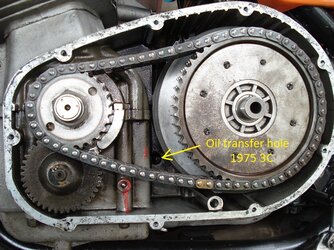
Early triple primary oiling

Paul Marx

Hero member
Location
France
A couple of us with early triples, one drum and my 3C n° 2098 are having trouble with clutches running dry, there being next to no oil in the primary case.

I think the subject has been mentioned on this forum earlier. These early triples have one hole between primary and main crankcase, that hole being about 40mm above the deck on the primary side. Later triples have larger and more importantly, lower holes between the two compartments.

Is the quantity of oil specified in the crankcase identical in early and later triples? If not, the dipsticks would be different surely. The 750 dipstick on those triples equates with 400cc more oil in the engine when the level is at the top on the stick.
What about the small hole on the oil pumps which squirts oil towards the primary chain on some pumps. Would these pumps be destined for use with the earlier triples?

With the communicating hole 40mm off the deck on the primary side, that would mean 40mm of oil sloshing around in there which seems a lot.

Thoughts?

Paul
 
Triple pumps do not have a chain lube orifice, at least I've never seen one. 120° engines have a squirt hole from the main lube circuit for the primary chain. Don't think Mk IIs have it, but not entirely sure.

It seems not enough oil finds its way through the hole and this oil shortage causes the clutch woes. A work-around would be to drill another hole at a lower position. Ideally, the primary chain should barely dip into the oil level to avoid excessive drag. The flailing chain will distribute it nicely.

My #2015 never had any clutch issues, at least not related to the oil supply, or lack thereof. But then, it's been running a RGS pump since forever.

piet
 
Triple pumps do not have a chain lube orifice, at least I've never seen one. 120° engines have a squirt hole from the main lube circuit for the primary chain. Don't think Mk IIs have it, but not entirely sure.

It seems not enough oil finds its way through the hole and this oil shortage causes the clutch woes. A work-around would be to drill another hole at a lower position. Ideally, the primary chain should barely dip into the oil level to avoid excessive drag. The flailing chain will distribute it nicely.

My #2015 never had any clutch issues, at least not related to the oil supply, or lack thereof. But then, it's been running a RGS pump since forever.

piet
Thanks Piet. My 3C is running a high volume pump fitted by Keith.
I've put an extra 400 cc of oil into the engine which brought the level above the top mark on the dipstick. I started the engine up, ran it 2 or 3 minutes and stopped it, measuring oil level immediately. Level was on the top mark. I usually check oil on a cold engine when a lot of oil has dribbled down. Maybe the early bikes need that little bit extra oil?
I'll be out testing it tomorrow.

Paul
 
A couple of us with early triples, one drum and my 3C n° 2098 are having trouble with clutches running dry, there being next to no oil in the primary case.

I think the subject has been mentioned on this forum earlier. These early triples have one hole between primary and main crankcase, that hole being about 40mm above the deck on the primary side. Later triples have larger and more importantly, lower holes between the two compartments.

Is the quantity of oil specified in the crankcase identical in early and later triples? If not, the dipsticks would be different surely. The 750 dipstick on those triples equates with 400cc more oil in the engine when the level is at the top on the stick.
What about the small hole on the oil pumps which squirts oil towards the primary chain on some pumps. Would these pumps be destined for use with the earlier triples?

With the communicating hole 40mm off the deck on the primary side, that would mean 40mm of oil sloshing around in there which seems a lot.

Thoughts?

Paul
When you speak about a dry clutch, what do you experience exactly? Symptoms ? Also related to noice? Thanks Paul
 
When you speak about a dry clutch, what do you experience exactly? Symptoms ? Also related to noice? Thanks Paul
The clutch grabs when let out. L'embrayage broute. And it sticks if left only a few hours. I went to a BBQ at a friends yesterday, stayed 3 hours and when leaving, started the bike, trod down into first and stalled the engine.

This happened when I initially rebuilt the bike, with a new clutch, and disappeared when I dismantled the clutch again and soaked the plates in oil. The problem reappeared after a few hundred km.
When I take out the screw for the tensioner, less than 50cc of oil drains from the primary case.

According to Marco Ianarelli who runs the drum brake triple facebook page, after a rebuild of a very early triple, you need to fill the engine with oil and lean it right over to the left for 1/2 hour to fill the primary side with oil.

Paul
 
I thought there are 3 small holes, maybe 3mm dia between the primary and main case all at the same level. I have had issues with adding 3 litres of oil when doing changes with that showing well overfilled on the dipstick caused by oil being held in the primary, so I go 2.5litre and slowly add a bit till the dipstick shows the correct level. I don't bother draining the primary as I find adjusting the chain a bit iffy and I always end up with an adjuster oil leak. A couple of mods have been done over the years, Red on one of the engine rebuilds did a bunch of clutch hub drillings to allow more oil penetration through the hub, I think maybe Phil Todd came up with that idea and I have a set of Reds kevlar plates. I have never had even one case of clutch sticking even before these mods, these days the clutch works so well. Doest matter what it's put through, drag start, hard slipping, it just works really well. Even with an extended lever, I get neutral easily all the time when stopped.
 
I thought there are 3 small holes, maybe 3mm dia between the primary and main case all at the same level. I have had issues with adding 3 litres of oil when doing changes with that showing well overfilled on the dipstick caused by oil being held in the primary, so I go 2.5litre and slowly add a bit till the dipstick shows the correct level. I don't bother draining the primary as I find adjusting the chain a bit iffy and I always end up with an adjuster oil leak. A couple of mods have been done over the years, Red on one of the engine rebuilds did a bunch of clutch hub drillings to allow more oil penetration through the hub, I think maybe Phil Todd came up with that idea and I have a set of Reds kevlar plates. I have never had even one case of clutch sticking even before these mods, these days the clutch works so well. Doest matter what it's put through, drag start, hard slipping, it just works really well. Even with an extended lever, I get neutral easily all the time when stopped.
There are not 3 small holes on early triples only one 40mm above the deck. The only feed in to the primary case through the left hand main bearing and that ain't much. If you don't help oil in there after a drain, you'll experience the symptoms of a dry clutch because there's hardly any oil in there.
Paul
 
Paul I have always made a point of leaning my early 3Cs to the left in order to get oil into the primary case, not sure if your dragging or sticking clutch is related to lack of oil, I swap over those friction surflex plates for Kevlar plates and the difference is unbelievable.
 
Primary chain oiling is a bit of a mystery on the early triples.

I've never quite figured out the logic of that hole 40mm above the floor of the primary chain case. Given that it's supposed to be a wet clutch, and the chain needs lubrication, I thought it might be an overflow hole, so that the primary chain case oil level can't get any higher than the hole. But that assumes oil will get in there somehow. Perhaps the oil that's pumped to the left main bearing is supposed to dribble into the chain case and gradually fill it up. But that doesn't seem too reliable a source of oil. Not much oil comes out when you take out the chain adjuster bolt.

The hole seems too high to be an overflow anyway. It's well above the bottom of the clutch sprocket, so if the oil is up to the level of the hole, the chain is running in an unnecessarily deep bath.

Later 180° triples have a second hole at the bottom of the primary chain case. I'm not sure of the logic behind that hole either, because it'll drain the chain case back into the gearbox, eliminating any possibility of an oil bath for the chain. Perhaps that's only on the models that have an oil jet directed at the chain.

I suspect the best course of action for the early models is to fill the engine with oil then lean the bike over on its left side far enough that some oil will drain through that hole into the primary case. Then stand the bike up and top up the engine oil level as needed to get it within range on the dipstick. At least that ensures the chain case has some oil for the chain to splash about in. It may get whipped into mist and find its way back through the hole into the gearbox, and some more oil will probably leak out of the left main bearing into the chain case. The primary case will eventually find its own level somewhere between the bottom of the chain run around the clutch sprocket and the overflow hole.

oil transfer hole - primary case.jpg
 
Paul I have always made a point of leaning my early 3Cs to the left in order to get oil into the primary case, not sure if your dragging or sticking clutch is related to lack of oil, I swap over those friction surflex plates for Kevlar plates and the difference is unbelievable.
Thanks Maurice. It is oil related since soaking the plates in oil cures the problem, for a while.
I've been pondering those Kevlar plates.

Paul
 
It's a longer thread on ILOC ,I myself haven"t experienced any issues , but both engines concerned have been recently rebuilt (with I think different issues) but I"ve learnt from Maurice here now, and on the other thread from Ian asking Marco about the lean, which I"ll do from future oil changes on the drummer and 1580. I also found my 1580 dipstick was too short at 174mm and not at 192mm below the plastic cap.
 
It's a longer thread on ILOC ,I myself haven"t experienced any issues , but both engines concerned have been recently rebuilt (with I think different issues) but I"ve learnt from Maurice here now, and on the other thread from Ian asking Marco about the lean, which I"ll do from future oil changes on the drummer and 1580. I also found my 1580 dipstick was too short at 174mm and not at 192mm below the plastic cap.
You only need to to the lean if you drain the primary case which isn't necessary every oil change. The oil in the primary case, on these early machines is staying there so the clutch and tensioner debris aren't contaminating the engine oil per se.

Paul
 
In the end, between measuring oil level after having switched off engine rather than cold, and after having left the bike tilted to the left with the footrest propped up against bits of wood, it's a massive 800cc of oil needed to bring it up to the top level on the dipstick where it was yesterday morning.

Paul
 
FWIW, am in the middle of clutch problem, sticking last few weeks, after a long layup. Had a 1200 series 1 motor at one time, top end valve train destroyed twice. Engine came to me, someone had drilled a small orifice above the inserted steel ball bearing "stopper" adjacent to the oil pump, vertical chamber, indeed it did oil the primary side mechanicals and starved the top end at low revs. Proved by winding the motor over without plugs and watching for oil in the cam blocks, none ensued. Corrected the new hole, oil returned to the upper valve train... while cranking. Photo of trashed cam followers are alarming if not amusing in a perverse way.... back to me clutch issues here next few days..... we ride them we fix them....j
 
Mmmmmmmm ( sound of un-oiled brain ).... after dismantling the clutch driven and padded plates, a mixture of "dry" and oil witness effects, on plates was noticed, both seemingly effectively stuck with considerable adhesion. The collective thoughts here on a dry clutch plate to steel driven plate, unwanted adhesion, and the oil witnessed plates sticking by way of negative pressure effect on the oil coated plates. Not reoiled the plates as per the favored ( avoidable ) "negative pressure" effect. The latter if of most notable effect, plates would stick every day even when riding, has me perplexed it does... am in your hands... if not clutch hand...j
 
Hi John, as I wrote earlier both Phil Todd and Red drill a bunch of holes in the drum when there out for a rebuild, I cannot say what effect that has as I have never had a clicking clutch problem before or after the holes. And the bike has sat in both states for a couple of years in the former state and in the latter for a couple of months. There appears no rime or reason why this happens to some and not others. I have seen surgically flat surfaces in lots of materials stick together in either wet or dry states only needing a tiny gap to get them apart, big sheets of glass especially, usually they lay butcher paper between to stop this happening. Maybe less smooth is good.
 
Back
Top