Electrics

8137 may have been the hghest number seen on 180's, but you never know, so 19,285? I dont think so, the engine size was masked in the photo, although on second look I can now see two "0" s these five digits do look factory though, all others look interfered with, but probably started as factory, so someone has gone to some trouble to get or reploicate a stamp set that looks genuine.and as for an engine number with six digits??? but you know what you have got and no doubt will enjoy it for what it is, IMHO very few of these bikes that have non original numbers are on the "nicked/stolen" list, if the orginal numbers were known, they are usually changed for some other reason, like achieveig the matching numbers that doesnt add any horsepower whatsoever, but doess ad £££'s
CLEM
 
Yes I have receipts and photocopies of the sellers ID card Clem. I don't think there was anything underhand going on. The guy had started building himself a bike using the silver frame because it had documents and had bought the one with the orange and red wheels as a donor bike.
 
I say four straps, all of them "clutched", and either angled towards the centre of the mass for both pair, or to the front if a wheel stop is available on the trailer, I have never used or desire the drive on bumpstop, plenty like them tough and I can see the advantage if you are loading single handed, but once lashed, there will be no function for it.
CLEM
I agree Clem. A minimum of 4 individual straps. Preferably motorcycle-specific tie down straps with the soft loops to go around tie-down points on the bike. I don't have the front wheel gadget either, so I tie the front wheel to the wheel stop rail.
 

Attachments

  • spare bike 3.jpg
    spare bike 3.jpg
    195 KB · Views: 34
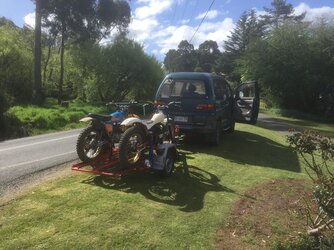
Just a twitch, one loop around the frame would have helped. But water under the bridge now, no damage thankfully. I use 4 tie-downs when I use my trailer, 2 around the lower triple tree and 2 on the rear. Plus a safety rope around the rear wheel. I once moved a twin with a fairing, and I couldn't find a way to try it down without rubbing the tie-downs against the fairing. Really frustrating, but at least I have never had a bike fall over in a trailer. That experience had me buy a Canyon Dancer, they have a sleeve that goes over the end of the handlebars. Tried it once and chucked it away. Absolutely horrible, don't waste your money.
 
I always double my front straps, except taking an RGS to Clem's place.
One front strap wore through and broke, on a motorway with only one lane due to road works and no hard shoulder. Of course there was 40 tonnes of lorry just behind. Luckily the bike didn't fall being held by the rear straps but it was 10 miles until we could pull over, very hairy.

Paul
 
That experience had me buy a Canyon Dancer, they have a sleeve that goes over the end of the handlebars.
I never knew they were called Canyon Dancer. They use something like that on the Spirit of Tasmania (ferry) for tying bikes down. I've never used one myself, but I wouldn't be keen to use the outer ends of the handlebars as the primary tie-down point.

You can usually find somewhere to attach a tie down, even if you have to make some kind of spider web out of rope and hook the tie down strap into it. Sometimes the bottom triple clamp works as an attachment point when there's a fairing in the way, crossing the straps over so they attach to the opposite sides can give a bit extra clearance under a fairing, but you lose a bit of stability. The rear straps will provide back-up though.
 
Useful though Cam. I have used the same method on ferries when the tie down points didn’t work with my fairing, so have had tie from the handlebars. Although I don’t have a trademarked item... I just use a short strap to connect the hooks so they don’t slip off.
 
One of the NSW blokes had an issue on the Tassie Ferry, seems the bike tie down gang likes you to use the side stand and he didn't have a side stand. There is no suspension compression with the Canyon Dancers they use when the bike is on the centre stand. They had no other option but they were not happy.
 
That experience had me buy a Canyon Dancer, they have a sleeve that goes over the end of the handlebars. Tried it once and chucked it away. Absolutely horrible, don't waste your money.

I have tried the older style and they are shite. There is a newer style with a hard plastic cup that goes over the end of the bars. They seem to work quite well but I still prefer to use short straps with a loop on each end. I can fit them to the bars, triple clamps or different parts of the frame and they are still the best option for me. If I am going any distance at all there is at least 4 straps per bike and often a fifth to keep things from shifting.

Jim
 
Ferries are a nightmare for strapping down the bike safely, for one thing you have to use what they supply, and on most ferries that I use that is a 50mm ratchet strap with a big pad threaded onto it for the seat, and secured into the deck at the truck fixing crosses, the trick here is to use the side stand, as that keeps both wheels firmly on the deck, and then be sure that the ratchet mechanism in on the same side as the side stand, I try to have the front wheel against something solid, but that is rarely possible, the ferry companies do not take responsibilty for the fixing, the rider has to do it themselves, so why are they allowed to interfere with it when the car deck is locked and the vesssel at sea? Spanish ferries and long haul ones have metal cables on the floor which are fixed into sliding sleeves periodically, maybe every eight metres or so, they run the entire lentgh of the ferry, when you strap your bike down to this it influnences the cables and if every body releases or tightens at the same time, all is good(ish) but that never happens, seen the straps being released and heard a bike crash 50 meters away, due to the tension of the cable being let go.Who takes responsibility for that?

The channel tunnel train is even worse, no straps, no tying, no nuffink, and they insist that you park the bike with the front wheel diagonally agasnt the car guide rails, with the side stand on the left of the bike (train travelling forward, standing behind bike), this means that if harsh braking takes place then the bike topples easilly, it it were agcinst the right guard rail it would be 300% safer, I have advised them of this and they wrote a three poage kletter in reply telling nothing.
 
My only ferry experience is the Tassie one and they have maybe 30 blokes who tie the bikes down. They did really well, friendly bunch cracking jokes. Leaving and removing the tie-downs is down to you. I was amazed at the number of bikes using it, and what they were, you don't see many SS100 Brough Superiors or Indian Scouts being toured about in oz. Or 10 Laverdas either I supose
 
No side stand - I don't trust them to tie my bike down - Lee had his Honda VFR damaged by ferry idiots in Norway and they refused to pay for repairs.
 
the ferry companies do not take responsibilty for the fixing, the rider has to do it themselves,
It's the opposite on the ferry between Tasmania and mainland Australia (the one Vince is talking about - across Bass Strait). The crew does all the tying down of all vehicles. Owners can put additional ties on their bikes if they choose, but it's the ship crew who have the responsibility to secure vehicles. Thjey use proper motorcycle tie downs and generally they do a pretty good job.

That hasn't always been the case though. When I was a young man, you had to tie your own bikes down using dirty old bits of rope that were provided by the ship. Experienced travellers would bring their own tie downs, although dedicated bike tie down straps hadn't been invented back then.

Bass Strait can get very rough (heaps of shipwreck in that area). On one particular crossing that my brother was on a long time ago (one one of the older ships) he knew it was likely to be a rough night, and being a seasoned traveller on that ship, he took extra care when tying his bike down. He had ropes all over his bike. The other bikers thought he was being obsessive. They all left to go to the bar while he was still there tying his bike down. He even put ropes on the bikes either side of his to stop them falling against his. The ship pitched and rolled like crazy during the night (it's an overnight trip) and he said he could hear a lot of crashing about on the vehicle deck from his accommodation a couple of decks above.
When the ship made port in the morning, and passengers were allowed back onto the vehicle deck, there was carnage. It was immediately obvious that the securing of vehicles had been woefully inadequate. A lot of vehicles had broken loose. There were smashed cars all over the place, and a container truck had toppled over and crushed several cars (that would put a bit of a damper on your road trip). There were a couple of dozen bikes on the ship that night and because of Tim's thorough job of tying it down, his Laverda 3C was the only bike left standing. I reckon that trip was a trigger for the shipping company to get their act together with securing of vehicles.
 
Our Cook Straight can get pretty rough too, although normally a lot shorter journey. The only guaranteed tie point is at the front and you tie your own bike. I like to check the bikes on either side of mine...
Here’s a video of a particularly rough crossing, and I am truly glad I wasn’t on it!
 
  • Like
Reactions: T.C
Yeah, there's continuing argument about the Cook Straight ferries and bikes. Piss poor arrangements.
Coming back from one of the WSB rounds at Manfield I had to ride the racebike aboard with tiedowns tucked into my jacket.
Then tie it down with no stands of course. Not easy. Luckily a couple of guys alongside helped.
Quite fun bumpstarting it in the parking area at Wellington - people waiting in cars recognised the bike and helped. We'd won the F3 supporting class at the meeting - only South Island winner. Then ride it up the ramp and aboard.

I've been on several pretty rough crossings over the years. Never gets any more pleasant.
 
Far out. Total carnage on the vehicle deck in that vid!! Surely after a crossing like that they'd change tack (excuse the pun) re securing vehicles? Who pays?
 
Far out. Total carnage on the vehicle deck in that vid!! Surely after a crossing like that they'd change tack (excuse the pun) re securing vehicles? Who pays?
I'd imagine there were some hard questions asked after that, although I don't recall.
As for who pays, I've never had to find out. Although I understand that most of the damage is covered by your own insurance, unless it could be proved that the ferry company was "negligent" with tying down or even in their decision to have put to sea at all..?
 
Back
Top