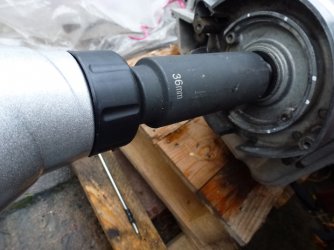
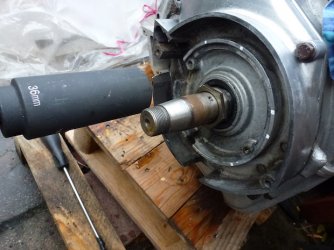
extra deep 36 socket

go the other way and have the 36mm end the smaller of the two, mine is 36x42 makes life much more simple as its a longer tool,
take the primary cover off and use a locking tool on the LHS crank end, never a bad thing to have a look in there anyway, life is simple if you are prepared for just a tiny bit of extra work, and as a matter of course change the alternator bearing and oil seal, when you have the cover off, they are cheap but be sure to get a bearing with C3 clearance as the engine unit does actually get hot. The sleeve nut you are removing may be scored where it runs on the seal, buy a new one if that is the case, a drop of Loctite when refitting ensures it will stay tight and not seep oil down the thread, although I am not sure that does actually happen, it does get spoken about.
CLEM
 
Hi all, Hi Clem,

thanks very much for your explanation, as you speak i have already removed it! (see photo)! with this combination of tools and a ratle gun, was 10 secs :D
I actually have the locking tool for the clutch side, but I was hesitant to use it, I was afraid of applying a torque in different side of the crank, because of the risk of unbalacing the crank timing. No idea if the torque would be enough for that, but didn't want to risk it....

What is a 3C bearing? never heard about. But I guess that is written in the bearing serial number?

Miguel

IMG_6509.JPG

IMG_6511.JPG

 
fine, you made it.
C3 bearings have other tolerances- lets say wider or they have more play to make the shafts running easier and to cover the colerances of the shafts and housings
good luck
Andre
 
Looks like the "plumbers socket" got on that nut just fine? Perfect application with the impact gun and the regular socket to spin it.

C3 are sized fractionally loose in clearance. They used to say you needed C3 roller bearings in motorcycle engines without adequate oil filtration.  The looser bearing clearances allowed the rollers to eject metal contamination rather that drive it into the bearing race. That's what they used to say....

That said years ago I fitted a C2 clearance alternator bearing rather than a C3 bearing without any issues in my Laverda. The original factory bearing failed at about 8000 miles. A C2 alternator bearing was what I could find on short notice local. That bearing was eventually changed out when I switched the DMC from the /2 to the /32 20,000 miles later as a matter of routine. The C2 bearing was still fine.  I used a new C3 bearing from Wolfgang.

I dont think it really matters. I do have an oil filter fitted though.
 
The bearing behind that nut seemed to run quite dry on my 74 3C, it needed replacing more often than I would have thought necessary.
 
pf1 said:
The bearing behind that nut seemed to run quite dry on my 74 3C, it needed replacing more often than I would have thought necessary.

I think that alternator bearing can be subject to some "side-loads". I had to replace one in my other 3C twice. A bit perplexing as there is a freewheel with a bearing in it very close the the alternator bearing and it seems reliable. No "side-loads" on that bearing though.

If you heat the cover and insert the alternator bearing, then go ahead and install the cover that alternator bearing could be out or in slightly sitting there in the cover in relation to the crank starter sprag, etc. even when the bearing is perfectly and fully seated in the cover. The cover gasket could be thicker..you never know what effects the stack. When you tighten the 36mm nut it can put some slight side loads on the bearing as the outer race is fixed in the cover and the inner race moves even a fraction.

I started using grease liberally smeared on the outside perimeter of the alternator bearing race when installing it in the alternator cover. I am certain the entire bearing moves slightly when I tighten the 36mm nut. That greased alternator bearing can now move slightly in the cover.

I use polyurea grease for alternator bearing fit in the cover (same grease for the swingarm fitting). Just my opinion.


I have non C3 bearings in the cam of my SF (by mistake) - spin freely when pressed onto the cams and head doesn't show any evidence of spinning and the fit in the head is an easy interference. Sometimes the press onto a shaft expands enough to reduce play. I think C3 is more important in those cases (eg, on a crank, on a gearbox shaft).
 
Piranha Brother 2 said:
I think C3 is more important in those cases (eg, on a crank, on a gearbox shaft).

My understanding of C3 clearance bearings is that they're intended for applications where they're an interference fit on the shaft or in the housing. The tight fit can close up the internal bearing clearance.
 
Dellortoman said:
My understanding of C3 clearance bearings is that they're intended for applications where they're an interference fit on the shaft or in the housing. The tight fit can close up the internal bearing clearance.
I have seen non C3 used quite a few times where spec was C3, including SF cams. If the assembly spins very easily I haven't bothered changing it and time has shown them to be ok. In others you can feel that they are too tight. In a place where you can't verify that they spin freely I would go for spec.
 
C3 bearings are for applications where they get hot, not from "working" but from heat in the housings,
as heat makes everything grow a bit in size (not just the bearing but everything around it) the heat can cause the bearing to become too tight, C3 = more clearance = when hot still fine, and not binding, which, if that happens,gets very noisy particularly on the alternator bearing, just buy them and fit them, its what was factory installed. Bearing for alternator cover is 16006/C3. in varying quality from bearing stockists, don't go for cheap Chinese, there is good Chinese but they are never cheap. Personal preference is for SKF and the box in my hands now, says, made in Italy, isn't that  German company?
CLEM
 
I used a 36mm deep HD socket from Deltic https://www.deltec.net/108-six-point-sockets-34-square-drive-deep-length, I did have to skim out the bottom of the socket for the correct internal depth of 76mm. The tube spanner wins my vote tho!
 
Just got that nut off my bike today. I bought one of those extra long ones by Grey Pneumatic in the USA a while back in readiness for this job. On it went, nice and deep. Two seconds with rattle gun the nut was off. To have something go so smoothly was an unexpected and extraordinary experience. Things don't usually go like this for me.
 

Attachments

  • P57 Fig 113(1).jpg
    P57 Fig 113(1).jpg
    192.4 KB · Views: 68
  • P57 fig 113.jpg
    P57 fig 113.jpg
    166.4 KB · Views: 67
They really shouldn't be that difficult to remove. I used to use a bent 3C rear axle spanner for the cush drive hub nut adapted from the original bikes tool kit. I believe the factory mechanics used this method too, Phil Todd posted a picture on the ILOC forum if I remember correctly.
 
Back
Top