Getting an RGS with a missing spark running

Dan - the reason I was a bit tetchy is that Piet was closely involved in the development & testing of the DMC...he's also got loads of valuable experience!

OK - sounds like you have original Nippon Denso (ND) coils fitted. When you were testing secondary resistance, was this with the plug caps in situ?  If so, do it again without the plug caps screwed on to the leads.  Measuring between the lead (push a nail or similar in the end) and primary negative wire (black) should give 8.3-8.5 kohm.    If the end of the HT lead is well and truly mashed, snip 5 or 10 mm off.  Should be enough length if this hasn't been done before.

Plug caps need to be suppressed type (5kohm) - they deteriorate with age, heat and vibration so well worth replacing.

ND coils are very reliable and I would be surprised if they are faulty.  The HT cable can be removed but it is a major PITA to do successfully because they are bonded in.  If you need to, you'd be better off getting some TEK KP03 or MP06 off eBay plus new copper HT lead-  fitted to lots of Jap machinery including Kawasaki 250 / 500 or Honda VF750.  They are direct replacements.  Or given you're in Canada - email or call Wolfgang Haerter laverda@lightspeed.ca  Columbia Car & Cycle, 357 Shakespeare Road Nakusp, BC, V0G 1R1  Ph./Fax : 250-265-4502.  He's away 9-17 Aug but could quickly provide anything you need.

The supporting bracket is very prone to fracture.  Not particularly relevant to no sparking. 

BTW - primary resistance is 4 ohm

Finally, when you were testing for a spark, please tell me that you had all three leads with a plug in and earthed, not just one plug being swapped from lead to lead?
 
Hey all

the way I tested spark was to leave all the (original) plugs in, and with their leads attached. No other pulling apart of anything. I then took a *new* NGK plug, pulled a lead, attached the new plug and did the usual trick of holding the plug to the camshaft cover while cranking. Got spark on #1 and #2, but not on #3. Retested several times to make sure this was not an anomaly.

Given that the plug leads are integral, I don't have an easy way to test their resistance. As you say, I'm focusing now on finding local replacements from dealer chains, because that gives me a shot at getting the machine running quicker. If that doesn't pan out, I'll go with Wolfgang.

I tested the secondary resistance from one of the primary leads to the electrode of a new plug plugged in. Also tried with the probe in the lead, but couldn't be 100% sure I was making contact, hence also using the plug. Not sure if this affects anything. Best I could do.

Having spot-on primary readings makes me wonder if this coils are bad. My other thought is that these are not originals: these coils have leads that are really supple and appear almost new.

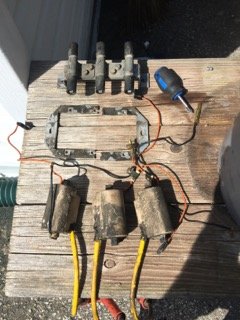
In the photo, you can see that the original frame that was above the coils is intact. I assume that these are the ballast resistors? These were completely unattached but still in place, and the wiring diagram I have from Witt doesn't show any connection to them. I assumed they were irrelevant to this setup - am I wrong? And if so, how would they be attached? Inline with the main lead, or on the primary lead? Sorry if I'm dense about this. Or do I need to worry about this at all?
 

Attachments

  • 002 - 8 1-2  - 1.jpg
    002 - 8 1-2 - 1.jpg
    36.4 KB · Views: 47
OK - understand how you tested for a spark, but were the other two plugs also grounded when you tested with the new plug?

Ballast resistors can be thrown away - not required.

I'm not asking you to test coil secondary resistance without HT leads - the readings I gave are with the leads.  They are solid core type, so either conduct or don't.

Push a nail down the plug lead to make good contact with the HT conductor core.

The coils you have are original - is that yellow sleeving over the black insulation?  That's not original
 
to answer the first question: all the plugs were in the cylinder head, with leads attached when the testing happened, so yes they were grounded

Good to know about the resistors - thanks. They also make it a lot harder to get into the area.

So, one coil had infinite resistance from primary lead through secondary. other two had different values, but were continuous. What's the implication - this seems like a pretty relevant issue from what I can tell.

Not at the bike right now, but will retest in an hour or so when I am, using nail, etc.

I'll have to look at the sleeving - It doesn't move in any way, and I think goes up under the beige wrapping on the coil, there's also a kind of insulating or sealing compound like silicone on it, that looks like someone's attempt to seal them up, will investigate.

Happen to know the year of any equivalent coils?
 
Wolfgang use to sell and still may, a complete kit of 3 new coils with leads, caps, and a new mounting bracket. My approach is I want to fix or prevent a problem once preferably in the garage , don't want  problems to happen on the road, and want to ride.  These bikes are 30 or 40 years old but if you attend to the problems and known aging issues you will have a reliable ride. These are all relatively simple fixes/improvements for backyard mechanics like myself with the help of the knowledge on the forum.
 
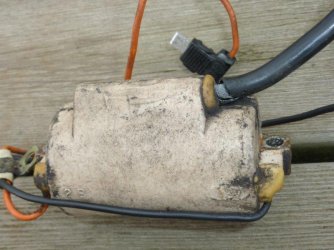
Pic of original coil - showing deterioration around original HT lead, also the hard epoxy that retains the lead.  If yours are silicone, then someone has previously been there and replaced lead.  If they are the filament resistance type rather than copper core then that might explain the very high resistances you previously measured.

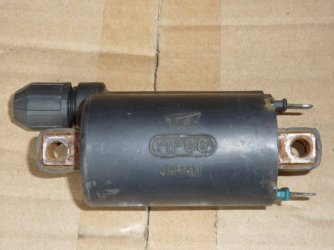
Second pic shows TEK MP06 - (the KP03 looks the same but is grey).  If you look at pics on eBay you'll see if they match - mid 80s to early 90s AFAIK for donor bikes.  I searched using the loose model description and came up with loads.  Just make sure you don't get a later VFR with double output coil for one pair of cylinders.  You also want to ensure the original HT leads are fitted to get the retaining screw, washer and grommet you'll need.

Can't help but think Henry is right...Wolfgang is online now!
 

Attachments

  • P1060579.jpg
    P1060579.jpg
    74.5 KB · Views: 19
  • P1060582.jpg
    P1060582.jpg
    61.9 KB · Views: 19
OK - so the bike is running beautifully now. In the end, no coils were replaced, I replaced all the connectors that were on the original coils, and sorted out some messy wiring. Put it back together with a temporary gusseting for the support frame, connected everything and the bike came on right away.

We've laid down about 40km on it now, and we'll give it another little test before taking it out longer....

Thanks for all the help! Love that Laverda exhaust note, and looking forward to more of it.

Dan
 
Good work Dan, and welcome to the world of Laverda tragics.

Even though you've got the bike running, it might still be worth checking the HT leads and plug caps. You might be able to get it running better.

Ignition systems normally have a resistor somewhere in the HT side, but the resistance shouldn't be more than 5 K Ohms.
The resistor can be the spark plugs themselves (NGK resistance plugs have a "R" in the designation, like BR8ES)
Or it can be in the plug leads. Resistor leads have a conducting core made from carbon impregnated silicon.
Or it can be in the plug caps. Only way to be sure is to test them with a meter.

Hard to tell from your photo but it looks like you have NGK plug caps, which usually have a resistor in them. Those yellow leads look like they may be carbon/silicon type which also have high resistance.

If you have resistance type leads with resistor caps, you'll have more resistance than ideal, and the spark will be weaker than it should be.

Unscrew the plug caps off the ends of the leads and measure the resistance of the caps with your multimeter. They should have 5 K Ohms resistance. Now look at the conducting core of the lead. If it's copper, all good. If it's carbon/silicon (dark grey stuff) it's a resistance lead which is not good. In that case, replace the leads with copper core (can be done even though they're glued in).

Plugs for your bike should be B8ES (without the "R").

Cheers,
Cam
 
Well done Dan good to hear you got it sorted.

I got one of the coil holders from Piet to sort mine out it was well pucker ... much better than the original. It went on the Corsa but lets not tell the rivet counters hey  :o

Now those yellow leads might well be copper already as they definately have been replaced, as Cam suggests unscrew one of the caps and have a squiz at the end of the lead.... but that will be next time the tank is off.. as it is after all an RGS and aint that easy to do without removing tank though can be done  :D As per Cam the caps look like NGK's so B8ES should see you right.

Personally if I were to replace the coils then would be going for new ones like Dyna or Nologies as seems way counter intuitive to me to be replacing old coils with used ones even of a different elk which may well be getting to the end of their life.

Go and ride the thing if its running OK and don't worry and enjoy it, as you have spent a good number of hours sorting it.
 
if I were to replace the coils then would be going for new ones like Dyna

...just so happens there are a set of Dyna minis on fleabay right now.....  ;)  Please form an orderly queue!! 
232036610454  232036609679  232036608487
 
Dan Donaldson said:
OK - so the bike is running beautifully now. In the end, no coils were replaced, I replaced all the connectors that were on the original coils, and sorted out some messy wiring. Put it back together with a temporary gusseting for the support frame, connected everything and the bike came on right away.

We've laid down about 40km on it now, and we'll give it another little test before taking it out longer....

Thanks for all the help! Love that Laverda exhaust note, and looking forward to more of it.

Dan

Hi Dan

think how much BETTER the bike can run with brand new NGK B8ES plugs, decent new coils (Dyna green 3 ohms or Dyna minis or similar) new high quality plug leads, and new spark plug boots, plus new wiring from the ignition to the coils and new grounds. Then you can forget the ignition (except spark plug periodic replacement) for another 30 + years.......

Paul LeClair
 
So, followup.... got back from a 600km roundtrip. Started off very well, with new plugs, coils tested and Witt ignition wiring connectors swapped out.

Problems did arise, lots of coughing and choking and generally rough riding. Generally seemed to run rich, and I thought the floats might be not closing off properly. At one point rechecked the plugs and a fair bit of carbon on two cyls, cleaned that up...

However, away from tools and on the road, took a chance on changing the fuel to regular from high test. After draining the bowls (which had already been done a couple of times, along with running the bike almost to vapours when caught on a looonnggg Canadian northern road without gas stations).

Immediate improvement - no irregular firing, great power (up around 150km/hr at a few points, and no lack of power left), responsive throttle, and good fuel consumption. Perhaps a little bit of knocking, but hard to say, certainly not pronounced.

I guess this bike likes lower grade fuel....thoughts?
 
Check for water in the petrol

Drain the float bowels into  drinking glas and See if water bubles collect at the ground (water is heavier than petrol...

 
Dan Donaldson said:
So, followup.... got back from a 600km roundtrip. Started off very well, with new plugs, coils tested and Witt ignition wiring connectors swapped out.

Problems did arise, lots of coughing and choking and generally rough riding. Generally seemed to run rich, and I thought the floats might be not closing off properly. At one point rechecked the plugs and a fair bit of carbon on two cyls, cleaned that up...

However, away from tools and on the road, took a chance on changing the fuel to regular from high test. After draining the bowls (which had already been done a couple of times, along with running the bike almost to vapours when caught on a looonnggg Canadian northern road without gas stations).

Immediate improvement - no irregular firing, great power (up around 150km/hr at a few points, and no lack of power left), responsive throttle, and good fuel consumption. Perhaps a little bit of knocking, but hard to say, certainly not pronounced.

I guess this bike likes lower grade fuel....thoughts?

Definitely not...

piet
 
sfcpiet said:
Definitely not...

piet

OK, so what would you recommend as a line of inquiry? The bike rapidly gets to unrideable on hi octane, but is smooth and responsive on lower grade, at least so far. The previous owner might have mentioned kitting the bike in a way that was never specified - rejetting maybe - to run smoothly on regular gas, but this may be a misremembering (I looked at a bunch of bikes around that time).

Obviously I've got to look at the carbs, given that the crap on the plugs looks bad in a few hundred kms but spark seems very good. Is there a starting point online for checking those? I'm also thinking that the rubber manifolds might be more cracked than I can see.... I tried wrapping the outside with tape to see if it made any difference - on the road, so not really able to do better then - but in any case no obvious change, and the rubber does look good...
 
The bike rapidly gets to unrideable on hi octane, but is smooth and responsive on lower grade, at least so far.

Will be the only RGS that does!  Lothar has suggested contaminated fuel.  You said you almost emptied the tank - if this was just before you filled with lower grade you may have pulled contamination through.  RGS tank susceptible to collecting water (from ethanol content) & consequential corrosion in narrow 'wings' at front.
 
I see where you're going. We didn't have the opportunity to completely drain the tank, but we did manage to add some stabilizer after we fueled it up. It was after that (but not long) that we had to pull the plugs, and at that time drained the bowls. I'm thinking that the stabilizer can only do so much, and wouldn't have any effect in the bowls themselves.

I'll let the low octane run down a bit, and then up the octane and see if anything gets better (or worse).... the fuel coming out of the tank doesn't look like there's any particulate, and the stuff out of the bowls didn't show any either, or any water either.... so we'll just have to keep watching it.

Meantime, any good guides to adjusting RGS Dell'ortos?

 
There's detailed explanation on this forum.  Use the search facility in the menu line (above, to the left) - not the search box top right which uses a less accurate search algorithm.  Paul LeClair has on more than one occasion provided a detailed how to that is Laverda specific...there may well be others
 
Dan modern fuels dont take long to go off and contamination sinks in. Yep my money is with Lothar that you might have had either some water or contamination of some kind or that the fuel was just simply stale. Stabilizer after the event let along at the get go dont seem to make much difference in my experience nothing beats fresh fuel.

Fresh low octane would be a lot more volatile and therefore aid to running than 2 or 3 month old hi octane thats for sure.

A friend of mine who has a duck and is a wee bit south of you couldn't get it to run, he told me full tank of fuel and stabilizer only been sitting for 3 months since last ride. We drained out the fuel and put in some fresh fuel and whalla the thing started and ran great.

Am sure fresh hi octane and oh make sure your air filter is in good nick ... I use old Ford Capri filters which just need a wee bit of cut and shutting at one end and they fit like a glove. NOS you can pick up for a few $$$
 
Back
Top