GT Gas Tank Restoration

Evan

Full member
Location
Texas
Found one! Started the cleaning process Friday. I watched everything about gas restoration on youtube. I am still @ the Vinegar stage. It is cleaning Ok. Today a dead rat came out!
Anyway much cleaner & clear water coming out w/ garden hose. I am not a chemist but one guy on youtube says the Vinegar can ruin the tank if left in there too long. Doesn't make sense to me because petrol is stronger so I thought. How long can I keep w/ the Vinegar. & then another mechanic told me just go ahead & fill w/ gas after final cleaning. I do not want to use sealant as one guy said it is hard to get out once in.
& are there any new knee pads available? Top grill is Ok. Emblems Ok. Petcocks petrified but they are still available new.
So I guess I'll go to Muriatic acid after the Vinegar. But any suggestions would be great.
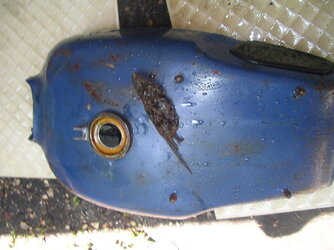
 

Attachments

  • IMGP0389.JPG
    IMGP0389.JPG
    143.3 KB · Views: 25
  • IMGP0390.JPG
    IMGP0390.JPG
    134 KB · Views: 23
I use electrolysis to remove rust and then rinse with diluted phosphoric acid to block the rust. I believe that knee grips are readily available as are replica taps.
Paul
 
Dry the tank inside, exhaust fumes are best.
Put in a couple of pounds of Kiln Dried sand, cap it, wrap it in old towels and carpet.
Wedge it in a cement mixer and leave it turning for eight hours.
Blow the sand and loosened rust out with an airline.
Repeat until the sand comes out clean.
Pressure test and, if all is good, flush it with a rust inhibitor.
 
Dry the tank inside, exhaust fumes are best.
Put in a couple of pounds of Kiln Dried sand, cap it, wrap it in old towels and carpet.
Wedge it in a cement mixer and leave it turning for eight hours.
Blow the sand and loosened rust out with an airline.
Repeat until the sand comes out clean.
Pressure test and, if all is good, flush it with a rust inhibitor.
That exhaust fumes idea is one of the best drying methods I’ve heard off. Makes perfect sense, why didn’t I think of that?
 
I have used muriatic acid in a number of fuel tanks and it works great. Don't leave it in too long or you will have no fuel tank left! As soon as the rust is gone rinse it out and refill with baking soda and water to neutralize the acid.

Putting some acetone in after the baking soda has been rinsed out will absorb the water left and you will have a clean tank.
 
The exhaust fumes (petrol ones not diesel) is something that I have used in a race paddock where electricity or a hair drier might not have been available, the hair drier method is preferable, dont get too close to the cap outlet, air needs to go in as well as out and this reduces the fire risk when de gasing the tank, its not complicated, all you are trying to do is boil the petrol remnants, it has a very low boiling point, boiling point of any liquid is the point of temperature rise which cause it to become a gas and evaporate, but all you need to do is have the tank outside and make it hotter than the boiling point of petrol which is about 70c to 72c so outside in the sun wont do it well enough, but if left upside down outside the "heavier than air" principle comes in, so if you have time , maybe a week or a fornight, all you have to do is fix the tank with the filler cap at the lowest point and leave it outside, even better if in the sun. You will end up with a gas free tank no matter which way you do it, but test before welding, by "waving" AT ARMS LENGTH the lighted torch under the open filler cap starting about two foot away and working inwards, at 3 or 4 inches if it "wooks" you were not gas free but you are now, so mind the hairs on the top oif your toes, the tank can then be cut and welded.
CLEM
 
outside in the sun wont do it well enough, but if left upside down outside the "heavier than air" principle comes in, so if you have time , maybe a week or a fornight, all you have to do is fix the tank with the filler cap at the lowest point and leave it outside, even better if in the sun. You will end up with a gas free tank no matter which way you do it, but test before welding, by "waving" AT ARMS LENGTH the lighted torch under the open filler cap starting about two foot away and working inwards, at 3 or 4 inches if it "wooks" you were not gas free but you are now, so mind the hairs on the top oif your toes, the tank can then be cut and welded.
CLEM
In hot sun in Oz we had them gas free after an hour. You can also see the fumes pouring out, and when all gone you couldn't even detect petrol smell from the tank and could weld away. Evan hasn't mentioned the need to weld it though, just cleaning out rust.
 
The exhaust fumes (petrol ones not diesel) is something that I have used in a race paddock where electricity or a hair drier might not have been available, the hair drier method is preferable, dont get too close to the cap outlet, air needs to go in as well as out and this reduces the fire risk when de gasing the tank, its not complicated, all you are trying to do is boil the petrol remnants, it has a very low boiling point, boiling point of any liquid is the point of temperature rise which cause it to become a gas and evaporate, but all you need to do is have the tank outside and make it hotter than the boiling point of petrol which is about 70c to 72c so outside in the sun wont do it well enough, but if left upside down outside the "heavier than air" principle comes in, so if you have time , maybe a week or a fornight, all you have to do is fix the tank with the filler cap at the lowest point and leave it outside, even better if in the sun. You will end up with a gas free tank no matter which way you do it, but test before welding, by "waving" AT ARMS LENGTH the lighted torch under the open filler cap starting about two foot away and working inwards, at 3 or 4 inches if it "wooks" you were not gas free but you are now, so mind the hairs on the top oif your toes, the tank can then be cut and welded.
CLEM
In my day of boiler maintenance:

A milk carton filled with acetylene, placed under the stool and a lit oxy torch quietly pushed toward the carton under the unsuspecting stool sitter was always fun.

Electricians, wiring charged capacitors to canteen seat frames.

Grafite grease under car door handles.

Coppercoat in awaiting shift workers boots.

Gasket board snuck into workmates lunch sandwiches.

KO wool shards intertwined in the toilet paper

All fun! 🤣
 
In my days of flight testing:

Freezing lunch boxes in liquid nitrogen.

Filling empty water bottles with a bit of liquid nitrogen.

Hoisting tool boxes 20m in the air on the overhead trolly crane.

In aircraft school:

Hand cranking a radial engine magneto attached to a metal work bench when the class was sitting on it eating lunch.
 
Buzzing up wheel bearing with an air line and setting them off, sparking down the road!
My boss helped me in the workshop when we had everyone off sick- he greased a Ball bearing, stuck it in an empty Bic Byro and fired it with an air line…we saw nothing but could hear the ball ricochetting off walls..didn’t do that again.
 
my favourite two are emptying a pals toolbox and putting a close fitting sheet of leads in the base, then re-installing his tools, adding another sheet every two or three days was very funny when getting above about 4 layers and carrying on.

similar one (for big head know all) was putting strips of newspaper in his trilby hat, and again building up every two or three days, hilarious when you start calling him a know all big head and he doesnt mention the ever tighter fiting hat when changing for the public transport to home.

not so funny, but done at the time, was a bit of timber cut and wedged under the brake poedal of a van, and even a wire rope from a rear axle to a cast iron drain cover, but by far the funniest, was when I fund the keys to my VW van would fit my mates, (identical vans, odentical signwriting bought about 3 months apart) and I had a longer trip home than he, and (almost) past his house on the way, so i would stop and turn his van around for him, or even park it on the other side of the road, and on one occassion 350 yards down the road, but still in site, he worked it out in the end.

CLEM
 
Thanks for all the advice. Once the tank is cleaned on the inside I have to touch up & paint the outside. On youtube one guy says use a 12 oz bottle of Marvel Mystery Oil for the inside. Then swish it around & it should last months on the inside. Another guy here says no. You do not want to put anything that can get into the filters or engine. So my question is what should I do for the inside of the tank while I take my time doing the outside? I don't want to coat w/ sealant.
Here in Texas its too hot to be out there on the back porch...Summer soltice! We're getting fried!!! Good thing is no problem drying it out.
 
i've done the MM treatment inside to prevent light rust while prepping the tank - and had to problems - though i do rinse it with some gas before mounting it and running it on the bike - never had a problem. I've also squirted WD-40 in them and other light lubricants and not had a problem, though again i've always swished a bit of gas through them with rubber stoppers in the petcock holes too - never a prob - coating the tanks is a cluster'F as at some point that stuff lifts and plugs everything up
 
We had a lot of fun using aircraft chocks, one in front of the rear wheel, one behind the front. Pushed in with a broomhandle to the side next to the hangar wall, where crew parked.
The fun stopped when one guy contacted the Automobile Association, they were not amused when after trying to fix the problem and then, unsuccessfully, trying to tow the car.
They threatened to charge him an exorbitant fee, for a nuisance callout.
Slapped wrists, all round. :(
 
Thanks for all the advice. Once the tank is cleaned on the inside I have to touch up & paint the outside. On youtube one guy says use a 12 oz bottle of Marvel Mystery Oil for the inside. Then swish it around & it should last months on the inside. Another guy here says no. You do not want to put anything that can get into the filters or engine. So my question is what should I do for the inside of the tank while I take my time doing the outside? I don't want to coat w/ sealant.
Here in Texas its too hot to be out there on the back porch...Summer soltice! We're getting fried!!! Good thing is no problem drying it out.
If it's properly derusted, you just swish the inside with diluted phosphoric acid.
No need for anything else.
 
Last edited:
I found the keys to my VW van would fit my mates, (identical vans, odentical signwriting bought about 3 months apart)
I once had a Grey VW Beetle. I parked it in a city street one day on a parking meter. When I came back from whatever business I was conducting, I went back to the street where I'd parked, jumped in a grey VW Beetle and took off home. On the way home I noticed an umbrella on the passenger seat, which was a mystery because I didn't own an umbrella. Looking around some more, it occurred to me that the car was a bit cleaner and tidier than mine. It became obvious that it wasn't my car. I headed back to the street where I'd parked my car, and there was my VW still, parked there. There were no spare parking spots to return the stranger's car to, so I double-parked (much to the annoyance of following traffic), jumped out of the car I was driving, got into my car and pulled it out of the parking spot, got back in the stranger's car and parked it in the spot I'd just vacated, then went home in my car. I don't know whether the other VW owner was ever aware that I'd taken their car for a 15-minute jaunt around the city. My key fitted the door and ignition lock perfectly.
 
Back
Top