
You are using an out of date browser. It may not display this or other websites correctly.
You should upgrade or use an alternative browser.
You should upgrade or use an alternative browser.
GT Gas Tank Restoration
- Thread starter Evan
- Start date

Gerald
Hero member
Interesting! I had several Beetles, not because I liked them, they were very cheap at the time. None of the Beetle keys fit other Beetles.I once had a Grey VW Beetle. I parked it in a city street one day on a parking meter. When I came back from whatever business I was conducting, I went back to the street where I'd parked, jumped in a grey VW Beetle and took off home. On the way home I noticed an umbrella on the passenger seat, which was a mystery because I didn't own an umbrella. Looking around some more, it occurred to me that the car was a bit cleaner and tidier than mine. It became obvious that it wasn't my car. I headed back to the street where I'd parked my car, and there was my VW still, parked there. There were no spare parking spots to return the stranger's car to, so I double-parked (much to the annoyance of following traffic), jumped out of the car I was driving, got into my car and pulled it out of the parking spot, got back in the stranger's car and parked it in the spot I'd just vacated, then went home in my car. I don't know whether the other VW owner was ever aware that I'd taken their car for a 15-minute jaunt around the city. My key fitted the door and ignition lock perfectly.
Tried that a few times just for fun, being young.
Gerald

CLEMTOG
Hero member
I was once installing pipework in a major Oxford street store and had use of an arch under the building on a side street for welding, machinery etc, there was a double iron gate that closed the arch off from the side street which had not been opend in decades, consequently it was an ideal place for parking a few bikes , well, we got to know one of them who was a massive hooray Henry and had an almost new Honda, and was telling us how good he was on it, and that he was waiting for the very next super swizzy model to arrive, I cant remember which model, but we warned him of the (totally ficticous) engine oil leak syndrome, and repeated it over a few days, then the new bike arrived and it was a stunner, so after about a week of listening to this prat, before he came to collect his bike in the evening, we reached through the gate and squirted some oil into a puddle under the crankcase, and bit on the bottom of the case for reality, he had the bike collected by the supplying dealer, the next day he was on a loan bike and we asked him where his bike was, then in the evening he came back and the news was out, nothing wrong with his bike, the situation had been worked out and we were blamed, Mochek were not amused, there was much laughter and he even said "well I suppose I did have that coming from you two BASTARDS"
CLEM
CLEM
Bottom of both sides look great for a 50 yr old. Metal all the way. Rat may have helped preserve it...Very Clean. Got a winner here. Don't even see reason for Muriatic A if it will weaken the metal. Will fill back up w/ the Vinegar to finish outside. One Post on Google says Vinegar can stay in for 2 wks. & then Gas. Then I can fire it up! Any other input? & thanks...(can't get any inside shots w/ camera)
Attachments
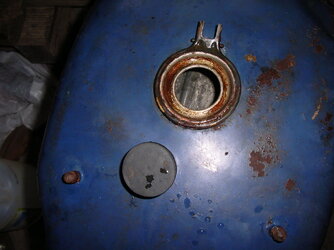


Looks fine, away you go.Bottom of both sides look great for a 50 yr old. Metal all the way. Rat may have helped preserve it...Very Clean. Got a winner here. Don't even see reason for Muriatic A if it will weaken the metal. Will fill back up w/ the Vinegar to finish outside. One Post on Google says Vinegar can stay in for 2 wks. & then Gas. Then I can fire it up! Any other input? & thanks...(can't get any inside shots w/ camera)
Be aware for future reference that those tanks are brazed, not welded.
Paul

Dellortoman
Hero member
- Location
- Tasmania, Australia
But any suggestions would be great.
OK, you asked for suggestions ...
Getting back to the original post about rust removal (which has been covered in detail many times on this forum - use the search facility) I'm not sure why you'd want to use vinegar, then follow it up with muriatic acid. You're going from a weak rust dissolving agent to a super strong one.
It kinda seems about as illogical as using a fine sandpaper on wood, then finishing with a coarse sandpaper.
Muriatic acid will certainly remove rust in a matter of minutes, but make sure you wash it all off, and use a neutralising agent because it'll eat holes in your tank if you don't get rid of it. It has way more potential to damage the tank than vinegar.
BTW, beware of websites that say vinegar will neutralise muriatic acid. It won't. They're both acids and two acids don't neutralise each other. I don't know why it's common practice to clean up muriatic acid with vinegar. You'd be better off using plain water. Better still, use water with baking soda dissolved in it. Baking soda is a base chemical that will neutralise the acid.
I'm not an industrial chemist, but I know a little chemistry. I'm aware that acids come in weak and strong varieties. Muriatic acid is another name for hydrochloric acid (HCl) which is a strong acid. It will react with steel (well, the iron that makes up about 97% of steel), turn it into ferric chloride and produce hydrogen gas in the process. It'll react with aluminium too.
I remember high school chemistry classes when we made hydrogen gas by pouring hydrochloric acid onto steel wool. The steel wool disappeared pretty quickly.
Even if muriatic acid is diluted with water, it's still a "strong" acid. You can't turn a strong acid into a weak one by diluting it. The difference between strong and weak acids is in the way they work chemically. It has nothing to do with how concentrated or dilute they are.
If you get some muriatic acid left in a crevice somewhere, it'll eat the metal away even if it's been diluted with water.
You really don't want to be messing around with any strong acid unless you know what you're doing.
The safest acids to use for rust removal are weak acids including phosphoric acid, tannic acid, oxalic acid, citric acid, acetic acid, aconitic acid and probably a whole bunch of others I've never heard of. Weak acids will micro-etch the surface of the steel, but not cause any structural damage like strong acids. Phosphoric acid is generally considered the best for rust removal, but it's reasonably costly if you want a lot of it.
Citric acid is my preferred agent for rust removal because it's available in dry form (crystals) in industrial quantities at very little cost. Just dissolve it in water at a ratio of about 5% by weight and soak your rusty stuff in it for a few days. A 1kg bag is only a few bucks and will make 20 litres of acid.
Vinegar is acetic acid and will also dissolve rust, but it usually comes in wet form so it's heavier to transport, which makes mail order of large quantities impractical. It's also about double the cost per litre of citric acid.
Molasses contains aconitic acid is popular for rust removal for reasons I've never understood, simply because I can imagine the awful sticky mess it must make. It comes in liquid form, so (like vinegar) transport is problematic. I'd rather buy 1kg of crystals than a 20-litre drum of liquid. Unless you're from da cane fields and can get it free from the sugar refinery next door, it's also more expensive than vinegar.
You may need to soak in a weak acid for several days if the rust is stubborn or heavily pitted into the surface.
Evan: Looking at your tank, if the rest of the tank is as clean inside as the bit you can see through the filler hole, I wouldn't bother with acid rust removal. Remove the fuel taps and shake as much loose crap out as you can (it might have real crap in it from the rat) then give it a good wash with water, drain it and let it dry in the sun.
If you're not painting the tank, just clean off the rust around the filler hole with a bit of steel wool (so the cap will have some chance of sealing) and that's pretty much it.
Rust converter (as distinct from rust remover) is a mixture of a weak acid and an organic polymer that converts rust into a hard, black substance that protects the steel and prevents further rust. According to manufacturer info, it is unsuitable for use inside fuel tanks unless it's covered with a fuel-resistant coating.
Opinions on internal polymer tank coatings will differ. I'm not a fan of the stuff myself. We've all heard horror stories of it delaminating and causing all sorts of bother. Make up your own mind. It just seems to me that unless there's a good reason to use it (like your tank is riddled with rust pinholes or made of wood) it's probably best avoided.
Dellortoman
Hero member
- Location
- Tasmania, Australia
This video may be of interest to anyone wanting to de-rust components. The guy in the video (Carlo) is an Italian ballistics expert who restores old firearms, which invariably require de-rusting. He's come up with his own recipe for a de-rusting agent that out-performs Evaporust and acid solutions by a huge margin and is dirt cheap to make. He's not an industrial chemist, so he explains the chemistry in layman's terms that's understandable for us non-chemists. Carlo is not a bullshit wank artist like you find on a lot of gun-based YouTube channels. He's a smart guy and the real deal ballistics expert. He is often called upon to provide forensic evidence on ballistics within the Italian judicial system.
If you're interested in restoring firearms, his main YouTube channel is called Backyard Ballistics. He also has recipes for blueing and parkerising of steel which may be handy for items other than firearms, like hand made workshop tools for example.
If you're interested in restoring firearms, his main YouTube channel is called Backyard Ballistics. He also has recipes for blueing and parkerising of steel which may be handy for items other than firearms, like hand made workshop tools for example.