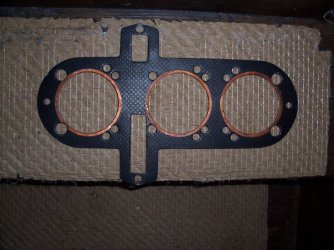
Head Gaskets

beauchemin said:
Would this compression ring sit on TOP of the bad gasket's fire-ring, or would you remove that ring from the gasket and replace it with a fatter copper ring?

I've just received my freshly re-bored 1000 barrel, so the timing is poor, but at least I've been warned.

To sum up, it seems that 1000 owners are faced with the following options:

1.  fit one of these "bad" gaskets, do multiple early head re-torque operations and HOPE for the best, or?
2.  send my barrel back for more machine work, essentially to have the spigots removed (which makes for a weird combustion chamber shape), or...
3.  add some kind of compression ring to the "bad" gasket - as per Keith's idea, or...
4.  wait until an original-style copper-ring gasket is available.

or

5. convert to 1200 barrels..... ;)

Paul LeClair

ps for 1200's, "face" both the block and the head, if everything is flat I don't see any reason not to use Clem's excellent full copper head gaskets, just have to properly "treat' them with an oxy acetylene torch before use
 
Gawd, will you guys shut up?

You're making me think the copper-ringed gasket I sent to Greg was worth its weight in gold.  :o

Surely there's a gasket manufacturer somewhere in the world who can reproduce it.

How about this for a dumb idea:
You can buy adhesive copper tape that is about 0.1mm thick from electronics suppliers. Fold some over the flame ring of a non-copper flame ring gasket and run it all the way around the ring, so it will add about 0.2mm to the gasket thickness. Copper is quite ductile, so it might not be too hard to work a thin strip around the edge. It won't matter that the tape adhesive will burn away. Once it's clamped between the head and cylinder, it isn't going to move. So it should stay put and fill the gap.  This is almost literally a band-aid solution  :D

M029457P01WL.jpg
 
Does anyone have an approx date when these changes were made by the gasket manufacturer.
Might ease the question of if this effects bikes recently fitted with head gaskets.Are we talking last year or a couple of years ago or what?  Everyones been blind sided by this.Feel for the pro builders affected,dick head gasket manufacturer deserves a good kick in the arse.
 
This could become a nightmare situation - with some barrels/liners flush and some not - the average user doesn't have the machinery or skills to cope with this. I used to have the gaskets made and insisted on a CU flame ring - to fit the recessed liner as standard. I also sell the currently made type and haven't seen any problems show up yet - I would have thought that the 1.5mm thick Viton "O" ring would seal in a 1mm gasket, but, from what Piet has found, this appears not to be so.
  The gaskets that I currently have are 1.3mm thick and have a CU ring. The extra thickness caused some of the holes to be belled out on the underside, potentially leaving less gasket to seal at the front.
  I have paid for the dies many years ago so costs to do 1mm thick ones would be reasonable if more that than just me went in to it - this would save problems many years hence if we all used the same. - Regards - Phil
 

Attachments

  • Hgask.jpg
    Hgask.jpg
    168.3 KB · Views: 72
ay Phil.  that gasket in ya photo looks exactly like the gasket i got from Richard Slater about 10 years ago.  but mine measures closer to 1.5 mm thick and the cu flame ring is about 2.0 mm.
& it has the 'belled-out' holes on the underside.  i'm guessing you and Richard have been comparing notes over the years.
cheers,  Mark
 
phil37 said:
Not Mine Mark - I only had the thicker ones made a couple of years back - Regards - Phil 
that's interesting Phil.  the gasket i have, was sourced from Richard Slater in September 2002.  just found the invoice.
i could take a photo, but it would look exactly like the gasket in your photo.

another Laverda world mystery.    :-\
cheers,  Mark
 
20140117_085939.jpg


Interesting about the headgaskets and flame rings. Took an old stock, unused OEM 1000 3c headgasket made by Reinz..marked 1.0..AFM22.

Gasket thickness is 1.0mm (as labeled)..the steel flame ring (it is magnetic..could be some other ferrous metal) is 1.3mm thick.. so the flame ring is .3mm thicker than the gasket material.

Took a new stock headgasket..a reproduction with no markings..the gasket material (reinforced with a graphite coating) is 1.0mm thick..the flame ring (also magnetic) is 1.0mm thick too.

It looks to  me like the old OEM headgaskets allowed for the 1000 barrel liners and some compression in the recess by .3mm..the new headgaskets are not made that way.
 
phil37 said:
This could become a nightmare situation - with some barrels/liners flush and some not - the average user doesn't have the machinery or skills to cope with this. I used to have the gaskets made and insisted on a CU flame ring - to fit the recessed liner as standard. I also sell the currently made type and haven't seen any problems show up yet - I would have thought that the 1.5mm thick Viton "O" ring would seal in a 1mm gasket, but, from what Piet has found, this appears not to be so.
  The gaskets that I currently have are 1.3mm thick and have a CU ring. The extra thickness caused some of the holes to be belled out on the underside, potentially leaving less gasket to seal at the front.
  I have paid for the dies many years ago so costs to do 1mm thick ones would be reasonable if more that than just me went in to it - this would save problems many years hence if we all used the same. - Regards - Phil

Phil,

I don't think the o-rings really do much in the way of sealing, reckon they're more-or-less only a sort of back-up for the gasket itself.  They won't stand the brunt of compression if the gasket lets go in one of the "corners", nor will it hold back oil pressure if there is the slightest recessing of the liner because of the overlap, as I had to find out.  More often than not, I find crumpled and deformed o-rings, even swollen ones, almost completely blocking the oil passage.

Imho, the o-rings were an attempt to keep the oil from sweating to the outside because of the early gasket mating face design, and a real problem once the liners start to protrude.  The factory tried to support the o-rings by fitting the thin walled bushes for 79-80, but omitted them later on.  I use a tiny smear of Loctite 514(?) all around the outer edge of the gasket, and if all is well in the liner dept., usually ends up completely oil tight.

The "copper" rings were only copper-plated steel, probably for corrosion resistance.

piet
 
My 81 series 2 Jota has the dowels inboard of the 4 'o' rings.
Never seen them on any other triple.
 
sfcpiet said:
,,  More often than not, I find crumpled and deformed o-rings, even swollen ones, almost completely blocking the oil passage.
+1.  'av often thought the top-end of a triple would get more oil without the o-rings.

sfcpiet said:
Imho, the o-rings were an attempt to keep the oil from sweating to the outside because of the early gasket mating face design,,,
& the oil passages for the centre pot don't 'av any o-rings.  but,, i've seen 'em seep oil as well.  ho-hum.

cheers,  Mark
 
sfcpiet said:
The "copper" rings were only copper-plated steel, probably for corrosion resistance. 
+1,,  again.
just put a magnet on the gasket i got from Slater's. the 'copper-looking' ring is magnetic,  so it ain't all copper.
something to learn everyday ay.  :D  cheers,  Mark
IMG_2580.jpg
 
Ha Mark,can you feel the fact that the flame rings are bigger than the rest of the gasket.Is it thicker both side,above and below.The disputed 0.2mm is tiny.Be good to have an easy way to tell the old from the new.Some with the bigger flame ring don't necessarily have the copper colour
 
ay Vince.  me thoughts, for what they're worth, suggests that it is difficult to predict that a particular gasket will seal with a particular engine.
and,,  a particular gasket will not seal with a particular engine.
an engine is an engine,  and for me they all have the potential to create trouble.  & it's good sometimes when they don't.  ;)
 
Hi Mark - The plot thickens!! - are you absolutely sure you didn't get that gasket from me a couple of years ago? - I've just had a little surprise - put a magnet on my allegedly CU flame rings - and they are Cu coated steel too - I'm not concerned about any performance issues - but  was sold them as with full CU rings - we even commented on the time about the high price of copper! - will be on the phone on Monday. - Piet are the "O" rings that you have seen distorted etc Viton or ordinary material? - have seen plenty of ordinary ones that are buggered in some way! - haven't had a head off recently so things may have changed - regards - Phil
 
phil37 said:
Hi Mark - The plot thickens!! - are you absolutely sure you didn't get that gasket from me a couple of years ago?
yes Phil.  that's one thing that i am absolutely sure about.  that gasket in me photo was sourced from Richard Slater in 2002.

Mark
 
Mark is correct, the centre oil feeds do not have o rings in the gaskets, and on early bikes they didnt have O rings at all, not anywhere on the head gasket anyway.

For years I have been trying to convince people that a solid copper head gasket, fitted to a machined flat top (1200) barrel is the way to go.Now we are being told by my very learned friend, who I respect a hell of a lot, that with certain types of composite gaskets we must machine the joint flat and not have  .01mm sunken liners.

The O rings always seemed a bit of a bodge to me, because they
a) are not significantly thick enough in relation to the gasket and
b) they have no proper machined pocket.
c) when fitters remove the head with cases in situ, the stud removal/refitting very often pokes the ring down the oil hole and may block or estrict it as well as create a leak.

Plenty of people are using my gaskets successfully, and a few more a pprpared to suffer a tiny oil weep,in exchange for a gasket that will not let combustion pressure out no matter how high your comp ratio, I cant send them out pre-anealed, since they need to be fitted asap after the process, a day or two would probably be OK, but with the passage of time the copper will re harden.

all Honda four, five and six cylinder racers had solid copper gaskets ande ran compressions of greater than 14:1 and RPM'ds of (on occassions) 18,000.

You might also like to learn that the Milan Taranto and Moto Giro single cylinder Laverda's were plagued with blowing head gaskets untill Dr Frtanscessco instigated solid copper ones.

The instalaton difficulty arries from the need for quality annealing, very accurate and progressing head tightening and piss poor 9mmm crankcase threads.

My son David has worked in the past on an underside steel flange, incorporating four bosses with threads in them, it never got finished.
CLEM
 
phil37 said:
Piet are the "O" rings that you have seen distorted etc Viton or ordinary material? - have seen plenty of ordinary ones that are buggered in some way! - haven't had a head off recently so things may have changed - regards - Phil

How the fuck should I know that, Phil?  :D

The buggers just fall to bits.  Never wasted a seconds' thought of what they may consist, just scraped off the remnants and chucked 'em in the bin. 

Clem,

No reason why your solid gasket shouldn't work, but the barrel and liners will need to be flush, either in 1000 or 1200 configuration.  I don't see the solid gasket being able to take up the liner recess in stock form, just the same as the gaskets that are causing these headaches.  Doesn't mean it will be any better or worse than the composite type though.  I have only ever seen one blown gasket from a Laverda triple, don't know the circumstances or who fitted it, never one from a 750 or 500 twin, so the composite gaskets can't be all bad...  It really is quite a pita to get the liners dead flush on a 1000 with the liner spigot, not as easy as it might sound.

Back in the days of exotic machinery and dodgy composite gasket materials, a solid copper gasket was the easy, and sometimes the only, solution.  Don't see many (any?) solid gaskets in modern machinery, the specific hp of which is equal or higher than in the "golden era", and needs to cope with daily use.

piet
 
Back
Top