Hierarchy of camshafts

Back when I used to work on the older BMW twins (pre 1995 models) you could not raise the compression ratio very much unless you went to dual plug heads or it would knock and eventually a holed piston. The dual plugs allowed you to retard the ignition timing and no more problems.

And Red, with the power you are making, I am surprised the crank cases are not cracking or flexing enough to twist the crank out of alignment. I remember back in the 1970's people racing pro stock Japanese drag bikes (mostly Suzuki GS1000) and the cases were a big problem. At about 175HP they would flex so much it would destroy the crank. Suzuki eventually made a few set of cast iron cases to fix the problem.
 
Last edited:
Back when I used to work on the older BMW twins (pre 1995 models) you could not raise the compression ratio very much unless you went to dual plug heads or it would knock and eventually a holed piston. The dual plugs allowed you to retard the ignition timing and no more problems.

And Red, with the power you are making, I am surprised the crank cases are not cracking or flexing enough to twist the crank out of alignment. I remember back in the 1970's people racing pro stock Japanese drag bikes (mostly Suzuki GS1000) and the cases were a big problem. At about 175HP they would flex so much it would destroy the crank. Suzuki eventually made a few set of cast iron cases to fix the problem.
The problem with the BMW heads is the chamber shape. High com and you have pockets of unburned fuel so starting the burn in two places can only help.
From personal experience with Suzukis from GS1000 through GSX1100 to GSXR1100 their problem is that they are comparatively shallow cases
The very deep Laverda cases IMO should be a lot stiffer. Also having a cast bottom closure rather than a bolt on sump plate will stiffen them too.

I remember pulling down our alky burning GSXR1100 - which made somewhere around 170hp at the wheel. Looking at the main bearing shells you could see how the cases had been flexing. Admittedly a large part of that was chassis flex being fed back into the cases.
Much later GSXR1000 cases are a lot deeper and shorter. They even stand up to roadrace sidecar loadings.
 
With effectively no squish to promote fast burning in a Laverda head It might well pay to try twin plugs.
The pistons on SF, and iirc also on triples, have a definite squish band with the corresponding flat on the head. We set up for 1mm clearance which equates to almost zero at full revs. Is this a waste of time?
 
The pistons on SF, and iirc also on triples, have a definite squish band with the corresponding flat on the head. We set up for 1mm clearance which equates to almost zero at full revs. Is this a waste of time?
By no means. But compared to the large areas available on a 4V or bathtub head it's insignificant.

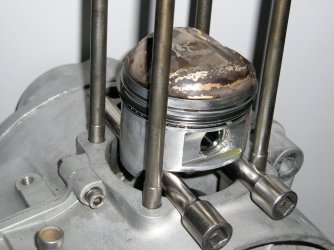
This is one solution for a deep hemi head with no squish. Road Aermacchi/HD Sprint turned racebike.. Piston crown shape follows the sides of the chamber and has a flat top - giving a compact chamber shape. 11.8:1 on 100 avgas - and 28 degrees advance.
 

Attachments

  • p7010013.jpg
    p7010013.jpg
    130.1 KB · Views: 23
Last edited:
I thought that Motod Laverda Cathcart raced in Battle of the Twins had its head ported to a bathtub style.
 
Back when I used to work on the older BMW twins (pre 1995 models) you could not raise the compression ratio very much unless you went to dual plug heads or it would knock and eventually a holed piston. The dual plugs allowed you to retard the ignition timing and no more problems.

And Red, with the power you are making, I am surprised the crank cases are not cracking or flexing enough to twist the crank out of alignment. I remember back in the 1970's people racing pro stock Japanese drag bikes (mostly Suzuki GS1000) and the cases were a big problem. At about 175HP they would flex so much it would destroy the crank. Suzuki eventually made a few set of cast iron cases to fix the problem.
I figure the BMW engines you refer to were running on pump gas ?
If I tried to run my engines on 98 octane they would knock their heads off

we had engine case and crank issues in 2016 when we first started to race so when we built the Scorch race bikes in 2017 I decided to do some modifications to the engine cases and crankshaft
changed to using EM Series roller bearings on the crank mains which are machined brass cage bearings and I use NJ type Roller bearings on the middle mains instead of NF style as the NJ bearings have more and wider rollers being held in the outside section instead of the inner
Still use the Ball bearing on the right side of the crank

Standard engine studs are 8mm thread but are a rolled thread so the actual diameter of the stud itself is around 7.3mm which means they have trouble maintaining case rigidity under load
So we machined custom M10 engine studs from 4140 with double the length of thread engagement into the top engine case
Allows us to torque the cases together at 32 lbs/ft instead of 20 lbs/ft and have never had an issue with engine cases or crankshaft flex since

but damn it is hard separating the engine cases, you have to lift them dead parallel as there is no give in those studs
 
I thought that Motod Laverda Cathcart raced in Battle of the Twins had its head ported to a bathtub style.
Possibly Vince, but you may recall it’s an Ogier not Motodd Laverda.
 
I have a hazy memory Cathcart raced both. I think he raced the Motod Mark 5 in World Bears till the Laverda engine reached its peak and then they swapped to a modern Triumph engine. That Laverda I remember reading was ported into that bathtub shape by Mez, some famous English porter and ran 40mm Delodos. From what I remember reading in old mags years ago the Ogier bike was the product of one bloke in Engineering terms, and right on the borderline of exploding every time it ran. By that, I mean tuned to the absolute maximum.
 
one day off and this turned from a simple question to a tuning conversation... :oops: :ROFLMAO:

I think the original question was what differences different cam profiles make as he was wondering about the Axtel cams on the RGS he is working on. With the engine else untouched, i think I summed it up already. But maybe I missunderstood the question, who knows... 💁‍♂️
 
How many times can you answer a question before moving on? Yes, generally you answered it about 10 posts back Lothar. I think Ricky Racer and his buddy another porting bloke in California developed Axtel cams for more punch out of corners. It's handy they can be made by regrinding A11 cams into that profile, I think but not sure about that. The interesting bit was how many of those Cams are being used in Oz. Lots like their road manners heaps.
 
Don't get too excited, after reading more he passed away quite a few years back so maybe it's a non-functioning business.
 
Just to clarify, Cathcart has ridden everything. But I think he actively Raced to success in full series both that Motod and 4-valve Ogier bike. I think both raced on the banking at Daytona. Fezzy memory again though.
 
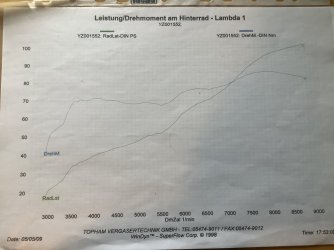
I put in the diagram of my 1000 SFC 120 deg., Pistons serie 75mm, CR 10:1, 40 mm downpipes, 36 mm RS Micunis, P1 cams, Witt #2 ignition, It was 102 HP at the backwheel….IMG_0292.jpeg

now I run it with 78 mm Pistons and lightened crank, but don‘t have a diagram.
 
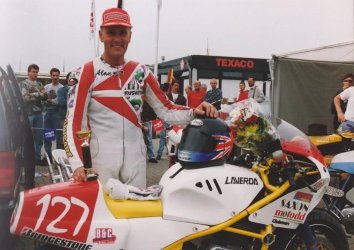
Allan Cathcart in Assen in the early 1990’s
Met Allan in Breganze this year and we had a chat about our common article in the magazine Mo about the Britten. I brought some new fotos and infos from my visit in NZ in 1989 to Europe.
 
Back
Top