Ignitech TCIP4 individual advance correction failure

piranha-bro2

Hero member
Location
Melbourne
Nothing to do with using an Android, but related to the TCIP4.

After my piston meltdown at Phillip island I won't be starting the repaired motor again until i fix a known issue with the TCiP4 I'm using, which may or may not have contributed to the fail. Ever since I started the bike I've been trying to get the Igni to do what it's supposed to do. Programming the software to correct a difference in advance between cyl1 and cyl2 has no effect. Ignition was 3 degrees retarded on the left cylinder when checked both statically and with a strobe. Correcting this in the dedicated menu within the software had zero affect - so i fitted the 2nd unit I bought at the same time (direct from Ignitech) and same problem. Both are V88 Hall effect. i then upgraded the unit to V96 - problem persisted. With V96 now fitted I then tried using adv curve 2 for cyl2 - no go.

With 3 deg diff, in the end I didn't think it would be a dangerous proposition, and after 2,500 often hard km I experienced no problems. First run on the dyno revealed a power increase upping from 32 to 35 deg max (on the most advanced) cylinder. It appears retarded ignition is a potential 'heat riser' - never knew that (counterintuitive to me). Throw in fuel surge on a racetrack and an almost empty tank and I add to the risk.

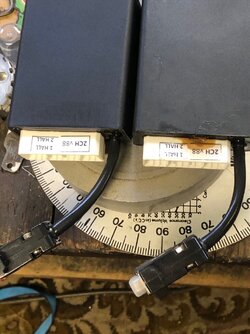
The simple fact is, I have a TCiP4 that isn't working properly on the output that controls the left cylinder - I've melted the top of the left piston - simple conclusion: I don't trust it. The other thing I've discovered is what looks like brownish grease from the unit - can only have come from inside the unit from what I can surmise (see pic, unused new left, used right). Unease raised even further.

Next issue of interest is A/F monitoring. I had the bike on the dyno a week prior to PI to reset the main jet after finally fitting large DNA filters - first dyno runs back in June were to set the main jet with open stacks. A/F was adjusted for main jet and AOK after both sessions, but I see a distinct problem with chucking a sensor into a collector/muffler that contains mixed exhaust gases from both cylinders. Inspecting my FCRs revealed I had erred on setting the float level to 9mm (old age, bad eyesight, delicate operation???!!!) and the left float level was around 2mm low (= lean). So I've added to a potential problem even further - retarded at max adv, lean mixture from low float level, fuel surge and near-empty tank.

Right piston is as clean as I could possibly want, so why doesn't it show ANY signs of distress? Is it because the correct A/F for the two cylinders means the right is a tad rich and the left a tad lean? Would an A/F reading of the left cylinder have shown a lean mixture? If so, I would ideally like to have individual A/F readings for each cylinder. Is there such a thing? I'd need bungs for two monitors, one in each header pipe. The I'd need a dyno person who uses two probes. My dyno guy only uses one, shoved down the left muffler, post-the collector.

Most likely my melt was caused by the combination of factors stated above. Thanks to those who I reached out to for their take on things. I'll be taking GregT's advice without fail: 'Don't run that motor again until you sort the Ignitech issue'. Thanks Greg!

Now, how do I get Ignitech to communicate ....!!
 

Attachments

  • TCP-I4s-new left, used right.jpg
    TCP-I4s-new left, used right.jpg
    140.7 KB · Views: 44
  • Rear-valve pocket gone .jpg
    Rear-valve pocket gone .jpg
    154 KB · Views: 43
Bit of a long shot, but I wonder if Liam at FBG might be able to help/share experience? Just thinking that he has a massive amount of expertise with Ignitech on twin cylinder Ducatis. No idea if he has had cause to apply individual advance correction, but worth asking? liam@fastbikegear.co.nz
 
Mmm, broad 2 bobs worth, base causal, fuelling, while ignition can produce certain thermal issues, am not aware of the potential to reduce the piston crown to this state. CAS documents i use are of great usefulness in these types of conundrums.

Ignitech ignition redardation from forward reference marker ( pickup characteristics (*) ) issue would be my starting point, static HE and dynamic forward reference would have my attention, ie velocity magnet to HE transfer characteristics over inherent ignitech issue. Common theme here is that the error is on your engine setup ( not a criticism ) and transfers between original and replacement modules.

Take it, the engine is cam timed, strobed on the cam at 3 degrees would be 6 at the crank, though reversing that for a strobed crank would reduce the "error" cylinder one to cylinder two offset to 1,5 degrees not a lot when working on a small radius vector, had to be vigilent when i designed the iis for cam timed triumph/bsa triples, and MG distributor versions, in vector accuracy.
HTH j.
 
Last edited:
Bit of a long shot, but I wonder if Liam at FBG might be able to help/share experience? Just thinking that he has a massive amount of expertise with Ignitech on twin cylinder Ducatis. No idea if he has had cause to apply individual advance correction, but worth asking? liam@fastbikegear.co.nz
Hi Rob. I've had in-depth conversations with Liam back when i got the Q started, both via phone and email. I actually proofed and edited his TCPI4 manual in exchange for help. Also purchased a pair of his Plasma 0.5ohm coils, fancy leads and plug caps on his advice.

I purchased from Ignitech direct, but he contacted them on my behalf; as a distributor he has rapid access to them - I have none. He wasn't able to get any joy out of them. Now that the Xmas break is out of the way I'll contact him again and try and sort this once and for all. While I doubt that the Igni box was the cause of the fail, I am not happy with either the inability to successfully program for the diff b/w cylinder advance or the grease-like stuff evident at the sealing face of the unit. If I set 'retard cyl 2 by 3 degrees' it should retard cyl 2 by 3 degrees!

Jon, HE rotor turns at half crank speed, strobe is degree wheel on crank. Phasing checked with piston stop and deg wheel and spot on at 90/270. No doubt the 3 deg out of phase is in the HE pickup plate; I have a second one I will try once the motor is back together. Interestingly, the plate on the bike has the pickup wires and screws fixed but not 'sealed' with a blob of silicone, whereas the second plate does (purchased at the same time). Perhaps it wasn't checked and set after manufacture?

I would love to send both these units back to Ignitech and have them check them. If there's a fault in the units I want it fixed. Oz to Czech Rep and back is a long way and waiting for a response could be joyless. Kind of caught between a rock and a hard place.
 
As i read your reply above, supposed you fabricated the encoder ( cam driven magnet and hall effect devices ), hence my missive on vector accuracy. Not my ignition system, rather, sticking my nose in on a subject which may help or no.

Seems your well aware that the intrinsic issue is very likely at the crank encoder, product error or similar. BTW have no idea how ignitech encodes a crank, spaced HE's or multi magnet, if indeed they supply a specific encoder assembly. Few ifs there... leave it with the forum...j
 
Interesting stuff, I have suggested an admin move this into its own thread.

For my part, I have also not had the expected results when attempting to adjust individual cylinder timing on my TCIP4v88 on the Corsa, but I can't remember the specifics or what setup I was using at the time (either single or triple inductive pickups).
 
So much for the myth that a Dyno pull or 2 will save the day. After trying so hard to dot every i this must be frustrating for you Q, more sweat required sadly.
 
So much for the myth that a Dyno pull or 2 will save the day. After trying so hard to dot every i this must be frustrating for you Q, more sweat required sadly.
You're not wrong there, Vince. After riding 2500km in all weather, long fast touring type runs, short runs, plenty of flat out acceleration runs, I felt it had passed the reliability test. Throw a bike on a track and anything amiss will eventually make itself known. I firmly believe that if I hadn't run the tank nearly dry it would have continued to run - and run beautifully. But now that this has happened I'm determined to sort the little niggles like the slightly low float level (done) and the ignition anomaly before I ride it anywhere. s for getting accurate A/F Rs for both pots on the dyno ... ? Yet to resolve that one. Lee reckons a pair of exhaust header temp sensors could be a winner, temp or permanent.
 
Interesting stuff, I have suggested an admin move this into its own thread.

For my part, I have also not had the expected results when attempting to adjust individual cylinder timing on my TCIP4v88 on the Corsa, but I can't remember the specifics or what setup I was using at the time (either single or triple inductive pickups).
Good idea, Steve. Very interested to hear that others have seen this issue. In its own thread maybe enough heads will bang together to drive a solution. My pickups are as supplied by Ignitech, Hall effect - though they look vastly different from the Hall effect pickups Red uses.

The rotor is like a drum with a cutout, which is what interrupts the signal - or however such electrickery things do what they do!

I'd thought that rather than physically move one pickup on the backing plate, it would be a breeze to use the very clever correction menu in the TCIP4 software. Surely Jiri and the mob are aware that it doesn't work?!
 
Maybe you could add individual exhaust bungs below the engine out of sight, Sainty Engineering the Top Fuel Drag blokes in western Sydney used to sell them. Could they have some kind of temp gauge and gas analyser built-in with a dash warning, I mean how close to the edge do you really expect to go in real life? I remember my 2 out of the blue smashed piston episodes. Months of great running and then bang, it's a real punch to the guts you could live without.
 
I'd thought that rather than physically move one pickup on the backing plate, it would be a breeze to use the very clever correction menu in the TCIP4 software. Surely Jiri and the mob are aware that it doesn't work?!

This, you cannot correct from a physical forward reference anomaly, the "error" will always persist, why this constant notion of "Advance" does not hold for digital ignitions. You have to think in "retard from forward reference". Proffer that ignitech do know what your experiencing is logical, not an error in their system.

Would be concentrating on the fuel/air problem there, and a correct crank encoder verified for the type of crank pin spacing on this/your motor, from the comfort of my keyboard. j
 
Quentin,

I can imagine you most probably experienced pre-ignition/knock with your late ignition timing. Efectively combustion occurring too early through self-ignition/compression, which causes a slow burn and giving off more heat than the quick "controlled" combustion induced by a correctly timed spark. Advancing the ignition timing would counter this effectively. Unfortunately, high-speed knock cannot be heard above all the other racket going on at speed. Depending on how far retarded, it does take a bit of time to generate enough heat to destroy the piston at WOT, your fuel issues probably accelerated that a bit.

I've found measuring A/F ratios in each header the only safe way to go. Take off in the collector can only show an average, which may or may not be OK.

Can you verify the hall sensors are at 90° to each other? Maybe you have a slight hysterisis between the 2? Or one sensor and 2 cut-outs in the rotor, with one mis-matched? Or your crank phasing out by 3°?

I'm currently reading up on a 250cc Parilla high-cam motor that I have in the workshop and find ignition specs of 48 and 50°BTDC full advance! And here's me thinking Laverdas were somewhat antique requiring 40° full advance. Nevertheless, 26hp from a mid-'60s 250 isn't too shoddy in my book.

piet
 
Quentin,

I can imagine you most probably experienced pre-ignition/knock with your late ignition timing. Efectively combustion occurring too early through self-ignition/compression, which causes a slow burn and giving off more heat than the quick "controlled" combustion induced by a correctly timed spark. Advancing the ignition timing would counter this effectively. Unfortunately, high-speed knock cannot be heard above all the other racket going on at speed. Depending on how far retarded, it does take a bit of time to generate enough heat to destroy the piston at WOT, your fuel issues probably accelerated that a bit.

I've found measuring A/F ratios in each header the only safe way to go. Take off in the collector can only show an average, which may or may not be OK.

Can you verify the hall sensors are at 90° to each other? Maybe you have a slight hysterisis between the 2? Or one sensor and 2 cut-outs in the rotor, with one mis-matched? Or your crank phasing out by 3°?

I'm currently reading up on a 250cc Parilla high-cam motor that I have in the workshop and find ignition specs of 48 and 50°BTDC full advance! And here's me thinking Laverdas were somewhat antique requiring 40° full advance. Nevertheless, 26hp from a mid-'60s 250 isn't too shoddy in my book.

piet
It’s a few years since I played with this, but on my engine I was re-using the original crank centre and webs. Due to the number of splines and not wanting to mash them, the nearest to 270 degrees with splines aligned was 273 degrees, hence 3 degrees offset, as far as I can remember.
 
It’s a few years since I played with this, but on my engine I was re-using the original crank centre and webs. Due to the number of splines and not wanting to mash them, the nearest to 270 degrees with splines aligned was 273 degrees, hence 3 degrees offset, as far as I can remember.
I think Quentin has a genuine late SFC crank, rephased to 90°. As the SFC centre isn't splined, phasing can generally be pretty precise.

piet
 
Lots here, let me add the boring bits, uncontrolled detonation is not pinking, digital ignitions work on hard and soft vectors. Computers cannot multiply or divide, only add or subtract, piston velocity is not linear, crank has instantaneous velocity, which changes. Computer processors that rely on soft vectors will be a trade off in accuracy. Racing Ducati of the 90's had 45-55DBTDC forward ignition timing. A/F actuality is being measured by a sophisticated device, the piston crown, it melts at 600 degrees C plus or minus alloying, superior to EGO placement, EGT is superior, to EGO, or better a combination of both.

Original crank encoding was done by way of missing tooth ( not mine ), original R and D iis work was on a missing tooth encoder, sub multiple of 360 degrees or as design dictates. Say 60 tooth ferro magnetic gear, 6m/m diameter VR pickup with pin point tip directed at the teeth. Rotate the gear, you have 60 hard vectors of crank angle, tooth present and not present ( not the missing tooth ) will yield 6 degrees, between those teeth is a soft time derived vector, ie 6/2 or 3 degrees, also have the differentiated signal from the VR, ie you can actually measure the width of a single tooth with this waveform. If the toothed gear is symmetrical you have half of 3 degrees as an additional hard vector, 1,5.

Floating point calculations for embedded controllers is semi complex, at machine code level, used floating point calculations in the iis design firmware.

When you have a lesser number of hard vectoring of a crank, then you will have to rely on soft vectors, which work though is imperfect. You do not get something for nothing in electronics, or rare as can be found. Hope this helps, not likely as first principles are hard to digest if not timed correctly, a smile here j.
 
Last edited:
Ignition was 3 degrees retarded on the left cylinder when checked both statically and with a strobe. Correcting this in the dedicated menu within the software had zero affect
Correct, you cannot add "advance" of a forward reference vector, its impossible, you would have to add say 357 degrees to the forward reference point signal, for the next crank cycle, then for a non wasted spark system it would be 718.5 ( corrected from previous draft ) degrees. Your asking ignitech to address what , in this case is a non issue.

Broader topic, as for the actual software manipulations in "correction" table indexing to compensate for mechanical errors, then i have no working knowledge if any issues are actual or operational issues of combined software interactions, for ignitech. Hardly going to be a cheer squad for those individuals, at ignitech, though i do have respect for what they have achieved. Few here would understand just how complex a digital ignition is to design, bug free and harsh environment. j
 
Last edited:
I can imagine you most probably experienced pre-ignition/knock with your late ignition timing. Efectively combustion occurring too early through self-ignition/compression, which causes a slow burn and giving off more heat than the quick "controlled" combustion induced by a correctly timed spark. Advancing the ignition timing would counter this effectively.
Slow burn is covered in air cooled aircraft engines, CAS documents make this abundantly clear in the graphs of real time measurements, not simulations on computer(s). While the slow burn is correct, it cannot of itself destroy a piston crown, only lack of fuel with air can cause metal failure of heat related effect. Uncontrolled detonation may actually "hole" a piston however.

Quentin has an air fuel problem on that cylinder, no two ways about it, ignition has not the capacity to damage a piston to that degree. We all have hard experiences, Piet has over and above that, my field(s) are many, ignition is well understood by me, not all, am learning all the time...j HTH.
 
Your last post was a lot easier for me to understand than the one before it Jon! GregT (where are you in this thread Greg?! :ROFLMAO: ) mentioned that retardation can/will cause excessive heat. In my case, I initially ran 32 deg max advance on advice from Tippie (my brother Lee) after dyno setting his SF race engine (very similar spec except for capacity and piston shape). Rex W suggested we try a tad more - 3 deg and we got 4 more HP. So at the end of the day, the hot left cylinder was still only running what I would probably have run without a dyno tune.
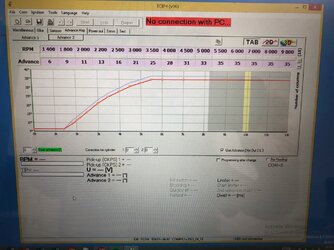
You're absolutely right Jon, that the piston burnt not because of an ignition issue, but a fuelling issue (slightly low float level, low fuel in tank, fuel surge) - but it had zero effect on the right cylinder, where the only diff was 2mm of float level and 3 degrees more advance - that must have been 'just enough'. But did that 3 degrees 'help' create the perfect storm?

It's all arbitrary to this discussion really, because what I really want to find out is WHY a function (actually TWO functions) within the TCIP4 don't work in my two units: 'Correction for cyl 1' and 'Use Advance Curve 2 for cylinder x/y'. In the screenshot below, you can see the two - in the actual curve you can see the red line for Adv curve 1 and the fainter blue line for Adv curve 2 - I'm told it won't work at idle speed - I'm fine with that - not likely to melt a piston at idle! This is how my unit is set. Put a strobe light on it, advance remains 3 deg retarded on cyl 2 regardless of which 'fix' I use.

OK - so I have to physically move one pickup from the plate supplied by Ignitech (it's for a Guzzi, cam-run, that I custom fitted to an alloy plate for the SFQ) - that means removing the silicone, removing the pickup, filing the holes and trying to get 1.5 degrees correction into it when refitting. You can see why I would prefer to simply type "3" into the 'Correction for cyl 2' menu or run Adv curve 2 for cyl 2. The fact that it doesn't work just has me wondering if the thing/s are faulty. And when I saw the grease emanating from the unit I immediately though 'heat'. Hopefully I'm wrong - it would certainly help if I could communicate with the manufacturers.

Greg also mentioned some interesting stuff on ignition advance and the relationship to piston-chamber shape. He built an engine with a piston of his own design and found he could measure clearly an increased top speed by gradually retarding the max advance from 34 deg to 28 deg. (Sorry to be talking for you Greg!!)

I'm at the point of trying to find someone with a TCIP4 who can verify that their version does successfully alter the above parameters. If so, then I guess I send these V88s back to Ignitech and buy a new one.
 

Attachments

  • V96 TCIP4 SFQ file.jpg
    V96 TCIP4 SFQ file.jpg
    145.4 KB · Views: 16
It’s a few years since I played with this, but on my engine I was re-using the original crank centre and webs. Due to the number of splines and not wanting to mash them, the nearest to 270 degrees with splines aligned was 273 degrees, hence 3 degrees offset, as far as I can remember.
Max, I rephased a stock SF crank for a friend many years ago - counting the number of splines I calculated that the closest I could get was 88 deg (simple 360 deg divided by # of splines). I do have an SFC crank and it's not that easy to get a perfect 360 or 270 or whatever you're chasing - unless you're Red and have a beautiful jig that holds things in place while the press does its work!

I was very careful doing mine and was chuffed when checking with a piston stop and degree wheel that it's as close to 90 deg as I would ever want. But had it not been, it would have been nice to be able to correct the diff in the Ignitech software. In FBG's manual he actually mentiosn the correction factor is useful for this very purpose.
 
Quentin,
I've found measuring A/F ratios in each header the only safe way to go. Take off in the collector can only show an average, which may or may not be OK.

Can you verify the hall sensors are at 90° to each other? Maybe you have a slight hysterisis between the 2? Or one sensor and 2 cut-outs in the rotor, with one mis-matched? Or your crank phasing out by 3°?

I'm currently reading up on a 250cc Parilla high-cam motor that I have in the workshop and find ignition specs of 48 and 50°BTDC full advance! And here's me thinking Laverdas were somewhat antique requiring 40° full advance. Nevertheless, 26hp from a mid-'60s 250 isn't too shoddy in my book.

piet
Answers my query about the need for two A/F readings, Piet.

Also interesting to read about the Parilla. In GregT's experience the need for high max advance is deemed a symptom of poor combustion chamber design. The Ross pistons in the Q have quite a different crown shape from the dome-plus-swish of the SF/Q versions. When Red commissioned them they had volume specs and profile data on the SF combustion chamber shape.
 
Last edited:
Back
Top