Ignitech

breganzane said:
Every digital ignition has effectively the same feature - but with IIS and Sachse (not sure about DMC) it is done to TDC rather than base advance and thus can be done statically.

Steve,

The DMC system incorporates a "wandering" advance feature to maintain a steady idle.  It does not have a fixed advance at idle speed, the markings may jump around quite a bit at idle speed when strobing.  It is however dependant on hardware positioning and can therefore be operator influenced to a certain degree.  This is why the system should be set at a checked/verified factory specified full advance mark for the particular model the system is being fitted to.  The system of course uses the "normal" inducer/trigger relationship as a base line from which the curves are calculated, but for all means and intentions, using full advance as a reference for adjusting is a lot easier, and safer/more reliable.  Curve #1 in all DMCs is an equivalent to the stock ignition setting.  Once this is checked and adjusted,the individual curve programms go from there.

Due to a programming glitsch, a few DMCs will not readily allow the engine return to idle speed, instead the revs hover a bit higher, only to drop rather suddenly and the engine dies.  In this case, advance at idle is insufficient.  No amount of carb fiddling will cure this condition, ever!  A simple fix is to dial a curve with less full advance, ie, 28? instead of 32?, and adjust this to the standard markings.  In this case, an additional 4? of advance will be available and idle will become rock-steady.  Advance at idle (800-900rpm) should be based at around 5-8? BTDC but is relatively immaterial, full advance of course is dependant on engine specifications and is extremely important.

Hope that makes sense,

piet
 
sfcpiet said:
The DMC system incorporates a "wandering" advance feature to maintain a steady idle.  

Are you sure about that Piet?

I think it would be damn near impossible to design such a feature. The problem being that there's no such thing as "advance" with an electronic ignition. The pickups don't predict the future. They can't see the rotor lobe approaching and then decide to fire before it gets there. All it can do is use the previous lobe pass and engine speed to calculate where the crank is. So a 30 degree "advance" is actually a 330 degree retard from the last rotor pass (or 690 degree retard in the case of a non wasted spark ignition).

The reason that the ignition point jumps all over the place at idle when viewed with a strobe is that the crank speed varies a lot when the engine is running at just above stall speed. If there's a plus or minus 3% variation in crank speed at idle, that's 10 degree error on the 330 degree calculation that the ignition has to perform. So the actual ignition point seen by the strobe will jump around plus or minus 10 deg. There's no "wandering idle" feature as such built into the software, it's simply an inevitable consequence of lumpy idle.

The interesting outcome of this is that it does actually help regulate the idle speed. If the engine speed increases, the error in ignition point moves in such a way as to slow it down again, and vice versa. I guess this is why it's sometimes thought of as a feature of electronic ignitions that the clever designer programmed into it.

Cheers,
Cam
 
Hi Cam,

Given he is so close to Uwe Witt, I assume Piet would know, and I'd heard about this (nice) feature before from him.  Idle control is not predicting angle or anything like that, just a control loop which adds a little advance if idle falls below ideal, and takes away if it's too high. 
My EFI system on the RGA also has this feature and along with a throttle kicker or air bypass valve is why all modern cars and bikes do not need a choke any more.  The ECU dynamically controls idle by adjusting ignition and air/fuel supply against a target table which is usually rpm vs coolant temp.  So for example target rpm is at 20deg is say 1400rpm, ramping down to 900 by say 70deg (whatever).  Obviously the DMC does not have a temp sensor so it will be a fixed target rpm of x-hundred rpm and it will chase that figure by adjusting idle advance.

Piet,
Knew about that feature, what I was trying to explain (poorly) was that every ignition system needs a 'reference' point in the engine cycle to tie what advance it thinks it is delivering, to the real angle of the crank at that time.  (?!)

Cheers
SteveB
 
Hi Steve

You and Piet may indeed be correct. Just seems a bit unnecessary and unlikely if the ignition system has an inherent idle control in the way it triggers. I'd expect that building an idle control into the ignition to seek a particular engine speed would make it difficult to set the idle with the throttle stop.

Anyway, what do I know? I'm in the electronics remedial class.  ???  :D

Cheers,
Cam
 
Dellortoman said:
I'd expect that building an idle control into the ignition to seek a particular engine speed would make it difficult to set the idle with the throttle stop.

Cam,

Doesn't actually.  Can't even notice it without a strobe light.

Steve is correct, the computer constantly monitors engine speed over a given period/rev range and corrects by setting more or less advance to keep revs stable.  A correction would be based on the data logged a couple of revolutions before.

Electronics are not my strong point either... ;)

piet

 
Dellortoman said:
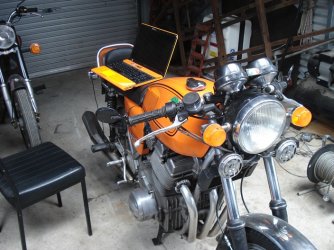
For reliable communication between computer and ignition system, it's important to have a laptop that it colour-matched to the bike.


If this would help, I woud do it!  >:D
But I allways still get "No connection with PC"
No Idea why, it was allready working, so the Cable is working, I have allways +11V on Board??????
 
I think it would be damn near impossible to design such a feature. The problem being that there's no such thing as "advance" with an electronic ignition. The pickups don't predict the future.


The pick-ups designate to the control unit a "full advance" number that the DMC uses..the control unit then waits and retards the timing based on the rpm.

Its not really predicting the future, its controlling the present..the DMC  processor is waiting to fire the plugs..based on the advance curve map and RPM.

At low speed tick-over the control unit processor has plenty of time to adjust the ignition timing around to steady the idle speed.

RPM is measured with an internal clock..so to speak..verses how many times it sees the DMC trigger rotor in a given amount of time.
 
1000/3C_Stefan said:
Cam, the DMC trigger rotor has two notches on it some degrees apart which could be used for calculating the engine speed just before firing the spark. Would guess the processor is fast enough to handle it at least at idle speed with low advance required and lots of time available. "Pistons are slow-let them come closer before knocking again" kind of strategy looks not impossible to me. Just for having  a smoother idle, not for setting the idle speed in general which is done by the throttle as you already mentioned.

Piet, it is possible to give some more details on which variants of DMC are facing that programming glitsch? Those symptoms you describe sound somewhat familiar to me...

Stefan,

Sorry, don't have any data on which units are afflicted.  If it bugs you too much, send it to Mr.Witt and request him to review/modify the programming in regard to idle speed advance.  The quick fix I suggested works well enough if you refrain from constantly playing around with different curves. :D

piet
 
DMC 1 (blue or silver box) => no software upgrade possible

DMC 2 (brown/bronce box) => re-programming possible.

Or to put it simple: if it has a multi-plug on top it is re-programmable, if it is a built-in-cable coming out of the box, no revising of the software possible. At least that's what I was told. But Uwe sometimes offers a kind of "trade-in": you will be upgraded to DMC 2 for an OK price. ;) Talk to him and see what he can offer.
 
Still fiddling with my new Ingitech on my RGS. The tach now swings wildly and doesn't give accurate readings beyond idle. Any ideas on a fix?
 
Change tachometer output to 1 pulse per rev, is probably on 2.  Works fine on my Corsa, is as accurate as those useless things get (ie not very).
Cheers
SteveB
 
I ordered an Ignitech ignition system for my RGS last week. I made up a piston stop and a degree wheel (using Cape?s degree wheel print out. Thanks Cape).

When I had determined TDC and set the degree wheel up, the strobe light was flashing at TDC at idle, and around 23 to 24 degrees BTDC at the advance setting.
I moved the stator plate as far as it would go in a clockwise direction, and it changed to firing at about three degrees BTDC at idle and about 26 degrees BTDC at advance. It started easier as well, and settled into an idle without choke much sooner.

I then had to do it all again, because I stripped a thread on the stator plate tightening up one of the pick up mount bolts. With the second stator plate (lucky I had a spare), I put it on, in what I thought was a neutral position, and it started up OK, and the readings were 3 to 4 degrees BTDC, at idle, and 26 to 28 at advance. (I?m not too accurate because my home made degree wheel pointer gets the vibrations up pretty good). There is more adjustment left on the second stator plate.

I left it at that and went for a ride. It seems to run better at low speeds in the traffic, I didn?t ride anywhere to really wind it out, but I think, overall it runs better, since moving the stator plate.

Now, my question. It seems to be running richer, it gets a bit of an exhaust burble happening when I back off and ride with a trailing throttle, sounds like it is about to back fire, but doesn?t quite do it.
I left it idling in the garage while I closed the gate, and the smell of unburnt fuel in the exhaust was very noticeable when I walked back into the garage, and the end of the exhaust was as black as midnight.

Can adjusting the timing have an effect on the mixture? Or am I noticing something that has been there already because I am looking more closely?

Another question, when I get the Ignitech system, do I set the base advance to the degree wheel reading I am getting at idle?

Thanks!

nMIO3wn.jpg


SBAEFZk.jpg


YTVzxlu.jpg


VCtyJRn.jpg


l1ibakV.jpg
 
Chappo said:
Another question, when I get the Ignitech system, do I set the base advance to the degree wheel reading I am getting at idle?

Pretty much, yes.

Just to make sure there's no programmed advance affecting the base advance, I usually load a zero program into the ignitech first up (flat zero advance curve and zero base advance), then start the engine and measure the base advance with a strobe. Once you've established the base advance, you can enter it in the program and start building your advance curve.

As for ignition timing affecting mixture. I don't think it has any effect on how much air/fuel mixture is sucked through the carbs - that's just down to the fluid dynamics of the carb. But it can definitely have an effect on how well that mixture is burned and converted to horsepower. If the engine isn't operating efficiently, then there will be unburned fuel in the exhaust. You might need a bit more advance at idle. Around 8-10? is normal.

I'd also follow Red's recommendation of letting the engine start on its base advance to make it easier on the starter motor/clutch. Starter motor cranking speed is around 400 rpm with a healthy battery, so I'd suggest starting the advance map somewhere around 700 rpm. That means it'll start on the base advance (3 or 4? in your case), then jump to the programmed advance once it's idling.

Cam
 
Wot he sed.  Always load a flat map and strobe to establish your base advance.  Changing the 'base advance' number in the program does not actually change your base (ie cranking) advance, it only changes the offset from the crank signal event to the programmed spark timing depending on the programmed curve.
 
Thanks Cam and Steve.

I'll try to get the idle reading closer to eight degrees and see how it runs.

When I receive the Ignitech, you'll probably see me back here.  :)
 
Hi all. I?m going to have a go at connecting my new Ignitech ignition tomorrow.

There is one thing I?d like to make sure of. I want to select the automatic option for the ?excitation (dwell time) of ignition coil?.

It says in the instructions:
?- automatic dwell time determination. Unit determines optimal dwell time by measure dynamic current in channel 1. With that choice the spark-coil has to be connected to channel 1.?

The last bit about the spark-coil having to be connected to channel 1. I take it this means I need to make sure I connect pickup one on the bike to the pick up one connection on the ignition box?

Do I just need to find colours B/R and R/N on the bikes ignition connectors to get the number one pickup?

VmwtorO.jpg


Hoping someone can clear this up for me.

EDIT: I just woke up and looked at this diagram again, and it looks obvious that connector with colours B/R R/N is the one to use.

I should be right.

Thanks
 
G'day Chappo

I think all it means is that you have to have a coil connected to pin #1 (channel 1) on the ignitech module, because that's the channel which senses the dynamic current in the coil. I don't reckon it matters which coil, so long as channel 1 sees a coil to sense.

"channel 1" in the ignitech info doesn't necessarily refer to cylinder 1 on the bike, but it would be logical to use that one for consistency of numbering. So one wire from pickup 1 should go to pin 9 and the other to either pin 7 or 16 (they're both ground terminals, and internally connected, so one is as good as another).

It doesn't matter whether the B/R (white/red) or R/N (red/black) goes to pin 9. The ignitech is smart enough to work out the polarity if you happen to get it arse about. Just set polarity of pickups to auto (in the "Bike" tab).

Very smart little ignitions - smarter than me anyway. I dunno what a some of the advanced programming features do. I leave things like "special specification of synchronisation" well alone!

Let us know how you get on.

Cam
 
Back
Top