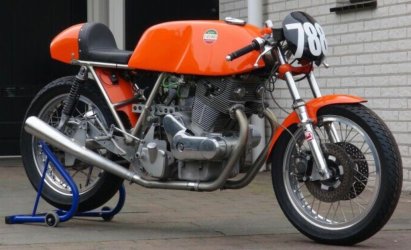
Is the 750 twin a load bearing frame member?

murphus

Senior member
I've always assumed the 750 twin/frame arrangement had the engine as a stressed member. Recently, I came across an article by Dave Minton and published in Real Classic in which he states, "Familiarly described as being a ‘load bearing’ frame member the engine in practice is no such thing, although it hangs from the frame." He goes on to say that the massively overbuilt helped quell vibration from the twin. "The heavy gauge of the tubes endows the frame with a weight probably unequalled in tube steel frames and this, no less than the mass of the engine, contributes to the comparatively low vibration of the models. The significance of the frame’s mass may be gauged by Fritz Egli’s disappointment over his SF and SFC-engined machines, which in his lightweight chassis vibrated sufficiently to dissuade him from pursuing a commercial future with them." So the question is, is it a stressed member?

 
Interesting question. I'd class it as a stressed member because IMHO the swingarm pivot section is clearly reinforced by the presence of the four massive engine mounts on the cases. Having said that, a mate was riding over the Nullarbor with me in the late 70s on his SF2. He said it was making awful noises and I discovered that all four rear engine mounts had broken - the only thing holding the motor in were the two top studs through the cam cover!! That's a STRONG frame! I don't fancy riding it at speed on a winding road like that.

Totally agree with Minton and Egli that the weight of the frame definitely improves vibration damping. I deliberately chose to keep my base SF frame when I built the SFQ for that very reason, happily sacrifcing weight advantages for comfort. Vibration is the one thing that really disappoints me with the SFQ. I can only assume it's the rocking couple of a 270 and the unavoidable increase in vibes from a big HP gain. It's totally fine up to 5k (145kph) but from there to 8k it just gets progressively worse. Phil Todd says his 270 is really nice at 80mph - no idea what it's like at 8k.

As a 360 with not much more than half the HP of the Q my SF1 as a 360 with a 'heavy' crank was a very comfortable high speed bike, never had stuff breaking off and have done many miles on it at 160kph in the good old days when you could risk it. I reckon GTs with low HP and a very heavy crank must be pretty smooth.

Batto's 917 SFC racer has a custom lightweight frame. It's still a 360 and obviously ran in a high RPM range when raced. It can't have been too bad vibe-wise or it would have shaken itself and Drmsby to bits.

In an email convo with Steve Elliott many decades ago when I was playing with 270 cranks he mentioned one of his early Palmellis (which interestingly used Ducati 916 geometry - in itself probably not the best option if subsequent articles I've read are anything to go by!). Elliott's frames were light - he said it vibrated so badly that you couldn't realistically do more than 3 or 4 laps on it. He said the bike in question was using a 180 degree crank, which if I'm not wrong was an experiment!! Maybe Toddy can elaborate. I'm sure that wouldn't have helped. One advantage of SF and SFC frames is you can weld them with any old stick welder ... they really are made out of std water pipe!!
 
Parallel twin vibration:

As Triumph and other Brit companies making parallel twins found out, you can't use the same balance factor for all frames. Triumph over the years used balance factors from 50% to 85% depending upon what frame it was going to use.

On the unit 650 twins, Triumph used an 85% balance factor up to when they switched to the oil in the frame bikes in 1971 which vibrated badly at 85% . So they went to 74% and all was better. The pre-unit 650's were 50% and were smooth until they used the double down tube frame in 1960, and they vibrate at 50% so the balance factor was changed again. The earlier frame was not as rigid and absorbed the vibration very nicely.

My brother has a Triumph race bike in a Trackmaster frame. Very light frame made from chrome moly tubing and it vibrated so badly at 85% it was un-rideable. It is now 60% and a great bike.
 
Changing the balance factor changed the direction of the vibrations into where frame members were effectively absorbing it, so I read. Having easy access to where the crank was drilled and either adding Mallory Metal or removing it, and seeing that effect. It's bloody expensive and time-consuming to experiment, so hearing what others find is so helpful.
 
Changing the balance factor changed the direction of the vibrations into where frame members were effectively absorbing it, so I read. Having easy access to where the crank was drilled and either adding Mallory Metal or removing it, and seeing that effect. It's bloody expensive and time-consuming to experiment, so hearing what others find is so helpful.
It changes both the direction and the rev phase at which it gets some other part of the bike to vibrate in sympathy. Phil Irving went into it in his bible. It does not have to be Mallory metal, it is just that mallory being so heavy you don´t have to add as much of it.
 
Don’t want to repeat things I said before, but just a few remarks:
Dave Minton never rode a real Egli, but in fact it was an Egli inspired machine made by Graham Binnion. Both share the large diameter spine tube, but the rest was quite different. My Fritz Egli chassis is much more compact, lower, shorter and the engine is positioned higher to gain ground clearance. For that time it was a remarkable achievement.
I don’t know if that explains the vibration issues the Binnion frame had, but my genuine Swiss Egli never suffered from excessive vibrations, not with the 1972 SF based original engine, nor with a genuine 1974 SFC engine that I ran in the Egli for some 10 years.

Now the CND850 with its 270 degree crank is a different story. That frame is also built in Egli style, but the way the engine hangs in that frame is quite different again. Now that bike is a violent shaker, and if that is what Minton experienced then I can see why he criticised it!

Marnix
 

Attachments

  • IMG_5747.jpeg
    IMG_5747.jpeg
    189.9 KB · Views: 30
While I don't have the scientific evidence to back it up, I have the gut feeling it is... sort of.

The stock thick-tube 750 frame is immensely strong, I've never seen one that has suffered major crash damage from a head-on shunt, it's always the forks that are gone. But I suspect the engine does support the frame under twisting stresses that would be experienced e.g. when hitting a dip while leant over in a corner. I don't see the frame alone being able to cope with torsional forces working between the headstock and swingarm pivot and suspect it relies on the engine cases to keep the swingarm pivot square to the headstock. As long as there are no twisting forces involved, I'd reckon it could cope quite OK without the engine block. But the real world isn't that simple.

The Egli and its derivates' top spinal tube is also immensely strong, but the rear subframe is usually somewhat flimsy. While nicely triangulated, the subframe relies strongly on the support of the engine through the rear engine plates to keep the subframe and swingarm pivot aligned to the headstock. The Egli look-a-like pictured below was described by the owner to be a violent shaker pre-restoration. After a complete engine rebuild and balance factor altered to 64% I found it to be anything but a shaker. Not quite as smooth as I would have liked and nowhere near as calm as an old clapped-out GT, but still very rideable. I found my works-engined Bimota SFC to be astonishingly smooth, I've yet to determine the balance factor used. The frame is extremely lightweight with paper-thin tubing bent to form what at first glance is a normal SFC frame.

The 180° triple cradle frame on the other hand definitely relies on the engine cases for stiffness. Cracked RH rear upper engine lugs are testimony to the stresses that are induced into the crankcase. Easy to see on an empty rolling chassis, push sideways on a bottom rail with your foot and watch the cradle bend and squirm. The backbone is nowhere as stiff as that of the 750 and the entire cradle is un-supported from the swingarm pivot to the the headstock without the engine installed. I've always considered the Jota 120, based on the 180° frame, somewhat of a weaver at high speed, possibly through the lack of engine support of the cradle. The 120° RGS-type frame is a lot stiffer at the backbone and shows no such traits. Imho, the 180° triples would benefit greatly from a substantial brace between cylinder head and top tube.

piets $0.02

Egli-look-a-like rear frame, nowhere near as substantial as a Laverda but works just as well through engine support. Work in progress.
20201118_180403.jpg
Finished bike;
20210914_130534.jpg
 
The consensus would seem to be that, yes, it is a stressed member ... but doesn't rely on it except in the swingarm pivot and lower engine mounting area.

Some very interesting observations about vibration ... seems pretty clear that a well-built and balanced 360 degree SF/C motor will be smoother at high RPM than a 270 - certainly confirms my own observations. If I wasn't totally hooked on the huge midrange of the SFQ - which I definitely attribute partly to the 'flywheel' effect of the 270 (one piston close to max velocity when the other is stopped) I'd be tempted to twist it back to 360, if only to test the theory. But before i do that I want to build an experimental 270 crank with as close to neutral balance on the outer crank webs to reduce the rocking couple of the wide 4-bearing crank; this would involve loading mallory metal onto the heavy side of the inner webs.

But the years tick by and I'm basically running out of them (years that is)!
 
Nah... customers' bike, rebuilt from a wreck that had spent a couple of decades in a shed. Turned out quite nice, it was an all-in project. I even designed and built an easy to use centre stand for it! I persuaded him to give up the boy-racer style for a more laid-back cruiser stance. He was 74 at the time and convinced it was an Egli, which it isn't. Some sort of spin-off.

piet
DSC03865.JPGDSC03867.JPG
20210914_130401.jpg
 
Is the swingarm shorter than standard? It looks short. Nice green, looks really comfortable
Swingarm lost its lower bracing in order to fit the exhaust system properly, way over the top anyway... about stock length. The whole bike is a bit compacter/shorter than a stock SF2. Really disliked the eccentric adjuster, took hours to restore that to working condition. Still don't like it.

Yep, nice rider. Owner was adamant the SFC pedals be retained.

piet
 
A mate had an 860 bevel with an eccentric chain adjuster in the swingarm pivot. We could never get the rear wheel aligned right. It was supposed to be fixed so both sides remained even, good in theory, but not on that bike. They affect ride height and swing arm angle while you adjust chain tension, complicated for no good reason.
 
What about Rickman chain adjusters - removable plate cams that fit into the swingarm pivot plate!!

Kawasaki 500 swingarms with those adjusters seem to be a popular option. I would have gone that route but needed a longer option.

What's the exhaust system Piet?
 
Those snail cam chain adjusters that work on the rear axle are quick and easy, and can take out any inconsistencies between the two sides.
 
A mate had an 860 bevel with an eccentric chain adjuster in the swingarm pivot. We could never get the rear wheel aligned right. It was supposed to be fixed so both sides remained even, good in theory, but not on that bike. They affect ride height and swing arm angle while you adjust chain tension, complicated for no good reason.
The very last Darmahs (I had an ‘83) had both the eccentric at the swingarm pivot and conventional adjusters like an SS at the rear. Very strange but you could take out any misalignment at the axle and from that point on readjust chain tension with the eccentric.

It seems to me that the SF frame design utilizes the engine as a stressed member - it obviously triangulates the chassis. However even without the engine the chassis appears plenty strong in bending, minus the third member of the triangle. As pointed out, it also looks to me that the engine stiffens up the frame torsionally.
 
Last edited:
Q, that green 750 that Piet restored once belonged to Eric Gilchrest. Picture of Eric at my lockup garage in Fulham London..
He later sold it to My mate Andrew who decades later had Piet restore it. Pretty sure it was a Binnion frame.
Always regret not buying it off Eric at the time. He sold it and brought a triple.
Whilst Andrew owned it, it was stolen and he managed to get it back years later.
Also a pic of Eric at a Slaters weekend with said triple.
 

Attachments

  • Eric&Mark.JPG
    Eric&Mark.JPG
    124.6 KB · Views: 27
  • Eric at Slater's.JPG
    Eric at Slater's.JPG
    133.3 KB · Views: 28
Don’t want to repeat things I said before, but just a few remarks:
Dave Minton never rode a real Egli, but in fact it was an Egli inspired machine made by Graham Binnion. Both share the large diameter spine tube, but the rest was quite different. My Fritz Egli chassis is much more compact, lower, shorter and the engine is positioned higher to gain ground clearance. For that time it was a remarkable achievement.
I don’t know if that explains the vibration issues the Binnion frame had, but my genuine Swiss Egli never suffered from excessive vibrations, not with the 1972 SF based original engine, nor with a genuine 1974 SFC engine that I ran in the Egli for some 10 years.

Now the CND850 with its 270 degree crank is a different story. That frame is also built in Egli style, but the way the engine hangs in that frame is quite different again. Now that bike is a violent shaker, and if that is what Minton experienced then I can see why he criticised it!

Marnix
Do I see a twin cable throttle, working just fine? ;)
 
Back
Top