Jota Centre Stand

Shiny

New member
Being new to Laverda ownership, I hope someone can help me with the following: The centre stand on my Jota seems much too easy to lift onto and push off, so much so, that I am frightened it will roll off accidentally!

The stand seems to be adjusted ok, but both wheels are on the floor.

I am wondering are the tyres the correct size, or are the rear shocks too long? Could someone give me the standard sizes of the tyres and rear shock, or is there something else I should look for?
 
Being new to Laverda ownership, I hope someone can help me with the following: The centre stand on my Jota seems much too easy to lift onto and push off, so much so, that I am frightened it will roll off accidentally!

The stand seems to be adjusted ok, but both wheels are on the floor.

I am wondering are the tyres the correct size, or are the rear shocks too long? Could someone give me the standard sizes of the tyres and rear shock, or is there something else I should look for?
What year is it?
Does it have Ceriani Or Marzocchi Forks?
Cerianis on the left (Red one), Marzocchis on the right (Orange).

Ceriani Marzocchi.jpg
 
It is a 1979 model and has Marzocchi forks. The rear shocks have been changed to Koni's
The Marzocchi equipped ones are not known for being easy to get on the stand. My Ceriani equipped one I routinely put on the stand while still in the saddle.
There are a couple of adjustable stop bolts, with locknuts, on the front of your stand, if it's the correct one.
Screwing them in, a little, may increase you feeling of security.
 
Last edited:
If both wheels remain grounded, either the tyres are far too large in section or the shocks/forks too long... or the stand for the Ceriani model is fitted. Check if the stand is equipped with adjusting screws, Ceriani has none, Marzocchi has 2 screws. Check if the stand bushes are present, if missing, this will effectively shorten the stand by 5-6mm.

Stock rear Ceriani shock length is 362mm, Konis will be 360, maybe 370mm which is pretty marginal when it comes to rear wheel clearance. I've also come across Marzocchi fork legs in Ceriani yokes, which buggers up everything.

Properly set up, both stands work pretty damn well as long as the tang is still the original length. Far better than most other marques.

Popular tyre sizes are 100/90 front and 120/90 rear, these are the closest match to the original sizes of 3.50 f-4.00 r or 4.10 f-4.25/85 r. Stand should work satisfactorily with any of these combos.

piet
 
Hi Piet.

Many thanks for your comprehensive information, it is of great help.
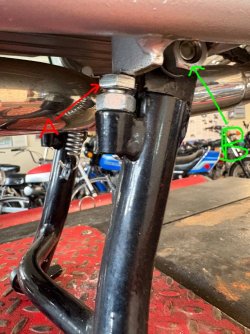
On the question of the stand adjusting screws: do these actually raise the bike, or adjust the angle of the stand? There does not seem to be much adjustment left in mine (see pics).

Regards
Paul (Shiny)

IMG_4964.JPEGIMG_4963.JPEG
 
Don't know why, but the text disappeared!

Screwing 'A' up/out will increase the height of the bike, but beware of overdoing it because you are reducing the over centre which will keep it on the stand.
'B' looks badly wrong. I'd suggest replacing both pivot bolts if they look like that.

IMG_4963.JPEG
 
Last edited:
It's a compromise between height and stability. If the stand is vertical, it's as high as it goes; if it's pivoted forward, it's as stable as it gets, but maybe too low, and the wheels hit ground. You can cheat by welding a strip of steel to its feet. It's a trick bit of design to hit all targets, high enough to remove a wheel, but not so high that you blow out your back using it. I love the kit that allows a Kawasaki sidestand to fit that is as easy to use as a modern, dont laugh, bike is.
 
Paul,

They're meant to adjust the stand to the correct and safe angle. Flat enough to keep the bike from rolling off by itself but steep enough to easily roll it off yourself. This requires only a few degrees difference, your bolts look perfectly normal.

It is important that any slop be removed and the pivot bolts kept tight. Many owners don't understand the mounting system and loosen the bolts to enable the stand to fully retract... this actually makes things worse as it allows the stand to bend and warp when deploying.

The bushes that you SHOULD find in the pivots are meant to be bolted solidly to the frame and the stand should swivel freely around these bushes. If it offers some resistance, it is a sign the stand may be a bit deformed. This usually disappears after a few months of use, the stand is forced back to shape and will eventually work smoothly again. If the bike leans to one side on the stand, the legs are twisted. A looong breaker bar/bit of scaffold pipe helps twist the legs back to near parallel. The stand needs to be securely and snugly fitted for this. Twisting can also be the result of the adjuster screws being adjusted unevenly.

Very often, the pivot holes of the stand are quite worn. These can be reamed a bit larger and over-size bushes fitted to suit. A drop of oil/squirt of chain lube every blue moon may help avoid this wear to a degree. Also prevents those horrible sqeaks!;)

piet
 
Last edited:
Many thanks to everyone for their input on this matter. I found that while the bushes in the centre stand were fine, the pivot bolts were both loose! Tightening these has made a difference, to the stability of the bike on the stand, but both wheels still touch the ground while on the stand.

From Piet's information on tyre size, the front tyre fitted to my Jota should be 100/90 x 18, but a 110/90 x 18 is fitted. This according to my calculations, means a tyre height difference of 9mm, which may well be my problem?

Your thoughts on this would be welcome.
 
Many thanks to everyone for their input on this matter. I found that while the bushes in the centre stand were fine, the pivot bolts were both loose! Tightening these has made a difference, to the stability of the bike on the stand, but both wheels still touch the ground while on the stand.

From Piet's information on tyre size, the front tyre fitted to my Jota should be 100/90 x 18, but a 110/90 x 18 is fitted. This according to my calculations, means a tyre height difference of 9mm, which may well be my problem?

Your thoughts on this would be welcome.
Part of the problem.

Rear wheel is normally 15-25mm clear of the deck, 4.5mm less tyre radius at the front can only be considered as a start.

Did you inspect the bores of the frame mount for the stand bushes? Depending on how long the stand has been flapping around, these bores can also be seriously worn. Every little millimetre here adds up... even new bolts can help getting things aligned again.

What are your shock length findings? Have the rear shock mounts been altered in any way? Have the fork stanchions been pushed through the yokes? Generally, the Marzocchi stanchion cap is proud of the yoke with the yoke clamping to the stanchion alone. This however can interfere with the handlebar should that silly multi-adjustable thing be fitted. ;)

piet
 
I am really happy I checked my hubris with Google. I was about to ask how a 100 x 90 is 9mm shorter than a 110 x 90, till Google told me the 90 wasn't the width but 90% of the height. One thing I have seen is that there can be variations between fitted and written specs with tyres. It doesn't take much to create the need for massive physical effort if the bike goes up more than needed. Mine needs a 20mm packer under the stand to have any chance of getting the rear wheel off, the rear guard tends to block it if it's not packed up higher.
 
From Piet's information on tyre size, the front tyre fitted to my Jota should be 100/90 x 18, but a 110/90 x 18 is fitted. This according to my calculations, means a tyre height difference of 9mm, which may well be my problem?

Your thoughts on this would be welcome.
I've run 110/90 Fronts since '79, with no problems. The Ceriani equipped ones behave perfectly, IMO, on their centre stands. Park it on the kerb, or a four by two, and you can remove the frnont wheel or the back wheel (NOT BOTH, AT THE SAME TIME!) and the bike is absolutely stable. Best centre stand, by far, on any bike I've ridden.
 
Back
Top